John’s professor awarded $1.4m Templeton Prize
The prize honours those working at the intersection between religion and science

A Cambridge palaeontology professor has been awarded the 2026 Templeton Prize.
St John’s emeritus professor Simon Conway Morris was awarded over $1.4 million for “outstanding contributions to the field of evolutionary biology” and his efforts “to explore the broader human implications of his scientific discoveries”.
The Templeton Prize, awarded by the John Templeton Foundation, is one of the world’s largest annual individual awards. It is granted to an individual who can “harness the power of the sciences to explore the deepest questions of the universe and humankind’s place and purpose within it”.
The first recipient of the award was Mother Teresa in 1973. Previous recipients also include the Dalai Lama and primatologist Jane Goodall.
Conway Morris completed his PhD at John’s in 1976, and is a fellow of the Royal Society. His research focuses on the Cambrian explosion, a period of rapid diversification of animal life around 500 million years ago. His work documents the 510 million-year-old Burgess Shale fauna, located near the Canadian Rockies.
Conway Morris’ research on evolutionary convergence suggests that evolution is highly predictable, and that similar biological forms and behaviours recur across vastly different evolutionary lineages.
As a practicing Christian, Conway Morris has participated in a number of public debates on religion and science, arguing that large-scale features of the history of evolution “are congruent with a Creation”.
Conway Morris said of receiving the award: “what a journey. As somebody once said – ‘Be careful when you step onto the unending road.’ A Ph.D. on fossil worms might logically lead to field-work in Greenland, but to an absorption with evolutionary convergence and thence the Fermi Paradox? And still the road stretches on, now to the question of human uniqueness and I suspect way beyond.”
Heather Hancock, John’s master, said: “We are proud and delighted that Professor Simon Conway Morris’s lifetime of research at the frontiers of evolutionary theory has been recognised by the award of this year’s Templeton Prize. Simon’s work and ideas have truly shaped the field, not least through his distinctive and groundbreaking research on evolutionary convergence.”
Timothy Dalrymple, president of the John Templeton Foundation, added: “What makes Conway Morris abundantly deserving of the Templeton Prize are his groundbreaking advancements on the theoretical foundations of evolutionary theory alongside his commitment to addressing the philosophical implications of that work for humankind.”
Critics of the award, which is intended to honour those working at the intersection between religion and science, argue that the prize is concerning because it blurs the boundaries between the two.
The Templeton prize has been accused of “cronyism” for awarding prizes to people with previous links to the organisation. Templeton Press, founded to publish books furthering the mission of the John Templeton Foundation, has published several of Conway Morris’ books.
Conway Morris is listed as having served on the Foundation’s Board of Advisors between at least 2004 and 2010.
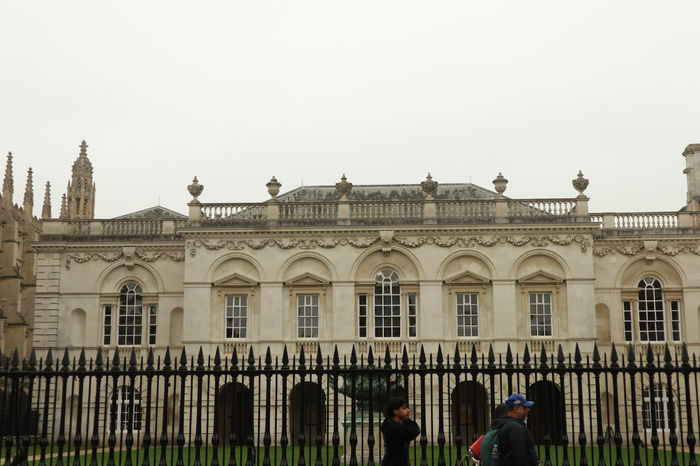
The John Templeton Foundations have donated to a number of other causes, including $1.4 million to the Adam Smith Institute and $497,000 to the Institute of Economic Affairs.
The John Templeton Foundation and Simon Conway Morris were contacted for comment.
 Comment / Top of the slops: the competitiveness of college dining4 June 2026
 Interviews / What’s the story behind Pages coffee house?8 June 2026
 News / News in Brief: Cambridge crowns, council confirmations, and competitive cricket8 June 2026
 Comment / The Cambridge drift1 June 2026
 News / Cambridge researchers produce ‘world-first’ AI vaccine6 June 2026
 Arts / Don’t rush me – I’m reading!9 June 2026
 Lifestyle / Don’t Cry at Me, Argentina – a next-year abroad story8 June 2026
- News / News in Brief: Cambridge crowns, council confirmations, and competitive cricket8 June 2026
 Science / Failure is the foundation of science8 June 2026
 Fashion / The hidden gems of formal fashion8 June 2026