
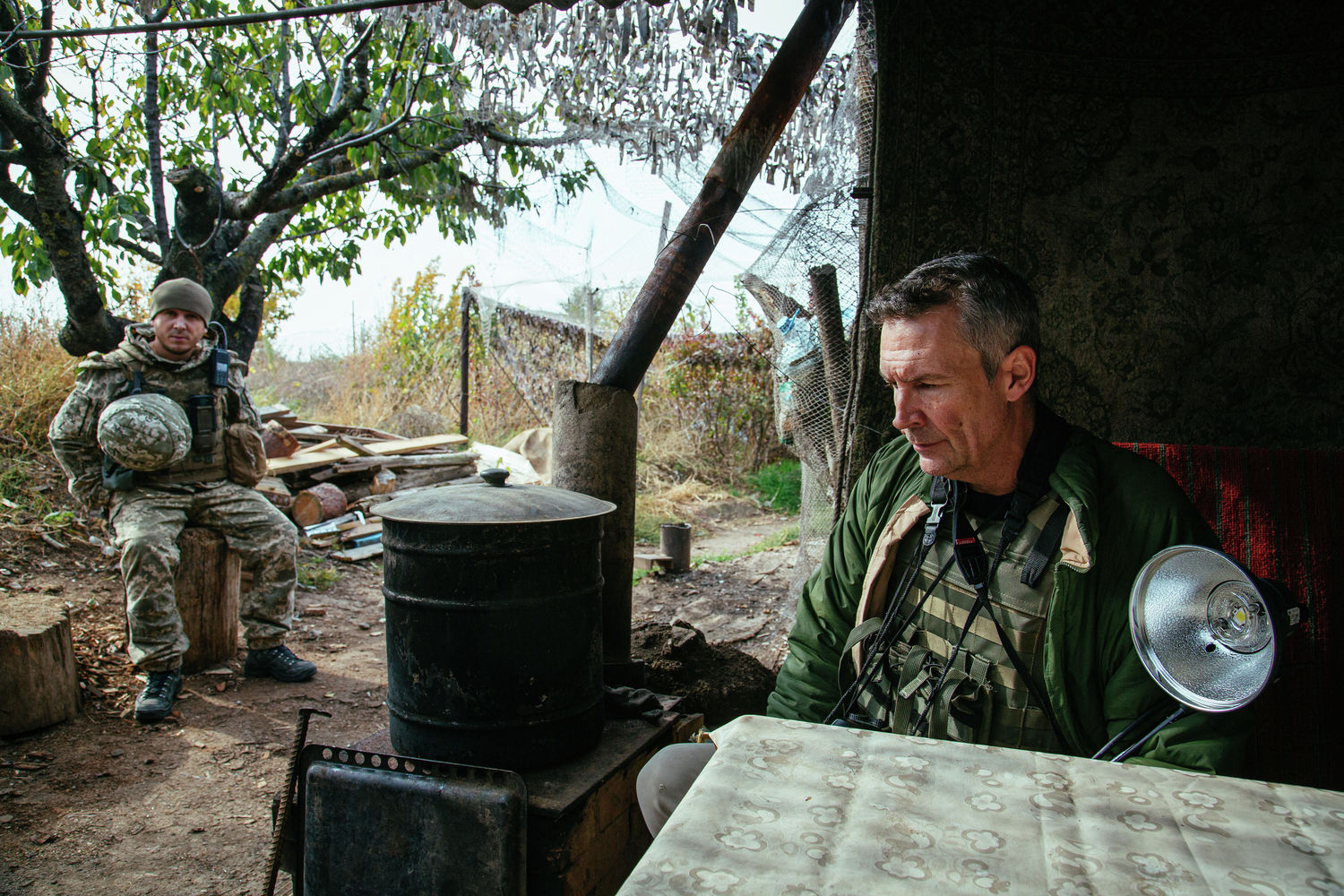
“I’m an artist,” Neville tells me. “I’m an artist who produces lens-based work.” Simple enough. Neville, who rarely creates for the gallery or the coffee-table, has often been referred to as a ‘photojournalist’ or ‘activist’. In resolutely calling himself an “artist,” however, Neville aims to set an example for the practical social and political role that he believes art, and especially documentary work, must play.
At the start of our conversation, Neville portrays the “art-world” as one often tainted by ego and commercialisation. “Photographers make these very desirable objects,” he explains. “These coffee table books, which are records of other people’s poverty […] and they make their own money from that.” From the “genesis” of his career, with a photography series in Port Glasgow in 2003, Neville has aimed to critique this pattern where photographic subjects are objectified and exploited. If you stand before Neville’s camera, his goal is to ensure that you “benefit in real terms”.
Neville is based in Kyiv and he is quick to tell me the things he loves about the country: “the culture, the history, the architecture and everything about it.”
Ukraine has been the subject of two of Neville’s books, photographed both before and after the Russian invasion. I’m curious to speak to Neville about how photography communicates war on news and social media platforms. We speak about the “digital noise” through which people become “overwhelmed with images” of conflict, and whilst Neville doesn’t negate the importance of remaining informed, he highlights the subsequent “Western compassion fatigue” that he aims to combat.
Neville reflects upon a conversation with the director of the Imperial War Museum, and fondly recounts a metaphor she used. “When you document war,” he begins, “it’s almost too big a subject. It’s like looking at the sun, and you can’t photograph the sun. So, what you have to do is photograph in the shadows.”
“It’s like looking at the sun, and you can’t photograph the sun – you have to photograph in the shadows”
For Neville, that manifests as “not trying to document a specific event.” He tells me that “I take photographs that aren’t about the news.” Depicted through the same “tropes, these stereotypes, about what constitutes a good war photograph,” seemingly distant conflicts merge in the Western consciousness into one. Not only do the pictures mimic each other, but they attempt to conjure the same emotions on repeat: “they’re meant to shock you in some way or elicit some kind of fear.” Living in Ukraine, Neville has experienced the conflict first-hand and reflects upon how accurately such images depict what the nation is living through. “Fear does play a part in our lives,” he tells me, “But it’s much more layered, it’s much more real, it’s much more nuanced than fear.” Neville reflects this sentiment in his photography, with his portraits of Ukrainians depicting facets of their lives often disregarded by media platforms. From a boy playing football in front of a tank, to volunteers distributing food, Neville’s photographs highlight the resistance and spirit of the Ukrainian people.
Neville aims to be specific not only in what he photographs and how, but who receives it. His series called Stop Tanks with Books aimed to gather international support for Ukraine’s fight for independence by “presenting real portraits of Ukrainians.” It was sent in 2022, before the full-blown invasion, to those with the power and means to take action, including approximately 750 world leaders. One result was the setting up of Postcode Ukraine with a recipient of the book, a charity that fuses “humanitarian aid deliveries” with “[his] own documentary practice,” thus both providing practical help to those “killed, injured or displaced” and “encouraging the West to engage with Ukraine.”
“There’s always time to help.”
In combining “art with aid,” Postcard Ukraine upholds Neville’s opinion that “art should have a real practical, ethical role”. He aims to “challenge the idea that a photographer is just someone who can turn up on a front line, take some pictures and disappear.” When photographing a community, the proximity begs a duty of understanding and of care that extends beyond the camera shutter: “you can find out what’s needed. You can talk to people and support them,” Neville states. He insists that “there’s always time to help”.
The purposeful choice of audience is central to Neville’s work and its impact. “It’s about me reaching out in a very personal and direct way,” he tells me, “and saying, here is a book that I’ve made, and it’s for you.” Addressed in such a direct manner, it becomes difficult for a viewer to remain the detached spectator, and the distance is shortened between themselves and the lives captured in the photograph.
I notice how personal Neville is in speaking about his work, often driven to communities through his own experiences. Even behind the lens, his presence is marked in anything he produces. I ask him about how he views his own role in a space as a photographer, whether he feels like an outsider, an intruder, or a window to a different world. For Neville, it is inevitable that the photograph is rooted in his own perspective, but that doesn’t negate its relevance.
After a moment of reflection, Neville comes to a conclusion: “I’ve always tried to think of my works as acts of empathy.” He acknowledges that “it’s never a transparent window in the world; it’s always mediated in some way.” What Neville encourages for photographers to do is “think about how this objectification of the subject is going to help? Because all photographs are objectifications of people, that’s inbuilt with the medium.”
“The currency of photography has been devalued”
Neville describes himself as “self-critical” and “challenging” of the moral and ethical basis of his work. What matters, he suggests, is acknowledging the limitations of the art form and the complexities of “representation,” before trying faithfully to capture your subjects.
I notice evidence of this “empathy” ethos in Neville’s very photographic style, which he has previously described as “democratic”. “I try and get the person at the front in focus as well as the person at the back,” he explains. Everyone and everything within that space, he continues: “seems to me to be historically important”.
As our conversation comes to a close, we return to the topic of “digital noise” online. Neville theorises that “the currency of photography has been devalued” through social media platforms. “Everyone,” he continues, “is engaging with photography in a very disposable way.” Bombarded with striking visual stimulus, mere composition is not enough to hold a viewer’s focus beyond skimming over a caption. Neville’s intentional dissemination of his art undoubtedly commands attention, and rethinks how art can revive a mind in the process of being desensitised.
“Photography can and should have an ethical role,” Neville states. He returns to these words throughout our conversation like a mantra. What is necessary, he continues, is “reframing it, redistributing it, reconsuming it in a way which really makes the subject matter centre.” As a parting remark, Neville challenges aspiring photographers to ask themselves: “are you trying to support a certain demographic, or are you really trying to support yourself?”
