In the creative crucible: Rick McMurray’s Burned As Witches
Jemima Peterson sits down with Rick McMurray to talk solo-projects, songwriting and hope in the twenty-first century
Rick McMurray speaks to me atop a drum stool: I’d expect little else from the drummer-extraordinaire of the high-powered rock band Ash. But we’re here to talk about something different: Burned As Witches, his new solo project and album of the same name. Yet it seems as though the drum stool also wants to be interviewed; McMurray swaps it out for a less squeaky one as we dive into the record.
Burned As Witches is immense – it’s riff-driven, pensive, and politically charged. McMurray comfortably widened his focus from drumsticks to guitar picks in order to make it, and his environment reflects this: he’s nestled amongst a jumble of guitars and amps, alongside all the drum paraphernalia. Every single vocal and instrumental track in the project was recorded by McMurray. He gestures around himself, announcing “Most of it was recorded in this room – apart from the drums.”
“With Burned As Witches, you don’t get escapism. They don’t take you on a flight of fancy: they keep you in the room with them”
I’d imagine that to start something new after being in the same band for three decades is no easy task. McMurray says, “I had the mindset, ‘What would Ash do? ’” To this I nod, knowingly, before he continues, “…and then I would do the polar opposite!” I laugh off my error and ask what this looks like. “Tim [Wheeler]’s writing is very chord-based,” so in contrast to his Ash bandmate, McMurray revelled in “riffs using one string and this whole caveman approach.” This mindset allows him to sidestep his personal gripe with many other musicians’ solo careers. “There’s a lot of [solo projects] I listen to and think ‘That sounds like the band you’re in! ’”
Nevertheless, it seems that these approaches aren’t as clear-cut as they appear. When I later ask him which part of the creative process surprised him the most, he offers, “When I sat down and listened to the whole thing, with melodies on there and the guts of the lyrics, it was like, ‘Oh, wow, it’s quite melodic! ’ I guess that Wheeler’s rubbing off on me more than I realise…”
“An amalgamation of odd bedfellows, the band name is inspired by Queens of the Stone Age, The Crucible and McCarthyism”
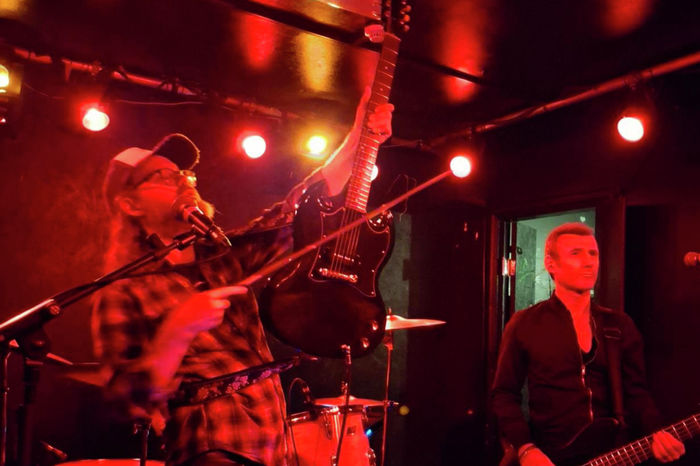
This is where the similarities with Ash end. “Even from the early days, it was an escapism thing,” McMurray reminisces. With Burned As Witches, you don’t get escapism. They don’t take you on a flight of fancy: they keep you in the room with them, with a crowd in thrall to the pulse and acute musicianship. Watching them command the stage at an album release show at the Black Heart in Camden, I was lucky enough to experience this for myself. From the metal memorabilia plastered to the walls to the slightly sticky surfaces and the heavy music blasting from the speakers downstairs, it was the perfect venue to host a band that pays homage to Black Sabbath, the forefathers of metal.
Burned As Witches acknowledge their influences and use them to create something distinct. An amalgamation of odd bedfellows, the band name is inspired by Queens of the Stone Age, The Crucible and McCarthyism; it is clear that McMurray was “really conscious” of his own vision for the project, adding his own flavour to classic riffage. The project also looks back to an ancient Ireland that lived in fear of the powers of the satirical verse, or bardic curse: McMurray explains that the third track, ‘Pay The Ferry’, “was my attempt at a bardic curse on the whole political, economic paradigm that we live in, and trying to bring that down through a song.”
“McMurray briefly turned away, only to return holding the bow of a violin [and] proceeded to use it on his guitar strings”
‘Hold Your Nerve’, the lead single, presents the exception to all this intentionality. “I started writing it and there were a couple of lines that really struck me; I didn’t really understand what they meant, but it was a bit like, ‘You need to keep these’” – I know the feeling, particularly when writing late at night for deadlines. He reflects further, “I think in hindsight, it’s a letter to my kids. […] The world doesn’t work the way we’re led to believe; do I want them to figure this out for themselves?” It interests me how a song written so intuitively has come to characterise such a purposeful album. “Maybe ten years ago I would’ve thought that knowledge is power, but these days it feels like it doesn’t help at all.”
Onstage, McMurray was the consummate entertainer, trading jokes, barbs and general randomness – “I don’t know if some of you saw me doing my Duolingo at the merch stand!” – with the audience throughout. The crowd was certainly a pleasure to be part of, with friends and colleagues of McMurray’s seemingly clustered amongst the rest of us; even his brother, Mike Hawk McMurray, sat behind him on the drums. Many of the ’thank-you’s before the final song were targeted at someone in attendance – it’s evident that although McMurray was the sole performer on the record, it wasn’t created without the support of those close to him.
Even as I was swept along with the celebratory atmosphere, I was anticipating the closing song, ‘To The Sky’. It’s relentless, and, in McMurray’s own words, has “a little bit of a sense of the epic,” with a stop-starting riff that repeatedly teases a final crescendo before continuing. This crescendo didn’t arrive without some surprises along the way. At one point, McMurray briefly turned away, only to return holding the bow of a violin – of all things – aloft. Brandishing it at the crowd, backdropped by cheers, he proceeded to use it on his guitar strings.
After the show, I continued to mull over the leading line of the chorus to ‘Hold Your Nerve’: ‘Maybe it’ll occur to you / Maybe I’ll figure out what I should do’. Even though McMurray came to this record with a clear vision, it’s the organic moments of not quite knowing, lyrically and creatively, that most fascinate me. It’s something I need to embrace more, I think – learning to be comfortable with the word ‘maybe’.
 News / Simon Goldhill resigns following sexual misconduct investigation16 June 2026
 Comment / Exercise, academia, and the Cambridge addiction to both17 June 2026
 Theatre / A celebration of Queer Love in sacred spaces: Romeo and Juliet in Peterhouse Chapel16 June 2026
 Music / ‘Returning again and again’ to the Bateman room16 June 2026
 Lifestyle / Breaking no contact…hours15 June 2026
 Lifestyle / You can’t always get what you want 18 June 2026
 Theatre / ‘Mental illness doesn’t exist in a vacuum’ says Obsessive, Compulsive, Divine 18 June 2026
 News / Caius to begin antisemitism inquiry after Nazi symbol carved into bench18 June 2026
 Film & TV / Gen Z, FilmTok and the A24 problem17 June 2026
 Features / Are the Footlights getting dimmer?17 June 2026