The familiar sounds and new forms of The Orielles
Francis McCabe reviews the electronic and analogue interplay of The Orielles at Cambridge’s Portland Arms
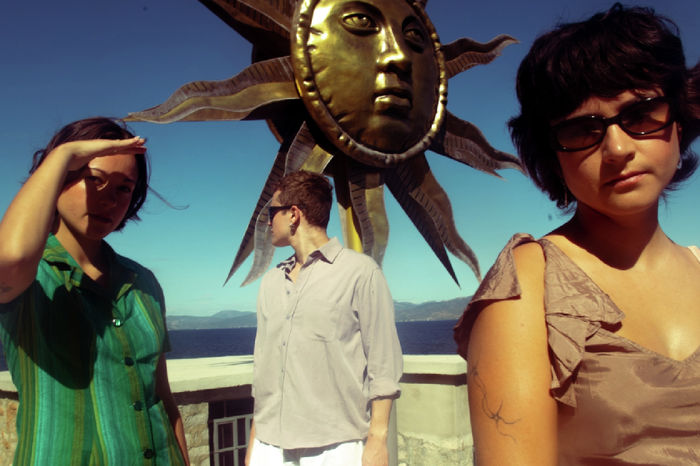
Two music editors walk into a Cambridge pub. One of them asks – why is the queue so long? Punchline? The Orielles. From a short and slapdash preliminary stream, I got a drive-by tour of their most popular tracks – nodding along, it’s a chirpy, catchy, quintessentially indie sound. What it did not prepare me for was my entrance to Cambridge’s Portland Arms: a sea of young-to-middle-aged music enthusiasts, wide-eyed and waiting, arms folded and looking towards a small stage bathed in purple light.
“It’s mesmeric, thundering, luringly ethereal, and that’s even before we pick up the pace”
From their first track, I know that I’ve been algorithmically deceived. The Orielles are an unassuming three-piece, and dazzlingly young. Guitarist and frontman, Henry Carlyle Wade, puts together a computerised electronic riff over which his guitar soon begins to drone, strings thumbed heavily. Drummer Sidonie “Sid” B. Hand-Halford, drops a sporadic, loosely-architectured pattern of cymbal bells and feathered hits to her hi-hat, before she begins a slow, half-speed backbeat. Her sister, bassist and singer Esmé Dee Hand-Halford, glides in, her voice falling glissando on the syncopated stabs as choked hi-hat and stumbling guitar chords come together. This is ‘Beam/S’ – and it sets the tone for the rest of the gig. It’s mesmeric, thundering, luringly ethereal, and that’s even before we pick up the pace. The track quickly becomes an anthemic, foot-stomping, shoulder-dropping indie ballad, walking in and out of subdivisions like it’s nothing, toying with tempo as its space-age sounds dawdle in and out of hearing.
“The Orielles hold a flickering candle to the greats of the past and present and yet deny them the limelight”
Most of their set comes from their 2022 album Tableau. While The Orielles’ early discography is charged with a charming, 80s-inspired sound, host to a intermittent twangling of 60s psychedelia, this stormy, enthralling second act speaks to the grungier side of the 90s: it’s at once gauzy, but swirlingly shoegaze, refreshingly 2000s with its electronic intermissions. Across tracks, Carlyle Wade’s guitar descends into distorted demonism, his body rolls into itself as he plays, halfway between Bez and Ian Brown, part Prodigy. The drums get thrashier, then tighten, becoming lighter, crisper; the vocals descend to a whisper, then swing up and out, almost tending into disharmony. Ghosts seem to swirl around the stage: at times there are shades of Talking Heads, Pixies, even a pinch of Arctic Monkeys – The Orielles hold a flickering candle to the greats of the past and present and yet deny them the limelight, what they lay down is addictively authentic, with a face turned towards the future.
I’m snapped back into the set as the tuning pegs of Hand-Halford’s bass catch the light, throwing a bright beam back and forth across the venue – a lighthouse casting a glare out across its ocean of fans. All instruments seem to exchange roles intermittently: the guitar chords become percussive, and the bass takes front and centre with a daring riff. Hand-Halford’s drums don’t relegate themselves to simply keeping tempo: casting out stray flams and rolls across the toms, she fills the songs with a shifting texture which only deepens with the addition of guitar and bass. Each song becomes an interlayered artifact, built from the ground up.
“The Orielles’ musical heredity is a stark genealogical mix of all things of the past, jumbled and mutated into a new, beautiful being”
While Tableau, on the whole, seems to marks the band’s improvisational and exploratory turn from their more cohesive, song-driven earlier works, it’s not without the three-piece’s characteristic charm. Where ‘Beam/S’ throws itself into and out of genres, dissolving into dark sound, ‘Darkened Corners’ boasts a bounding, Damon Albarn-like, playful sound. Carlyle Wade exchanges a few jokes with the sound guy, and raises his beer to the audience. Then he drops down beneath the line of heads, toying, presumably, with a vast network of pedals. Casually introducing the next track, out chirrups the excited electronic beat of ‘The Room’. Flipping between a hyperactive, snare-heavy, heart-palpitating drum groove and moments of airy emptiness, the lyrics are instantly catchy, falling in line with a quintessentially eighties synthesiser. In other songs, Hand-Halford’s voice is electronically modulated, allowing just enough of the human to bleed through, the higher notes giving out into electronic intermission.

Listening to each track with head full of influences, you just can’t quite get a name out. The Orielles’ musical heredity is a stark genealogical mix of all things of the past, jumbled and mutated into a new, beautiful being. A family tree like a grand old oak, reaching outwards, into time, its branches full of kinks and geometric turns. Skirting across genres with seamless talent and never letting their audience settle at one tempo, The Orielles refuse to keep the computer at arms-length: they aren’t afraid of it. They delight in the diversity of their songs, and equally so in their sometimes-strangeness.
 Comment / Top of the slops: the competitiveness of college dining4 June 2026
 Interviews / What’s the story behind Pages coffee house?8 June 2026
 News / News in Brief: Cambridge crowns, council confirmations, and competitive cricket8 June 2026
 Comment / The Cambridge drift1 June 2026
 News / Cambridge researchers produce ‘world-first’ AI vaccine6 June 2026
 Arts / Don’t rush me – I’m reading!9 June 2026
 Lifestyle / Don’t Cry at Me, Argentina – a next-year abroad story8 June 2026
- News / News in Brief: Cambridge crowns, council confirmations, and competitive cricket8 June 2026
 Science / Failure is the foundation of science8 June 2026
 Fashion / The hidden gems of formal fashion8 June 2026