Ceilidhing through Cambridge: ‘It’s such a joyful thing to be doing’
Tara Buxton chats with Cambridge University Ceilidh Band about the folk musician’s specialised skillset
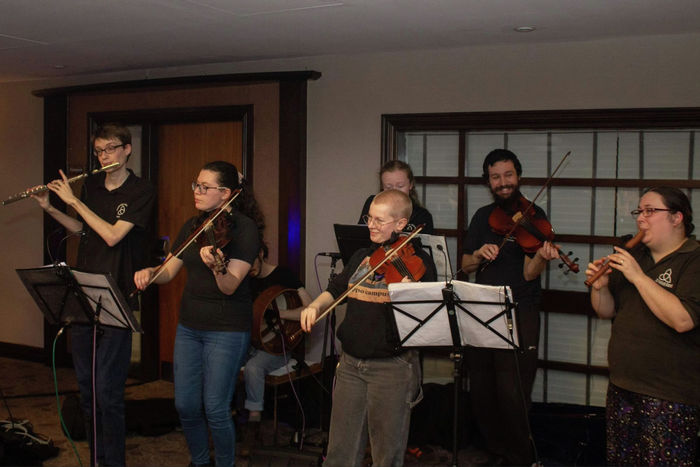
If you’ve ceilidhed in Cambridge, I don’t need to tell you how much fun it is. But for the uninitiated, it’s hard to describe how two hours of cardio becomes so joyous. Whether you’re drunk at a May Ball or stone-cold sober, the buzz of ceilidh dancing is undeniable. But what is a ceilidh like for the musicians playing the lively tunes? I sat down with Krystian, the president of Cambridge University Ceilidh Band (CUCB), and secretary Izzy to find out.
How did you both start out playing for ceilidhs?
Izzy: I hadn’t played for any Ceilidhs before uni, but I’d played a little bit of folk music in my last year of school. I play violin and I’m classically trained, so I’ve been playing for a long time, but not folk music. I tried it out when I came here, and I guess stuck with it!
Krystian: I’ve been playing folky stuff since I was about 13-ish, but I’d been playing the violin for a bit longer before that. I don’t really touch my violin unless it’s for folky stuff! For me, one of my favourite things is a session, when we play in a pub. So I started playing properly in first year.
“It’s an opportunity for you to laugh at yourself a bit”
Which do you find more fun – playing for a group of inexperienced people who crash into each other a lot, or watching a more skilled group ace a routine?
Izzy: There are benefits to both! From a musician’s perspective, if the dancers don’t know what they’re doing, you have to stop and start much more and go a bit slower, which can be less fun. If people are getting it straight away, it’s not going to take as long to teach them the dances and you can get straight into it. But equally, it’s so rewarding to watch people build up the confidence over the course of an evening.
Krystian: It is really fun to watch people crash into each other. Especially after formal too, and May Balls are great…
How often do you get to dance yourself?
Krystian: It’s once a term usually. We put on a Ceilidh just for the band, and you get to swap in and out of playing and dancing. You get to do both, and people can try out leading and calling.
Izzy: It’s harder than it looks honestly, Ceilidh dancing. When you’ve watched someone call a dance so many times and everyone’s crashing into each other, you go ‘I could totally do that’. But it’s harder than you think!
“I got humbled a little bit when I started playing”
Do you have a favourite ceilidh dance?
Krystian: It’s called the Circassian Circle. You all get in a big circle, run into the middle and out again twice, and you get to spin each other around really fast. That’s the best one.
Why is ceilidh such an important tradition in Scottish culture, and why do you think it’s important that we ceilidh in Cambridge?
Krystian: I would say first of all, it’s not just in Scottish culture. You have Irish céilithe as well; in Wales you have the twmpath; there’s an English variant of the ceilidh. Traditionally, it was always about socialising and coming together as a community and having fun! It would be the same people, and they’d know the dances – it’s not like that anymore, especially here. But it’s an opportunity for you to laugh at yourself a bit. Cambridge has a tendency to make you take yourself a bit too seriously. Ceilidhing is great because it’s simple and everyone kinda sucks at it. It takes away that pressure.
Izzy: From a musician’s perspective, coming from classical music, which can be quite rigid, stressful, and competitive, that is just not present in folk music. There’s such a lovely community of people – it’s very freeing. It’s fundamentally such a joyful thing to be doing.
“You’re training a different area of your musical skill than you would be playing straight from sheet music”
What is the most memorable moment from your CUCB career?
Krystian: We do an exchange every year with the Oxford Ceilidh band. I think one of my best memories is the late night session that we did in Oxford. It’s like 40 people, so loud, so fast, just a ridiculous amount of fun.
Izzy: Getting a tune for the first time in a session feels so good. I remember when I first started I didn’t know any tunes. You go to the sessions and there’s no music; people start just playing things! But a few weeks later, you pick up bits, you’ll recognise things we play in rehearsals, and then you get it for the first time and it really feels like you’re a part of something.
Krystian: It’s almost similar to jazz in that respect – you’re picking it up by ear. You’re training a different area of your musical skill than you would be playing straight from sheet music. You learn to listen to each other, to hear what the vibe is, where things are going.
What do you think would surprise people about performing in a Ceilidh band?
Izzy: I got humbled a little bit when I started playing. I’d been playing violin for like, 13 years maybe? I get to a gig, Krystian is leading, and we play show sets at the start of ceilidhs which are really fast, and I just couldn’t do it! That’s when it became my main focus.
Krystian: I think there’s a tendency to think that this kind of music all sounds the same. To some extent, that’s a little true, but that really does depend on the way it gets played and what you add to it. When we have a gig lined up, the difference in the combination of people who play is actually really big. If you only went to one ceilidh, you wouldn’t know what a ceilidh from us sounds like!
 Sport / The imperfect privilege of Cambridge sport12 June 2026
 News / News in Brief: prizes, planning proposals, and pottery14 June 2026
 Comment / Top of the slops: the competitiveness of college dining4 June 2026
 Lifestyle / A town with a view11 June 2026
 Lifestyle / Confessions of a May Ball crasher12 June 2026
 Fashion / Will you wear wigs?14 June 2026
 Lifestyle / Blind Date: ‘It was like the romantic version of a Saw trap’14 June 2026
 Theatre / Hope is a thing with wings (and a stage, and an audience)14 June 2026
 Science / What’s out there? Earth, exoplanets, and the search for life14 June 2026
 Interviews / Is politics going bananas? 14 June 2026