Chatterbox toys and the ‘Ice Cream Truck of Rights’: Carolina Rubio Macwright on empowering immigrants
Lauren Quinn discusses the power of compassion in the contemporary global landscape with the immigration lawyer and organiser
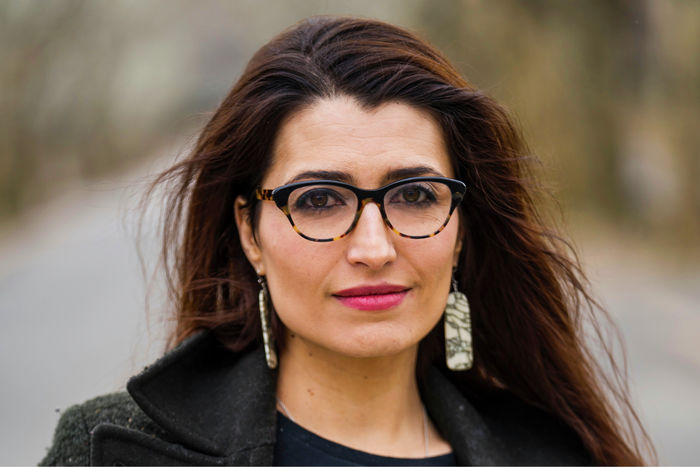
Carolina Rubio MacWright is quite the polymath. She’s an immigration lawyer, climate activist, ultramarathon runner, and the founder of the nonprofit organisation Touching Land. Based in America, her work touches thousands of immigrants’ lives, fuelled by her own experience as an immigrant to America from Colombia.
Rubio MacWright’s interest in the legal system stemmed from her childhood in Colombia. She notes: “I’ve always questioned why things are the way they are – if there’s not a good reason and if people are getting hurt, I will say something”. Rubio MacWright studied law during the day and art at night in Colombia, achieving a bachelor’s in Fine Art. She recalls that this experience, alongside performance art extracurriculars when she had immigrated to America to study the bar at Florida International University, helped her to notice “that law was very much performance art”. As a lawyer, she realised her ability to read juries stemmed from “growing up in Colombia, where you had to be hyper aware of people’s demeanours, because you could be kidnapped or killed”.
“I’ve always questioned why things are the way they are”
The immigration attorney’s work now stretches far beyond the courtroom, launching Touching Land, a non-profit organisation using “somatic legal education” alongside the arts. After noting how ‘know your rights’ workshops were in fact causing more panic at the start of the Trump presidency due to the “inaccessible legal jargon” and “convoluted laws”, Rubio MacWright decided that a change had to take place. Her unique merging of professions happened when she began going to the US-Mexico border to help people understand their rights, and realised that mothers had“such high anxiety they were unable to understand what we were saying, but the kids wanted to learn”. Understanding that children “are the bridge to their parents’ understanding and their advocators,” she designed a chatterbox toy, enabling them to help their parents integrate into life in the US.
Touching Land utilises clay workshops, community projects, and running to remind immigrants of their rights, while bringing them together with local residents to increase understanding and communication. Rubio MacWright states: “Immigrants are in between moments – between their lives, between states, between their rights,” and as such “we’ve found that as long as we centre education around joy and belonging, then regardless of material or modality we would be successful”. She observes that within her workshops, the experience of working with clay while discussing the legal rights of immigrants had a “grounding” effect, since they can “build something they imagine and see it come to fruition”.
“In our workshops we focus on what we deserve, not what we are handed”
Rubio MacWright is also an ultramarathon runner, successfully completing the infamous Western States 100-mile endurance run, and she has transferred this to her work with Touching Land. Noting that running helps her “remember what it feels like to be free,” Rubio MacWright brings together immigrants and ally runners for ten weeks of training to “highlight discrepancies in areas including food deserts and high incarceration rates due to race”. Her running routes “intersect with many social justice issues,” including how climate change is destroying lands linked to sustenance, displacing populations. She then provides runners with the “tools of change,” such as teaching them how to provide medical help, or become a legal guardian of a 16-22 year old immigrant in the city’s programme.
Talking about the extreme bias in immigration law in the US, she stresses: “the immigration books were drafted in the 1960s, when there were only 15 women in all of Congress, and no immigrants in the room when it was written.” Therefore, our approach to immigration law should be “based on our intuition”. “Even if something is legal, do I have a duty and the power to speak up so laws can change? Slavery was legal, segregation was legal: equity is still not a thing. In our workshops we focus on what we deserve, not what we are handed”.
“We imagine change as this really big thing, but really it is the everyday decisions that make up the future”
When I ask Rubio MacWright about the current climate of America, she observes: “[We] are in a pivotal moment in history: Christian nationalism and misogyny and racism are normalised,” with immigration legislative systems “built for capitalism”. “There are 12 million undocumented people in the US, paying taxes of over $93 billion per year, even though they are never going to see a dime”. She notes that to make a change in current persecuting legislation “it would require the economy to adjust”.
Rubio MacWright created the ‘Ice Cream Truck of Rights’ after the pandemic to target struggling New York communities. It began as a “Trojan horse” for workers on agricultural fields in California and Florida to increase awareness of their rights. Collaborating with the Ice Cream Museum, she created 24 flavours all linked to issues of the area such as ‘Stop Rum Raising The Rent’, ‘Not Without My Lawyer Fudge’, and ‘A Matcha Green New Deal’. With a selection of these flavours focused on immigrant rights, over 8000 ice creams were given out across New York’s five boroughs – alongside information lists of people who could advocate for their rights, and a “jingle” in English and Spanish to remember rights by song.
The Colombian-born lawyer and activist asserts: “I’m hopeful that the future generations will look at the bigger picture when interacting with legislation. You don’t put your child in a boat where the likelihood of death is quite high unless death is imminent on your own soil”. Rubio MacWright’s message is to focus on asking why: “Why do we have this law and who is benefitting from it?”. She observes:“we imagine change as this really big thing, but really it is the everyday decisions that make up the future”.
To close our interview, I ask the Touching Land founder how individuals looking to create change should start. She proposes three pointers: “What’s in your toolkit? How can you talk about these issues? Find something you’re really passionate about, and learn more to be able to challenge traditions”.
 News / Venue cancels Cambridge talk by right-wing commentator Matt Goodwin after backlash28 May 2026
 Interviews / Cambridge MP Daniel Zeichner on political realism and the ‘politics of grievance’29 May 2026
 Features / The language of optimisation and the architecture of merit30 May 2026
 Comment / We must support our strikers29 May 2026
 Lifestyle / Blind Date: ‘I should’ve changed my socks’24 May 2026
 Film & TV / Project Hail Mary’s production design shows the power of human creativity30 May 2026
 Music / This music DOES contain hope30 May 2026
 Sport / Should we play more BUCS?30 May 2026
- Features / The language of optimisation and the architecture of merit30 May 2026
- Comment / We must support our strikers29 May 2026