If you like Hamlet, you’ll love Hamnet
Heidi Lewis reviews the acclaimed film depicting the making of Shakespeare’s masterpiece
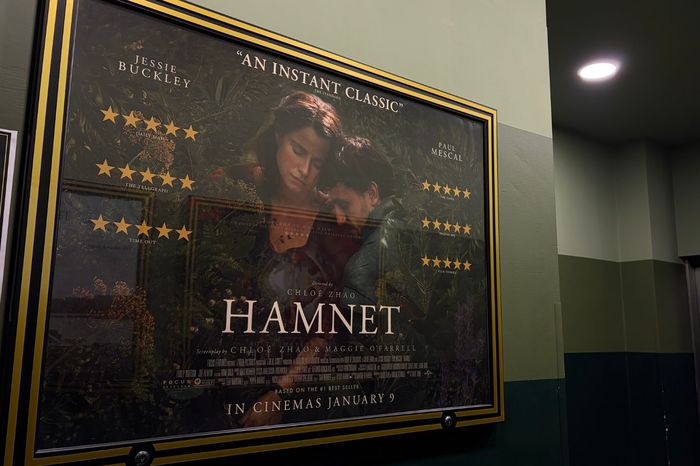
Hamnet has been one of my most anticipated films ever since the trailer dropped in August. The film is based on Maggie O’Farrell’s 2020 masterpiece, which perfectly captures the forgotten grief of Shakespeare’s loved ones, while he gallivanted around London as his family fell apart. The semi-autobiographical novel takes you through a realistic and gritty journey of loss, based in fact while filling in the gaps of events with fiction. Despite my personal high expectations, director Chloé Zhao’s adaptation beats them with ease.
The film explores the relationship between William Shakespeare (Paul Mescal) and Agnes Shakespeare (Jessie Buckley) as their family grows, which greatly clashes against Shakespeare’s rising success as a playwright in London. He is torn apart by his desperate need for both the love of his family, and his ambition for more. This eventually destroys him as he chooses success, and is not there to hold his dying son Hamnet (Jacobi Jupe), the final straw that breaks their family. The audience sits in Agnes’ fury and overwhelming grief at both the loss of her son, but also the loss of the husband and family she once knew, as she now navigates life with a gaping hole in her heart. The film culminates in Shakespeare avenging his son’s death in his own way by writing Hamlet, inverting the roles where it is the father dead instead. This is what he desperately wanted – to trade his life for his son’s.
There is so much aching grief carved into every scene, even before Hamnet tragically passes away. The freedom of Agnes’ hawk, able to roam the skies as he pleases while she remains on the ground, trapped by her controlling stepmother. Agnes’s red dress, a constant reminder that she does not fit into the world around her and will always be marked as such by society. The early beauty and warmth of their family is so bittersweet because it is ultimately futile. The directional style is slow, allowing you to linger in scenes until you feel almost uncomfortable. There is no escaping their tragedy of loss, and Zhao reminds us of this with every desperate sob that we cannot tear our eyes away from. Look, she tells us, look what is happening to them.
Jessie Buckley absolutely steals the film away as our narrator. Buckley portrays Agnes’ gut-wrenching despair and anger as beautifully intertwined. Her children are her world, her life-force. She wants to be the mother that was stolen away from her. All she wants to do is protect them, and when she cannot, she is utterly lost in grief. Buckley’s acting forces the audience into her shoes, and it is impossible to shy away from the bitter truth of her situation – her son is dead. The release of laughter after she watches Hamlet, with her son’s namesake dead on the stage, implies her realisation. Centuries on, audiences will continue to mourn her son, even when she is no longer on earth to do so herself. We will forever cry for his death, curse the fate that dealt him these cards, and he will be remembered through art. She can never move on, and neither will we.
“Look, she tells us, look what is happening to them”
Paul Mescal sinks into his role beautifully. The chemistry between him and Buckley is deeply vivid, and every lingering touch is filled with devotion. So, when it is taken away in the second half, you notice. Devotion begins to slip away, and fade into desperation. He needs her, but does he want her? He wants success. He wants to prove to his father that he is not just a worthless son, but a man with money, fame, and admirers. It clouds his devotion, intentionally or not. The deliverance of his rivalry with his father is perfectly done – even when Shakespeare’s fury bubbles over to violence, there is still a lingering fear behind his actions. His father still holds power over him despite their separation, mirroring the familial conflict in Hamlet.
The younger actors, Jacobi Jupe, Olivia Lynes (as Judith) and Bodhi Rae Breathnach (as Susanna) are phenomenal. Their performances are deeply earnest, capturing a childhood innocence that is unfairly ripped away from them. The audience grows to love and care for these children themselves. Lynes’ tearful cry when Judith looks at her deceased brother and says that it does not look like him ripples through the screen – you could practically hear hearts breaking. The casting was incredibly well done, not just for the sheer talent on-screen, but because the actors of Hamnet and Hamlet are brothers. Hamlet (Noah Jupe) breaks and heals Agnes’ heart because she can see her son so strongly in his face, and so can the audience because of the real-life familial relation. It is so clever yet so cruel. As Hamlet exits stage, just for one moment, Agnes sees Hamnet in his stead, disappearing into the darkness of the wings.
“She can never move on, and neither will we”
Hamnet’s death scene was powerful. The flicking between Agnes’ sheer panic at her son’s fear and pain, against the fading world through his eyes. There is no pain, but peace. The bright white of the world around him, as the hawk soars into the sky. The audience and Hamnet see the bird at the same time, and then we understand that no matter Agnes’ desperation, he cannot be saved. And yet, he still heeds his father’s words. Be brave. He faces death with all the valour of a knight he so desperately wished to play on stage, and he passes into the next world with the final thought that his father will be proud of him.
The performance of Hamlet concludes the film on a perfect note. Zhao has extended it beyond the end of the novel, and we get to witness Agnes watching and reacting to key moments of the play, such as her husband’s own performance as the ghost. There is a gut-wrenching callback to an earlier scene, where William is telling Agnes about the story of Orpheus and Eurydice. Like those two lovers, when Agnes whispers for William to look at her before he exits stage, he does. While this is a complete romanticisation of their marriage, and the film does utterly gloss over Shakespeare’s real-life infidelity, it is undeniably a sweet moment, reminding us of the true love between them at the beginning. The film is, after all, not meant to be strictly biographical, and I greatly enjoy Zhao’s direction of their relationship.
Hamnet is a must-see, whether you hold interest in Shakespeare’s life or not. Zhao transforms the book into something more accessible for a wider audience, and it is a total experience.
 News / C4P vandalises University offices over divestment10 June 2026
 Lifestyle / A town with a view11 June 2026
 Comment / Top of the slops: the competitiveness of college dining4 June 2026
 Sport / The imperfect privilege of Cambridge sport12 June 2026
 Comment / ‘On the Poverty of Student Life’: sixty years on10 June 2026
 Lifestyle / Confessions of a May Ball crasher12 June 2026
 Lifestyle / May Week horoscopes12 June 2026
 Lifestyle / The finalist’s bucket list12 June 2026
 Theatre / All of Cambridge is a stage12 June 2026
 Music / ‘It’s feminine intuition’: predictions for OR312 June 2026