When directors play with the frame
Jacob Smith analyses how directors can innovatively convey narrative perspective
[Spoilers for Weapons (2025)]
Weapons needs no introduction. The genre-bending thriller by director Zach Cregger stunned audiences and revived the corpse of the horror genre, curing it of a stagnation afflicting its reputation for years. Brilliant horror movies release now and then but the genre at large has descended into a self cannibalising trope-fest, each film running down a valley of cliches at break-neck pace. Gems lie in the rubble, but the rubble is overwhelming, made of The Conjuring spin-offs, growing in size every Halloween. Jumpscare here. Disorienting shaky-cam there. Weapons relied on this stagnation to subvert audience expectation, upending the expected cinematographic tropes and angles with cinematic language from other film genres.
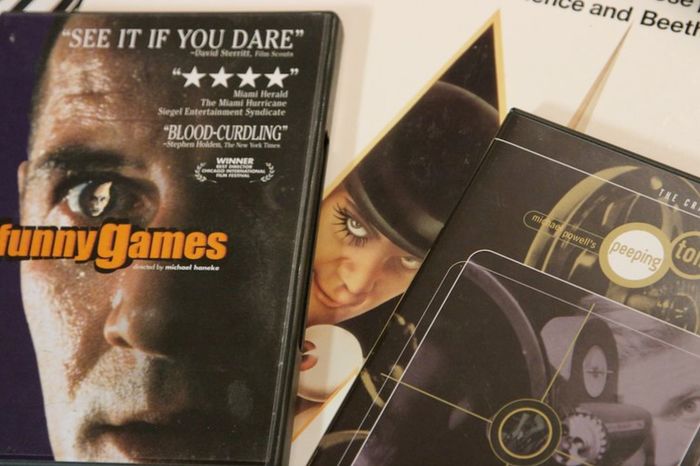
The film’s cinematographic language was a subversion of horror norms, and leaned into comedic angles, creating a unique experience where you’re never sure whether to jump or laugh, caught in the impossible state of wanting to do both. The uncertainty this creates is brilliant for discomforting the audience. The bending of the genre’s camera language can be called frame-bending, and offers something fresh, something self aware and subversive, something the horror genre needs. It reminds me of Michael Haneke’s original Funny Games (1997), a home invasion thriller which frequently breaks the fourth wall, and uses a cinematographic language associated with a different genre, much in the same way Weapons does.
“Frame-bending offers something fresh, something self aware and subversive, something the horror genre needs”
Funny Games takes the traditional home invasion narrative and warps it by using distant shots and straight-on angles to create a camera language completely out of touch with the narrative. While a family is tortured by a home invader off-screen, the camera will choose to instead focus on one invader making a sandwich, whilst screams ring out in the background. The sandwich shot then cuts to a TV, drenched in blood, another ‘domestic’ shot, but one which informs us of a tragic casualty off-screen. The camera focuses on elements of the set traditionally antithetical to a thriller, creating a palpable tension in the audience.
Similarly, while a child attempts to break out of his own house, the camera watches, static, from afar, as if framing the shot as a portrait of an event. We are not watching through the perspective of the boy, not even on his side. Instead we stare, passive spectators of a deranged home invasion. The distance creates an unnerving estrangement between the audience and the action. They aren’t thrown into the action with rapid close-ups and intense angles of wounds. They are kept in mid range, watching as if it were a casual domestic scene, while the characters cry and mourn. When the fourth wall is broken, it is done by antagonist Paul (Arno Frisch) to remind the viewer of their place, their role in these events, as a participant, a silent accomplice. It’s our desire for thriller stories that caused this, and it’s our viewership which makes it continue. This works with the detached, static camera angles to create a sense of voyeurism, peeking into an unfiltered scene, the angles almost uninterested in the torture on screen.
“It’s our desire for thriller stories that caused this, and it’s our viewership which makes it continue”
While Funny Games breaks the fourth wall, Weapons plays with it, bending the frame of the narrative to create fresh visual storytelling in the horror genre. The camera interacts with the narrative, working to build on the narrative tone and enforce it through perspective. In ‘Chapter 1: Justine’, the camera stalks her back, with close-ups of her neck, while she is accosted from unseen angles. We follow Justine from behind, stalking her with our eyes as the parents do. Being blamed by the parents of a suburban town for the disappearance of the children in her school class, the camera style on her is very perspective-informed, reflecting the pressure and scrutiny she receives, and often represents her vision, re-focusing in line with her own presumed perspective shifts as she stares at something in the distance, and prop reveals that match when she spots them.
The film begins with camera angles signalling a thriller experience, with stalking shots and limited perspective angles. However, as the movie progresses, the camera moves between thriller and comedy cinematography. Alex (Cary Christopher), a young boy, holds the perspective of the final chapter, and his is shot in largely the same way of Justine’s. Tight shots, perspective camera movements. And yet comedy is never far away, interrupting the tension, or joining in, leaving us experiencing an unnerving uncertainty in how to feel. This can be seen when [spoiler] Archer (Josh Brolin) discovers the kidnapped children in the basement, and stumbles on a crouched, hiding Aunt Gladys (Amy Madigan). The camera pauses on her freakish expression as we take in the shock of finding her, and then a second later, as she jumps up at Archer, a sound effect is heard. In the discovery, pause, and delayed sound effect, the camera and narrative work to confuse each other, in turn confusing the feelings of the viewer.
This is paid off when Gladys is chased through the suburbs by a hoard of blood thirsty children. Distance is the boundary between horror and comedy, and this scene is made up with far shots, focally shifting to an unaffected, far-off observer of the climax. As Gladys runs for her life, the camera lethargically follows her, working to diffuse the culmination of a series of meticulous peaks and dips in tension with bathos. And through the comedic bathos it delivers catharsis, watching such a menacing and powerful villain appear tiny, feeble and humorous. As Funny Games and Weapons showcase, genre-aware frame-bending is key to revitalising the creativity in stagnating genres, allowing us to enjoy them afresh.
 Comment / Top of the slops: the competitiveness of college dining4 June 2026
 Interviews / What’s the story behind Pages coffee house?8 June 2026
 News / News in Brief: Cambridge crowns, council confirmations, and competitive cricket8 June 2026
 Comment / The Cambridge drift1 June 2026
 News / Cambridge researchers produce ‘world-first’ AI vaccine6 June 2026
 Arts / Don’t rush me – I’m reading!9 June 2026
 Lifestyle / Don’t Cry at Me, Argentina – a next-year abroad story8 June 2026
- News / News in Brief: Cambridge crowns, council confirmations, and competitive cricket8 June 2026
 Science / Failure is the foundation of science8 June 2026
 Fashion / The hidden gems of formal fashion8 June 2026