Looking back on Met Gala 2026
Sadie Nicholls asks whether the Met Gala can survive its politics
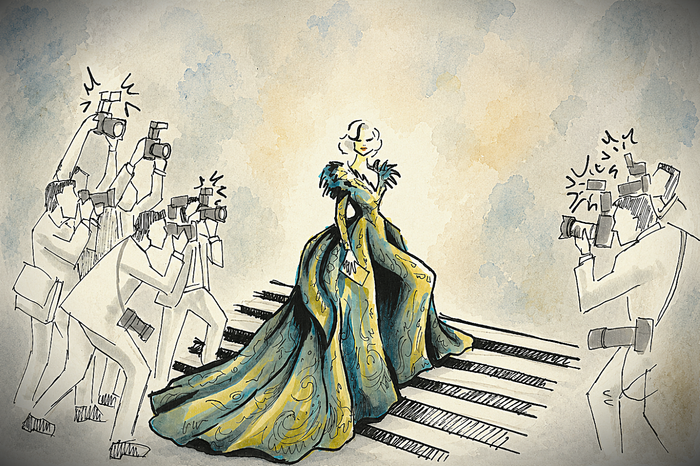
The Met Gala has always been an uneasy union of spectacle and wealth. First held in 1948 as a fundraiser for the Metropolitan Museum of Art’s Costume Institute, the event has since become fashion’s most scrutinised red carpet. This year was no exception. The Met Gala dress code, ‘Fashion is Art’, is built upon the thematic exploration of the Costume Institute’s spring 2026 exhibition, Costume Art. By foregrounding fashion as both beauty and craft, the theme granted attendees considerable creative autonomy, and looking back, it is safe to say most designs did not disappoint. From reinterpretations of iconic paintings to the embodiment of statues, the reception of the looks has been predominantly positive.
“The Met Gala has always been an uneasy union of spectacle and wealth”
As a celebration of the fashion industry’s capabilities, various interpretations of wearable art populated the red carpet, as one art form looked to another for inspiration. Gracie Abrams’s look was a perfect example of this, wearing a carefully curated gold Chanel dress that is reminiscent of Gustav Klimt’s ‘The Kiss’. While Abrams was not the only celebrity to make a specific art reference, her outfit stands out as more than a replication of Klimt’s work. Instead, the gold embroidery and gemstone embellishments brought the painting to life, while creating something original. The result is far more interesting than Lauren Sanchez-Bezos’s outfit, which was rebuked as boring for how it copies the dress seen in Singer Sargent’s ‘Madame X’ painting with little creativity. Emma Chamberlain’s look similarly drew inspiration from paintings, particularly Van Gogh’s, but with a far more eye-catching look. Fashion quite literally became a canvas, as she turned up in a hand-painted Mugler dress. The result of 40 hours of dedication, it is an incredible reflection of what the fashion industry has to offer.
“Fashion quite literally became a canvas”
Not all celebrities looked to paint for inspiration, though, with a handful of sculptures making an appearance. Met Gala connoisseurs from the Kardashian-Jenner family chose to turn the body into art, playing with ideas of sculpture and nudity that many reviewers have dismissed as underwhelming. In contrast, Anok Yai was voted best dressed by British Vogue readers. The supermodel’s Balenciaga look transformed her into a sculptural reimagining of the Black Madonna, a central art motif in Catholic churches across Europe. Her black drop waist gown, paired with complex makeup, ensured she succeeded in her aim of transcending the human. But what is less certain is whether her look is enough to bring “hope […] in a Trump world,” which she has stated was her intention.
Yet, even the most visually arresting looks of the night could not fully draw attention away from the controversy surrounding the event’s funding. The Met Gala has long been vulnerable to accusations of excess, with individual tickets reported by the BBC to sell for around $75,000 (£56,000), making the event an obvious target for criticism about inequality and elite self-display. But this year, the Met Gala became even less palatable due to funding by billionaire Jeff Bezos, who is said to have given at least $10 million to the event. The Met lists them among the supporters of Costume Art, but reporting around the gala described Bezos’s patronage as a major source of backlash.
This criticism was not made in abstraction. Many have mobilised against his controversial involvement, with ‘Boycott the Bezos Met Gala’ posters plastered around Manhattan. Notably, Zohran Mamdani did boycott the event, breaking a long tradition of New York mayors attending. He chose to make a political statement by not going, in contrast to American Congresswoman Alexandria Ocasio-Cortez, who, in 2021, harnessed the publicity of the event to spread the provocative message of “tax the rich”, printed in bright red text across her dress.
“Ultimately, the Met Gala has never been politically innocent”
These longstanding debates over taxation continue to plague the Met, as well as issues of worker treatment brought to the fore by the Amazon-Bezos involvement. Concerns over this have led to activist group ‘Everyone Hates Elon’ leaving around 300 bottles of fake urine in the Metropolitan Museum of Art in reference to allegations that Amazon workers are denied toilet breaks. Reflecting the potency of opposition towards Bezos, this has put the Met Gala at a heightened risk as attacks of those at its core escalate to the extent that Bezos did not walk the red carpet.
Ultimately, the Met Gala has never been politically innocent. It has, for decades, been an uncomfortable display of elitism and disproportionate wealth. This, sadly, has not changed. The Bezos funding is merely a continuation of longstanding and fundamental issues. What does seem to be changing, though, is the public’s ability to overlook the controversial implications of the event as it becomes ever harder to enjoy fashion without politics. However, fashion is not now, nor ever has been apolitical, leaving us to question how we will reconcile our love for the Met’s famous red carpet with concerns over inequality and injustice.
 News / C4P vandalises University offices over divestment10 June 2026
 Comment / Top of the slops: the competitiveness of college dining4 June 2026
 Lifestyle / A town with a view11 June 2026
 Theatre / The recipe to success this Easter term 10 June 2026
 Comment / ‘On the Poverty of Student Life’: sixty years on10 June 2026
 Lifestyle / Confessions of a May Ball crasher12 June 2026
 Lifestyle / May Week horoscopes12 June 2026
 Lifestyle / The finalist’s bucket list12 June 2026
 Theatre / All of Cambridge is a stage12 June 2026
 Music / ‘It’s feminine intuition’: predictions for OR312 June 2026