Is the time of the smartwatch up?
Matilda Billinge argues that analogue watches express individuality in a way smartwatches never can
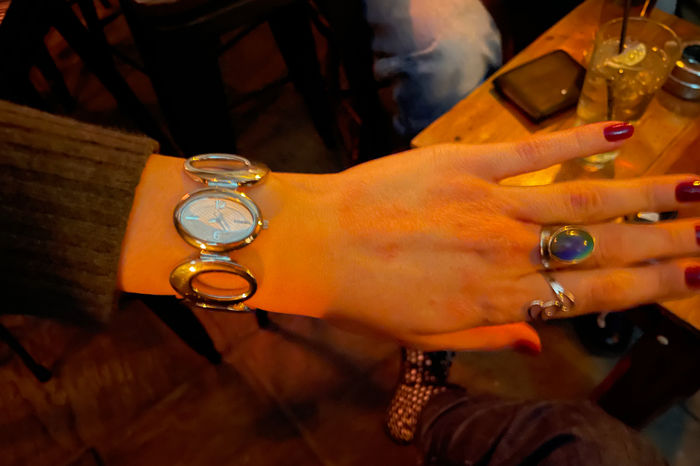
In early December, I was catching up with a good friend when she pulled back her sleeve and ecstatically proclaimed, “Look at my new watch!” It was a Vinted find, with a sleek, silver, oval design and white analogue face; very her. She explained, while twisting it proudly back and forth, that although she had worn a smartwatch for many years, its only true appeal was the step-counting feature which her phone could easily replicate. I was fully in favour of the switch. My friend’s new accessory communicated far more about her style and personality than her smartwatch ever had: it seemed to possess a sense of character (as well as visual interest) that the other had been sorely lacking. Although this conversation was quickly sidetracked, I found myself mulling over the merits of traditional tech on the train ride home as I regarded my own watch-less wrist.
Searching for a watch in the era of wearable technology can seem like less of a matter of style and more akin to choosing a new phone or laptop. Smartwatches boast a whole host of features, including the supposed ability to accurately track exercise routines, heart health, sleep patterns, and even the menstrual cycle. Before I come across as too disparaging, they certainly have their advantages, such as encouraging wearers to be more active in their everyday lives. However, I worry that the true spirit of the watch has been lost in our technology-obsessed zeitgeist.
“Watches have always been an accessory first and foremost”
These utilitarian-looking devices are the antithesis of the individuality that should define the way we dress. Watches have always been an accessory first and foremost. A practical accessory, certainly, but ultimately still a fashion statement. From the aristocratic elegance of the pocket watch to the iconic timepieces of beloved characters such as James Bond, watches are best worn when they communicate something about the personality of the wearer. This is truer now than ever, since the smartphone has all but replaced the watch’s primary function of telling the time on the go.
From a purely aesthetic standpoint, choosing your own ‘traditional’ watch offers a freedom of expression that goes beyond simply changing the colour of the band on your Fitbit. With so many unique designs to pick from, both new and preloved, you are unlikely to find yourself inadvertently matching with someone else. If your dream watch turns up with a dead battery in a charity shop or flea market, fear not; most are easily (and cheaply) repaired by a high-street cobbler. Depending on your preference, there are a plethora of options: chunky or dainty, metallic or fabric strap, digital or analogue. Since watches are designed to last, there is an extensive second-hand market offering both vintage and contemporary styles – my own watch was the spoils of a heated Ebay bidding war.
“A watch can also add variation to a bracelet stack or complement a collection of rings”
In terms of styling, a nice watch can lend a sense of coherence to your look. It can be the perfect finishing touch to an outfit, particularly if you are somebody who prefers to wear minimal jewellery. On the other hand, a watch can also add variation to a bracelet stack or complement a collection of rings, proving its versatility as an accessory. It is the ultimate symbol of the put-together, and can elevate even the most casual of outfits. Accessorising with a watch is, if you’ll forgive the pun, timeless. It is also far less overstimulating than its health-tracking equivalent.

There is something comfortingly simplistic about being able to check the time without also being bombarded by seven Outlook notifications or a second-by-second heart rate tracker. My friend’s decision to ditch the high-tech for something with a bit more character encouraged me to resurrect my own timepiece from the bottom of my jewellery box, and as I cycle to lectures, the ability to glance down and instantly ascertain how late I am is invaluable. Furthermore, I question the need for many of the smartphone-adjacent smartwatch features, such as the ability to send messages, which seem designed to entrap you in the stress of constant communication. Perhaps some accessories are better left to the world of fashion alone. If you are a smartwatch or ring owner, the new year may be the perfect time to give your cortisol levels a break and reclaim the unique charm of a classic watch.
 Comment / Top of the slops: the competitiveness of college dining4 June 2026
 Interviews / What’s the story behind Pages coffee house?8 June 2026
 News / News in Brief: Cambridge crowns, council confirmations, and competitive cricket8 June 2026
 Comment / The Cambridge drift1 June 2026
 News / Cambridge researchers produce ‘world-first’ AI vaccine6 June 2026
 Arts / Don’t rush me – I’m reading!9 June 2026
 Lifestyle / Don’t Cry at Me, Argentina – a next-year abroad story8 June 2026
- News / News in Brief: Cambridge crowns, council confirmations, and competitive cricket8 June 2026
 Science / Failure is the foundation of science8 June 2026
 Fashion / The hidden gems of formal fashion8 June 2026