A history of Cambridge women’s fashion
Arushi Dattani consults A Newnham Anthology to get a better insight into how some of the first female Cambridge students dressed
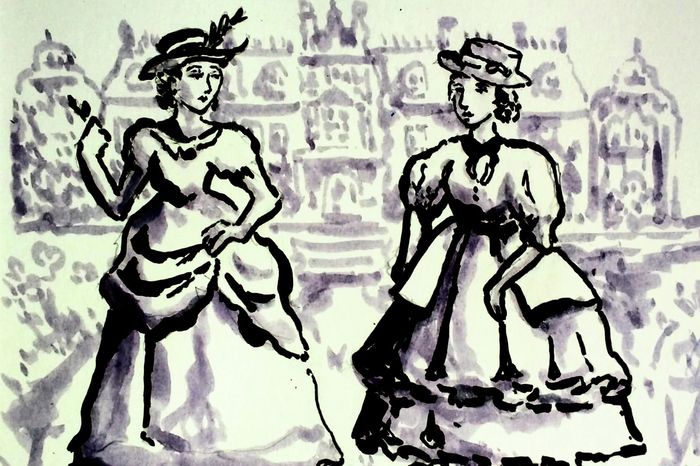
In 1869, female students were welcomed to Cambridge for the first time in its history. Almost 150 years on, these colleges and their female students have left a lasting legacy at Cambridge with their fight for the right to gain a top university education. Alongside their fight for equality, these students have contributed greatly to the rich cultural history of the university. So, using A Newnham Anthology, I’ve decided to explore the history of these students through the outfits and fashions worn by these first Cambridge women.
The first female students were supposed to attract as little attention as possible, to minimise controversy. So, when the first Newnham students arrived, Professor Sidgewick lamented the “unfortunate personal appearance” of the students – by which he actually meant their good looks and stylish outfits – fearing the women would attract too much attention! Early students would have worn “long skirts, leg-of-mutton sleeves and straw boaters” on a day-to-day basis and stylish ball gowns and dresses at the different events and dances at the women’s colleges. Glamorous gowns of “blue cashmere trimmed with silk” and “dark green velvet” were worn at Girton dances in the late 1870s, accessorised with “gold beads” or snowdrop motifs. Such dances continued to be popular into the 1900s and were held weekly, with one fancy dress dance per term. Evening dresses for such events were often made of luxurious fabrics and often had billowing skirts and trains or were lace-trimmed. Flowers such as “rosebuds” or an “arum lily” provided a finishing touch.
“By the 1900s, the students “affected a mannish style in dress in the daytime”, wearing coats and long skirts, knotted ties and blouses”
Daily dress appeared to be more simple, with most students appearing quite “neat and ordinary”. One principal, Mrs Sidgewick, was the epitome of this idea, questioning the idea of taking a dressing-gown to university, remarking that “I always wear my macintosh” instead, which also happened to be “her usual garb by day too”. However, despite some interest in practicality in clothing, long skirts were still expected of students – even on the hockey field. If a student wanted to “leave off her flannel petticoat when playing hockey,” she would even need to “write home for permission”! By the 1900s, the students “affected a mannish style in dress in the daytime”, wearing coats and long skirts, knotted ties and blouses. Hair was done up in a bun with “a hundred hair-pins” and hats were an essential accessory and were found in many shapes and sizes. Surprisingly, though, the lab uniforms were rather less practical: a “white blouse … of ‘nun’s veilling’” alongside a tweed skirt and coat. These expensive blouses were rather unfortunate for some students, one of whom “made large holes in the front” when first wearing it, due to a “clumsy spilling of acid”…
During WWI, the students still wore “corset[s] armoured with whalebone,” but they soon went out of fashion and were replaced by “dresses [that] were loosely tubular, with a belt somewhere round the hips”. Hats were still a key part of women’s dress – in fact, they “were forbidden to go to lectures, or into town at all, without [them]”. At the same time, the women rowers decided to rebel against the traditional “gym tunics,” which “had always been ugly, inefficient and … by now … old-fashioned,” wanting to replace them with more sensible shorts. This attempt involved an interesting meeting with the then-principal, which involved modelling the shorts through “gingerly board[ing] a footstool and row[ing] around [the principal’s] drawing-room”. Thankfully, the encounter did not disappoint and the uniform was soon changed!
“The first person to speak to me … an Indian girl … [who] knocked on my door one evening … immaculate in sari”
After WWII, due to a lack of available fabrics, silk bedspreads and blackout material were transformed into evening gowns. A lack of stockings caused many to turn to slacks (highly frowned upon by one of the tutors: “Perhaps dears, you would just look at your back views in the mirror, and then possibly put on a little jacket or something”) and some even “wore bedroom slippers at breakfast,” due to the freezing temperatures that winter. International students also seemed to form a key part of the fashion, with one student remembering “the first person to speak to me … an Indian girl … [who] knocked on my door one evening … immaculate in sari”.
In 1948, with women finally being able to attain degrees, came the problem of academic dress. It was eventually decided that “gowns should be made in the same style as those worn by men” and the women “were to wear a ‘plain, dark coat-and-skirt’… ‘a plain white blouse, plain dark low-heeled shoes, dark stockings, no jewellery and no varnish on the finger-nails’”. The lack of nail polish was apparently explained by the desire to “protect the Vice-Chancellor, who if he should suddenly find himself gazing down at ten bright red talons between his hands, might from nervous shock forget his Latin words!”
“By the 60s, however, student fashion had become much more rebellious”
The post-war fashions soon turned to a celebration of patriotism where tweed skirts, nylons and “cashmere twin sets” were the norm, heavily inspired by the newly-crowned queen. Pearls were worn and hair was “just above shoulder-length and frizzled round the bottom with a perm like the Queen had”. By the 60s, however, student fashion had become much more rebellious, with “varied and colourful” outfits. Students wore brightly coloured trouser suits, “maroon-and-orange bell-bottoms” and “sheer silver microskirts.” Most importantly, however was the obsession with “boots, boots, boots of all types and heights.” Knee-length skirts, cardigans, practical shoes and short hair were also commonly seen across Newnham.
So, we can clearly see how fashion in Cambridge has evolved alongside the changing attitudes to women and their emancipation. There have been many key changes in fashion and dress codes for the women in Cambridge, allowing them to have more freedom in their daily lives. For me, the key moment was in 1968 when the UL dismantled their dress code. This meant that women could finally visit the UL wearing trouser suits, enabling them to “make that unpremeditated visit to the Library without a quick call into College to change”. This symbolised a final step towards the liberation of the women of Cambridge through fashion.
 Comment / Top of the slops: the competitiveness of college dining4 June 2026
 Interviews / What’s the story behind Pages coffee house?8 June 2026
 News / News in Brief: Cambridge crowns, council confirmations, and competitive cricket8 June 2026
 Comment / The Cambridge drift1 June 2026
 News / Cambridge researchers produce ‘world-first’ AI vaccine6 June 2026
 Arts / Don’t rush me – I’m reading!9 June 2026
 Lifestyle / Don’t Cry at Me, Argentina – a next-year abroad story8 June 2026
- News / News in Brief: Cambridge crowns, council confirmations, and competitive cricket8 June 2026
 Science / Failure is the foundation of science8 June 2026
 Fashion / The hidden gems of formal fashion8 June 2026