Why we undergrads should be talking to postgrads
Abril Duarte González argues that engaging with postgraduate students can help bridge the gap between undergraduates and the world of academia
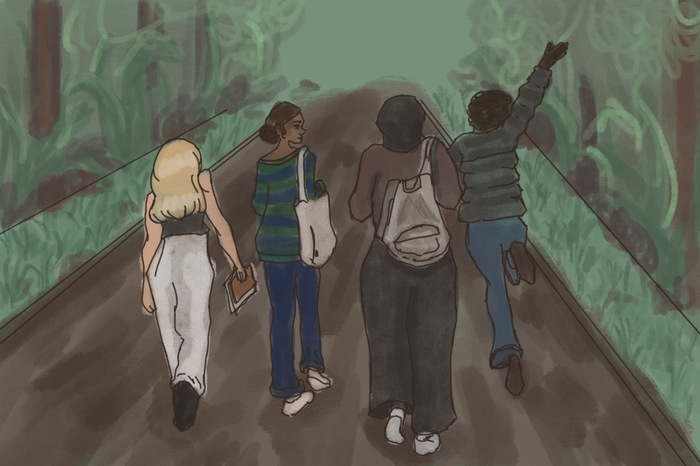
Around this time last year, I applied to be on the committee of my college’s history society – slightly on a whim, slightly out of guilt for having enjoyed all the talks I attended and never really speaking to anyone at them. It felt like the kind of thing you’re supposed to do here: show up, get involved, prove to yourself you’re not just getting your degree. Now that my term on the committee is over, I could report back about the admin, the budgeting, the emails with catering – everything that conveniently fits into a neat CV line. But that all feels beside the point. The only thing that actually changed how I think about being here was much less official: the people we ended up talking to, and how much that mattered.
Being in a society and actually going to things turns out to be one of the easiest ways to step outside the undergraduate bubble. In our case, we kept up the tradition of Thursday evening talks every other week. Afterwards, we would take the speaker to formal hall: three courses, two hours, five of us, and one guest. At the start of Michaelmas, we decided to focus on inviting academics from within the College, partly to highlight the work happening under the same roof. We ended up inviting mostly PhD candidates. It turned out to be the best decision we made.
Over the term, we met all sorts of people. Some dinners flowed, others stalled into awkward silences or slightly intense back-and-forths that felt more like interrogations than conversations. But when it worked, it really worked.
"They were making use of methods and approaches that feel almost entirely absent from the way we’re taught"
One speaker, an architect-turned-historian, used digitised census data to map where different social classes lived in Victorian Manchester. It challenged a familiar picture of strict class segregation, showing instead that people of different classes often lived within the same buildings. What struck me wasn’t just the argument, but the method: colour-coded maps, coded datasets, digital tools that none of us had really encountered in our course. Another speaker, originally trained in philosophy, worked on the history of mending pottery. He spoke about ‘enactment’ as a historical method, about paying attention to the traces of repair in objects – something that, again, none of us had really come across before.
Both projects might sound niche to the non-historian reader. But that’s partly the point. They were making use of methods and approaches that feel almost entirely absent from the way we’re taught. We stay close to the monograph, to a familiar rotation of names we feel the need to reference: Michel Foucault, Natalie Zemon Davis, E. P. Thompson, Peter Burke. Seeing methodology actually being done – explained, questioned, made to make sense in conversation – felt completely different. Without that, the gap between what we study and what historians actually do can feel oddly large, and honestly, a bit discouraging.
“Seeing that the thing you’ve built up as abstract, even unrealistic, is actually happening right in front of you”
At a place like Cambridge, that distance can feel especially sharp. Your supervisors have been publishing for decades. Part of you is just thinking: 'how am I here?' It’s not entirely rational, but it’s there – that sense of being right at the bottom of a food chain, both exciting and deeply alienating.
Spending time with postgraduates disrupts that. The age gap is smaller, the power dynamic less pronounced. They’re close enough to the system to understand it from the inside, but close enough to where you are to remember what it feels like. Conversations feel less performative, more honest. We talked about inner-college politics, accommodation, funding for postgrad degrees, what it’s actually like to be a supervisor. None of us were trying to prove ourselves; you’re just talking. And that matters more than you expect.
There’s also a bias we don’t really question. We assume the most established academics have the most to offer. When we invited a more well-known speaker to one of our Thursday talks, attendance noticeably went up. The same logic plays out in supervisions: when people find out they’ve been assigned a junior fellow, there’s often a flicker of disappointment – as if the ‘junior’ in junior fellow means less valuable. It doesn’t. Junior fellows are often right at the forefront of new research, experimenting, figuring out how to make their work legible because they have to, less caught up in the administrative weight of more senior roles. When I read something I genuinely enjoy and realise it was written by someone early in their career, it’s oddly motivating. It makes the idea of doing something like that yourself feel less out of reach.

So maybe the point isn’t networking, or exposure, or any of the words we like to dress this up in. Maybe it’s just proximity. Seeing that the thing you’ve built up as abstract, even unrealistic, is actually happening right in front of you. And if you’re anything like me – watching people around you line themselves up for law firms, consulting schemes, tech internships, while you’re still circling the idea of staying in academia – that matters. Not as a plan, not even as reassurance, but just as proof: there are other ways of continuing, and there are people already doing it.
 Comment / Top of the slops: the competitiveness of college dining4 June 2026
 Interviews / What’s the story behind Pages coffee house?8 June 2026
 News / News in Brief: Cambridge crowns, council confirmations, and competitive cricket8 June 2026
 Comment / The Cambridge drift1 June 2026
 News / Cambridge researchers produce ‘world-first’ AI vaccine6 June 2026
 Arts / Don’t rush me – I’m reading!9 June 2026
 Lifestyle / Don’t Cry at Me, Argentina – a next-year abroad story8 June 2026
- News / News in Brief: Cambridge crowns, council confirmations, and competitive cricket8 June 2026
 Science / Failure is the foundation of science8 June 2026
 Fashion / The hidden gems of formal fashion8 June 2026