The art of rowing
Ollie Liversedge treats the views from his boat as an art gallery
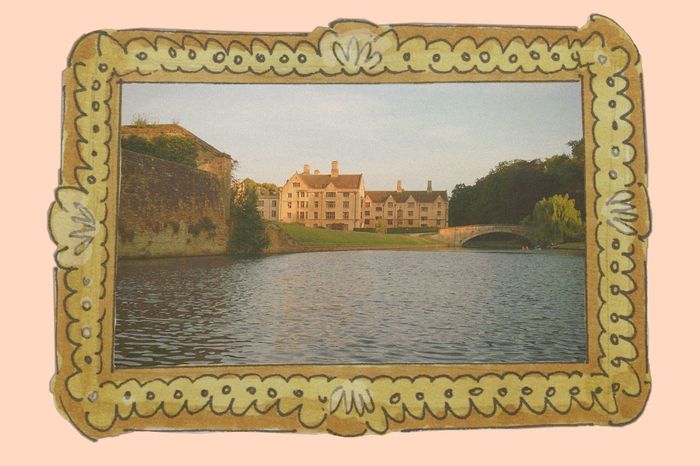
On Tuesday, I found myself rowing to the Reach and back in a 4+. It was raining, it was freezing cold, and I could feel my fingers turning blue with every stroke. With no escape now that we were halfway to the weir, I decided the only way to overcome my meteorological torment was to treat the Cam’s riverside like an art gallery. If I had to suffer, I could at least look at something nice while doing so. Rowing forces you into a particular kind of looking. You face backwards, watching the world drift away from you in slow motion. Buildings, bridges, and green spaces slide by like paintings on a moving wall. They start to look like compositions: shapes, textures, and fragments of history arranged along the water’s edge. I’m sure college rowers in 1926 were just as upset to be out in the cold and rain as I was. Imagining some equally miserable Petrean rowing here a hundred years ago – seeing what I was seeing, with the same tragic expression – gave me an enormous sense of kinship with the river.
“The only way to overcome my meteorological torment was to treat the Cam’s riverside like an art gallery”
We started at Peterhouse Boathouse. I have always thought the building has a dignified charm, with its jaunty angles and narrow balcony. The current structure was built in 1928, replacing a previous boathouse that dated to 1897; the club is now hoping to refurbish again. The oldest boathouse on the river is Goldie Boathouse, built in 1882. Home to the University Boat Club, it is named for the oarsman J. H. D. Goldie, who rowed in four Boat Races from 1869 to 1872, and won three. It is one of the most magisterial boathouses on the bank. Close competition comes from the Mock Tudor Trinity Hall boathouse (the Latham-Scott Boathouse), with its nostalgic beams and flourish, and the wonderfully modern Downing Boathouse, which houses the Cambridge Rowing Tank opened in 2018. Together, they form a kind of accidental architectural timeline, best noticed when shivering from head to toe, I suppose.
By the time we had passed the college boathouses and were heading towards Chesterton, the cox’s teeth were chattering, her face was turning white, and her lips were turning blue. So I kept my eyes firmly on the riverside views. We soon reached the Green Dragon, a historic pub in Chesterton village that dates back to the 16th century. The pub claims that Oliver Cromwell once sat in it practising throwing knives at the fire lintel. It also claims that J. R. R. Tolkien visited frequently while writing The Hobbit and The Lord of the Rings. Whether or not these stories are entirely reliable, the building certainly looks like the sort of place where a future Lord Protector or fantasy author might pass a damp afternoon. As I rowed by, I envied Frodo, who only had to go to Mordor and back, not the Reach in this weather. I wondered which future revolutionaries and novelists were currently sitting cosy inside.
Looking wistfully over towards Stourbridge Common, I tried to imagine what the river might have looked like when Cromwell glanced out from the pub window, perhaps between downing a pint and planning to overthrow the monarchy. For 700 years, Stourbridge Common was home to an annual fair, first formalised in a charter granted by King John in 1211 to support lepers. It grew into one of the most important fairs in Europe and later inspired John Bunyan’s ‘Vanity Fair’ in The Pilgrim’s Progress. The fair declined at the end of the eighteenth century and was abolished in 1934, but I think we should bring it back. Today, the Common is a local nature reserve and floodplain. Much like Ditton Meadows further up the Reach, it is a place where cattle graze while people gather to fish, blast rap music, and smoke: a scene surely worthy of Constable, minus the JBL speaker…
“I tried to imagine what the river might have looked like when Cromwell glanced out from the pub window”
As we reached the end of the Reach, I pictured the burger I could be eating at the Plough in Fen Ditton right about then. Once a paper mill and coaching inn, the Plough Country Pub & Restaurant is now the perfect place to sit and watch Bumps with friends, with excellent views from Grassy Corner to Ditton Corner. From inside the boat, however, as I felt my nose solidifying into a hard block of ice, it is the worst place to be told we are turning around and heading back. At least on the row back, I’d have a whole new angle on all the horticultures and architectures I was paddling slowly by. Rowing may be cold, wet, and occasionally miserable, but it does give you an opportunity to slow down and look at things. And along this stretch of the Cam, there is quite a lot worth looking at!
 News / Simon Goldhill resigns following sexual misconduct investigation16 June 2026
 News / News in Brief: Pokémon, planting, and the plague21 June 2026
 Lifestyle / Not a pub, not a club: Cambridge nightlife’s best third spaces22 June 2026
 News / Join Varsity’s editorial team this Michaelmas22 June 2026
 Comment / How do we find exambiguity?22 June 2026
 Music / Liverpool vs Manchester: the musical derby23 June 2026
- Lifestyle / Not a pub, not a club: Cambridge nightlife’s best third spaces22 June 2026
 Fashion / Academic prestige or aesthetic appeal?22 June 2026
 Sport / Martina Abels Marti leads Newbroke to Cuppers victory against SJK amidst transgender ruling controversy22 June 2026
- Comment / How do we find exambiguity?22 June 2026