Visiting A Gap in the Clouds
Mia Apfel reviews the new Heong Gallery exhibition at Downing
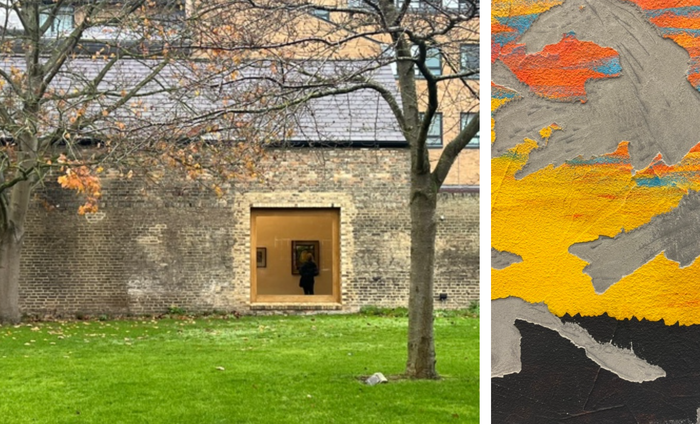
The space which the Heong Gallery occupies in Downing is itself A Gap in the Clouds, an architectural aperture, offering a break from the college’s wide expanse. The artworks on display are without name placards or descriptive detail on the walls; the context is stripped bare, leaving the viewer with nothing but the visual pieces and their surroundings. The windows of the room, opening onto the landscape of collegiate gardens, become wooden frames squaring in brief glimpses of the natural. The exhibition’s artwork, then, is not limited to the pieces it has chosen to display but extends to the accidental landscape gaps which expose themselves during the viewer’s experience of the room.
“New appreciation and perspective is to be found in the juxtaposition of hung artworks inside against the backdrop of gnarled trees and the actual clouds above”
In provoking questions about what we consider to be a ‘landscape’, where the boundaries lie between ‘inside’ and ‘outside’ scapes, and how we ourselves interact with our surroundings, Downing’s new exhibition profoundly changes how we perceive our spatial footing, steady or precarious. The viewer not only becomes aware of how they interpret the aesthetic renderings of ‘landscape’ on display, but also how they regard and engage with the real-life landscape which they stand in. One feels as though, even after having exited the exhibition’s physical space, its content continues to bleed into the surroundings. Standing outside, from across the grassy plain of Downing’s front court, you can see back in through the window gaps of the gallery, fissures in a brick façade; new appreciation and perspective is to be found in the juxtaposition of hung artworks inside against the backdrop of gnarled trees and the actual clouds above. Experiencing the exhibition in this embodied manner pushes the contemporariness of artwork to its limit. The immediacy of landscape quickens.
A borrowed phrase from one of the artists on display, David Shrigley, the exhibition’s title extends the possibility for momentary clearing. The red-lettered phrase of Shrigley’s 2020 screenprint cuts open its clouded backdrop of navy gloom; a gaping white chasm leaves space for the clarity of light amid darkness. There is starkness to the handwritten lettering. Respite is found in quiet simplicity. Yet, the chaos of the ‘clouds’ cannot be resisted; expansive brushstrokes, swiftly carved in thick curves, swoop inwards with movement which threatens to close the image’s temporary opening.
“The artwork uses a humorously contemporary, and surprisingly innovative, medium: Lego bricks. Re-interpreting Van Gogh’s renowned painting of the same title, WeiWei replaces the crows with drones”
Shrigley’s weather motif, wary of whether we can be relieved from the heavy weight of ‘clouds’, marks an ecological concern, manifest in the exhibition in its entirety. The artworks, variant in medium, size, and style, are bound by an awareness of humanity’s fraught relationship with the natural landscape. Whilst Shrigley’s interpretation of this is arguably light-hearted, other pieces are more urgent, confrontational, or critical: coaxing recognition of the crises – technological, natural, human – which face our surroundings.
Several of the works consider the effects of perceiving the natural through the lens of the camera. Yto Barrada’s Wallpaper – Tangier (2001) subtly blurs the line between verisimilitude and technological reproduction. A C-type print of an Alpine landscape, Barrada’s photograph tricks the eye. Only after examining the picture in microscopic detail will a perceptive viewer realise that this is not a direct photograph, but the image of an image glued down. A seam at the centre uncannily exposes what seems to be a peeling, faded wallpaper. This photographic play with reality uses displacement to alter our perception of a landscape out of context.
Ai Weiwei’s Wheatfield with Crows (2024) similarly works to disrupt a familiar image of landscape. Weiwei’s expansive piece occupies the room’s back wall, but, like Barrada’s photograph, only gains full meaning once a viewer peers close-up. The artwork uses a humorously contemporary, and surprisingly innovative, medium: Lego bricks. Re-interpreting Van Gogh’s renowned painting of the same title, WeiWei replaces the crows with drones. Expected organicism is undermined by the pixelated nature and plastic surface of the Lego. WeiWei, by opening an artificial gap in the closed sphere of the natural, produces a comment on the effects of technology and surveillance, playful yet unsettling.
Zheng Bo is another artist in the exhibition who uses technology to explore ecology in a contemporary age. Using video projection to display a recorded visual of a performer enacting the slow gestures of Qigong, a co-ordinated system of bodily movement practised in China, Bo’s Ecosensibility Exercise (2024) explores the relationship between the human body and its natural surroundings. Yet the shadowy projection on the gallery wall also implicates the viewer in this practise; our own dark, flimsy shape overlays the visuals, and the flickering digital leaves gaps in the technological production.

The inability for artists to detach their interpretation of ecological landscape from their own weighty presence as human, destructively digital, and disturbingly modern, is clear. The result is a series of affective responses to landscape. The exhibition’s curatorial message acknowledges the entanglement of the mind’s interior with the world’s exterior content. The curators, Elisa Schaar and Adina Drinceanu, haven taken effort to examine landscape as subjective, rather than objective, charged rather than neutral. Artworks have been chosen because of their embedded awareness of how “mental states – ranging from melancholy and anxiety to calmness and resilience – are explored, confronted, or transformed” in space.
 Comment / The Cambridge drift1 June 2026
 Comment / Top of the slops: the competitiveness of college dining4 June 2026
 News / Cambridge psychologist warns against blanket social media ban for under-16s1 June 2026
 News / University support staff strikes end after month of action2 June 2026
 Music / We need to talk about Kendrick2 June 2026
- Comment / Top of the slops: the competitiveness of college dining4 June 2026
 Interviews / Bible Scholar Mattie Mae Motl: “God is a woman”4 June 2026
 Features / One big happy (college) family?4 June 2026
 Theatre / Bold beginnings in the Corpus Playroom 3 June 2026
- Music / We need to talk about Kendrick2 June 2026