An ode to artworks as album covers
Ludovica De Lorenzo explores the appropriation of art in the music industry
Works of art express messages and tell stories through visuals. As viewers, we can often identify their historical context, cultural significance, aims, and messages.
“When exhibited in private or public spaces, we might wonder whether it’s a reference to the original work of art or to the music album”
But what happens to all these elements when artworks are decontextualised and exhibited as album covers? It is not rare for musicians to emphasise the concepts of their albums by choosing existing artworks as covers. This puts the art pieces into a contemporary framing and, at times, changes their original meaning. In short, artworks as album covers impact viewers differently to the point that, when they are exhibited in private or public spaces, we might wonder whether it’s a reference to the original work of art or to the music album. I will never forget when, seeing a poster of ‘Bird on a Money’ in a bar, I could not figure out whether the person who exhibited it was an amateur of Basquiat, or they were just referencing the album by The Strokes. This double function of art pieces is more common than we think.
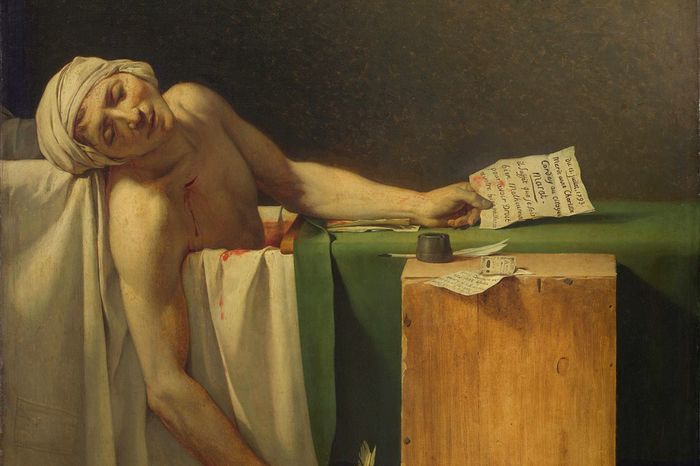
Post-punk duo Have a Nice Life chose a frame of ‘The Death of Marat’ by Jacques-Louis David as the cover of their debut album, titled ‘Deathconsciousness’. It deals with experimental synth sounds, delays, and distortions. It is interesting that, instead of experimenting with visuals too, they chose an 18th century artwork as the album cover. ‘The Death of Marat’ captures Marat’s dead body in a bloodbath after being assassinated by one of his political opponents, Charlotte Corday. Reframed into the context of the post-punk album, David’s piece becomes the manifesto of a contemporary and subtle pessimism. The band expresses itself in the guise of contemporary revolutionaries who, just like Marat, want to deconstruct their present but are destined to endure a terrible ending.
What connects the album to this artwork is the disillusionment given by the evidence of an ineluctable fate. On one hand, Marat’s revolutionary actions were stopped by his killer. A knife is on the ground, a charity transfer is in Marat’s hand, and nothing remains after the assassination but a soulless body, and what could have been of the revolutionary. On the other hand, the band is aware that their revolutionary velleity is destined to die, killed by its own inapplicability. In short, the juxtaposition of David’s artwork with the debut album ‘Deathconsciousness’ echoes the band’s discontent and decadentism. What may initially appear as a risky choice by Have a Nice Life turns out to be a brilliant way of highlighting their cynical perception of a current decline.
“In short, the juxtaposition of David’s artwork with the debut album ‘Deathconsciousness’ echoes the band’s discontent and decadentism”
In the same way, Jean-Michel Basquiat’s ‘Bird on Money’ is a perfect match for ‘The New Abnormal’ by The Strokes. In ‘Bird on Money’, Basquiat portrays the complexity of contemporary life, the hustle of the city, and the challenges that it brings. On Basquiat’s canvas, the rich and crowded composition, use of blues, yellows, greens, and whites, as well as the repetitive drawing patterns, could already stand by themselves. But, once again, when reframed through the Strokes’ album, the artwork conveys a message equally rich in meaning. Basquiat’s piece becomes a visual representation of the band’s opposition to contemporary shallowness. The band rejects what is ephemeral and superficial, and Basquiat’s canvas represents this well, bringing his figures back to the essential, but keeping them trapped in a crowded composition. The black drawings and the white doodles between the layers of the background suggest movement, action, and chaos. When associated with ‘The New Abnormal’, this also suggests confusion and vagueness. In a way, Basquiat’s attitude towards contemporary confusion and the city’s profligacy matches the band’s critique against vacuousness, which leads to a state of social uncertainty. As Casablancas sings in the song from the album, ‘The Adults are Talking’: “And now you don’t know how you could ever complain/Because you’re all confused.”
One last case comes from Rostam and Hamilton’s album ‘I Had a Dream That You Were Mine’, whose cover is a ‘Portrait of a Girl’, a photograph taken in 1955 by Bill Brandt, 61 years before their music project. The picture portrays a girl’s face in the foreground, looking in ecstasis at the roof of a spacious room. It is unlikely to guess who this girl is, what she is doing in that room, and whether that place is hers or someone else’s. Associated with the album ‘I had a dream that you were mine’, Bradt’s picture gives up its mysteriousness and dream-like content to draw a narrative suggested by Hamilton and Rostam’s songs. The girl portrayed by Bradt is not only the subject of his artwork, but also Hamilton and Rostam’s muse. By appearing on the cover, this girl lends a face to the ghost that haunts the narrative of the album, themed around old loves, ancient feelings, and coping with regret. Even though the photograph slightly changed in meaning when associated with the album, it remains connected to it through the aesthetics mentioned in the song. For instance, the black and white colours of the photograph are recalled in ‘A 1000 Times’, when they sing “The streets were bright / those ancient years were black and white”.
Considering the resonance of this phenomenon, how positively does it impact the art world? This is a remarkable occasion to bring older art back to life and to exhibit it to a broader audience. By becoming visuals of music projects, art pieces become available to people who are distant from art, and integrate nuances of meaning that resonate with a contemporary and evolving context. It is also true that using existing art takes opportunities from emerging artists, who provide new and compelling aesthetics as well as interesting experimentations. It is challenging to determine what the right attitude is, but what remains certain is that musicians have their own artistic license, and they are free to choose the visuals that represent them the most.
 Comment / The Cambridge drift1 June 2026
 Comment / Top of the slops: the competitiveness of college dining4 June 2026
 News / Cambridge psychologist warns against blanket social media ban for under-16s1 June 2026
 News / University support staff strikes end after month of action2 June 2026
 Music / We need to talk about Kendrick2 June 2026
- Comment / Top of the slops: the competitiveness of college dining4 June 2026
 Interviews / Bible Scholar Mattie Mae Motl: “God is a woman”4 June 2026
 Features / One big happy (college) family?4 June 2026
 Theatre / Bold beginnings in the Corpus Playroom 3 June 2026
- Music / We need to talk about Kendrick2 June 2026