
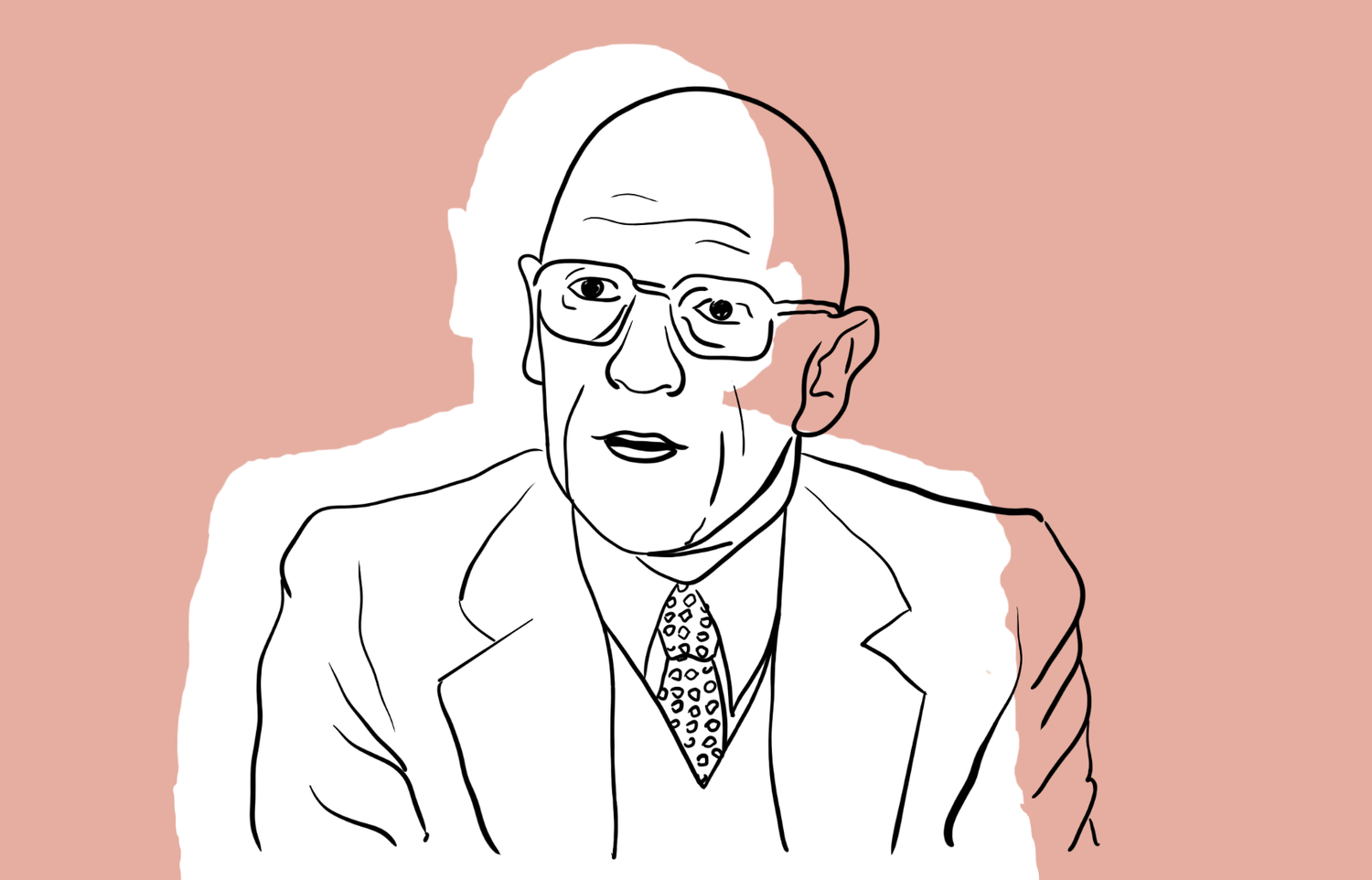
There is no critic in the world more cited than the Postmodernist Michel Foucault. Research suggests that the theorist has amassed 1.42 million citations on Google Scholar (2024), approximately 75% more than any other author in history (excluding the sciences). As Gage Greer put it in Medium magazine, this indicates that, “to this day, only The Bible has a greater impact than Foucault on shaping Western society and culture.” This figure is startling. But perhaps, at least to the average student studying the humanities, not entirely unsurprising.
Whether in the footnotes of academic articles or appearing as the topic of whole papers, within almost any piece of undergraduate or graduate research there comes a point in which his hard-to-pronounce name (remember to drop the ‘lt’) can be located. You may even encounter him at the most unlikely of times: signalled during smokers’ chat, pub trip catchups, or, even worse, at a Cambridge formal. But why does the seemingly unbreakable grip of Foucault’s obscurantist philosophy retain such a powerful hold over critical discussion and thought? Especially when most people are unlikely to even have read his incredibly hard to decipher theory. While I do not wish to limit the scope of anyone’s intellectual ambitions, I do think it is important to interrogate why we feel the need to continually reference Foucault to substantiate our insights, and perhaps why I feel we should sometimes push against this urge.
“Why does the seemingly unbreakable grip of Foucault’s obscurantist philosophy retain such a powerful hold over critical discussion and thought?”
Although he pre-emptively stirred intrigue among French intellectual circles in the late 1950s, it was the publication of Madness and Civilisation (1961) that helped to initially bring Foucault into prominence. In this book Foucault controversially challenged traditional narratives of progress in the field of psychiatry, arguing that “madness” was not a fixed, natural condition but a social and cultural construct. Through historical investigation, Foucault shows his readers that psychiatry should not be conceived as the culmination of the natural progression of “objective science”, but that it should instead be conceptualised as constructed from socio-cultural categories of “normal”, themselves constantly subject to flux according to power relations. These structures of power continually justify and reinstate themselves through a complex mix of internalisation, cultural discourse, and normalised social practices, with marginalisation or punishment for those who step out of line.
The critique presented in Madness and Civilisation establishes a prominent vein that runs throughout Foucault’s thought and helps towards an overall definition of the postmodern condition: namely, that the tools of knowledge and power are not strange bedfellows, but are very deeply intertwined. Foucault’s analysis later extended into prisons, sexuality, and our understanding of history, but this central premise remained prominent.
Despite producing an inventive framework through which authority and oppressive structures could be scrutinised, it is difficult to diagnose exactly why Foucault’s work seemed to rise to such prominence. His initial influence appears to coincide with the growing scepticism towards Marxism and traditional Enlightenment progressivism, sharing a disillusionment with the promises of freedom offered by political revolutions and ideological projects.
“Structures of power continually justify and reinstate themselves through a complex mix of internalisation, cultural discourse, and normalised social practices”
But there are also several elements of Foucault’s work that have made it ripe for adaptation and adoption beyond his lifetime. First, Foucault’s concepts moved beyond simplistic binaries of oppressor and oppressed to address the diffuse and decentralised nature of power in modern societies. Second is his interdisciplinary approach – as a product of philosophical, historical and sociological thinking, Foucault’s work resists neat disciplinary categorisation and provides portable utensils to question authority across fields. Third, Foucault has offered many enduring terms and metaphors (such as the ‘Foucauldian panopticon’) that have become intellectual shorthand, and have, consequently, engraved themselves in academic thinking. And lastly, his relevance in a political and cultural climate that questions categories of identity and subjectivity. His contention that identity classifications are constructed through power relations and cultural norms constitutes much of the theoretical backbone in arguments over gender studies, queer theory, postcolonialism, and Black studies.
At an individual level, I believe there are additional reasons why students and scholars are so quick to invoke Foucault’s legacy. His French heritage, which means even correctly pronouncing his name conveys a certain gravitas, carries a certain allure and status. There is also a deep and understandable gratification in coming to terms with a difficult text and adopting its complex voice in your own work. Additionally, I can see why Foucault’s anti-establishment stance resonates strongly within the Academy. The way in which his theory promises to draw away the curtain and challenge the status quo is one of those eye opening moments (if not a highly idealised quality of intellectual work). It makes sense that academics and students alike wish to inject and recreate that same kind of revelatory pleasure into their own insights.
However, being such a substantial figure that is wheeled out as an explanation for such a large array of topics, a certain self-ironising logic can be seen to play out. Foucault’s philosophy becomes too often referenced for academic showcasing; an obligatory footnote. His theory, applied at its most rudimentary and formulaic, leads to predictable conclusions about the oppressive relationship between knowledge and power. In this position, Foucault’s intellectual hegemony, which was designed to expose hidden normative standards, inadvertently becomes normative itself.
“The overuse of Foucault signals an intellectual posturing, that, when deployed lazily, alienates more than it illuminates”

This is a problem for all intellectual theories which become mobilised to demonstrate entry into the higher echelons of academic legitimacy, but perhaps a specifically pointed one for Foucault. By consistently deploying a philosophy which emphasises the power-knowledge nexus, the sense of empowerment and the possibility for resistance can also begin to fade. This is not only problematic when thought about in terms of theoretical practice: constantly adopting the same stance produces a certain critical fatigue by leading to the same foregone conclusions, but this is also significant in terms of worldly engagements. A decline in emotional engagement, order and structure can be seen as symptomatic of a society where the capacity for meaningful action and critique has been thoroughly diminished.
This is an even more worrying concern as the dynamic becomes increasingly exploited by right-wing critics. Social commentators from Curtis Yarvin to Charlie Kirk argue that postmodern analysis has become deeply institutionalised, marginalising alternative forms of discourse (specifically more conservative ones). While this critique may overstate the singular importance of Foucauldian theory in promoting a ‘liberal agenda’, I do think, the routinised – sometimes even casual – usage of Foucault can inadvertently calcify an intellectual rigidity that undermines the vitality of Foucault’s originally radical insights.
Ultimately, it is difficult to criticise such an all-encompassing philosophy, especially when the foundation behind the theory helps to support political categories of identity outside the gilded walls of academia. But the overuse of Foucault signals an intellectual posturing, that, when deployed lazily, alienates more than it illuminates. While Foucault’s pioneering critiques of power, knowledge, and subjectivity undeniably transformed critical thought, much of his work has now been heavily mined, extrapolated, and adapted. One should never invoke a critic for the safety of their insights but should use them to work against the grain, to riff against popular reception, and actively push towards discomfort. What else is university for?
