Fact-checking R.F. Kuang’s Katabasis
Shan Tan-Ya wonders how hellish the Cambridge PhD experience really is
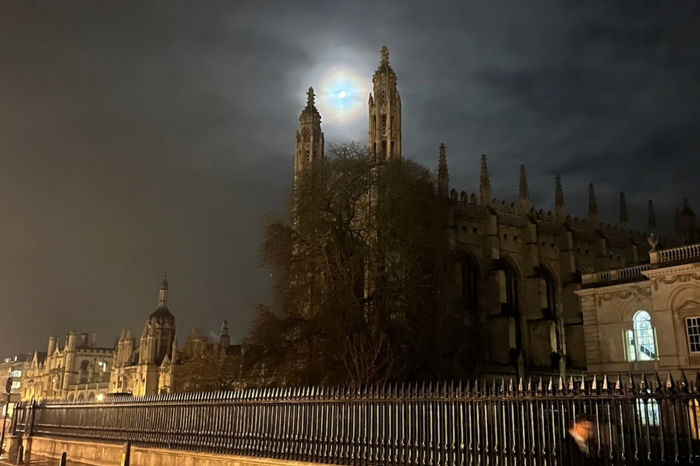
If you walked down Sidney Street last term, your gaze may have been caught by Waterstones’ gold-filled window display for R.F. Kuang’s latest novel, Katabasis, released last September. Any release by Kuang is a global literary event nowadays, but I was particularly predisposed to obsess over this one’s premise. Not only is it set in an alternate 1980s Cambridge University which teaches magic (sorry, ‘magick’), but it focuses on postgraduate study. As a fantasy-loving PhD student here, I am therefore both the target audience and straight-up target of the book’s critique of academia. As such, I have a unique opportunity to answer the question you’ve all been asking: how realistic is Katabasis’s depiction of PhD life at Cambridge?
“I am therefore both the target audience and straight-up target of the book’s critique”
Let’s start with the inciting incident of the novel: after the tragic death of their supervisor, two PhD students studying ‘analytic magick’ decide to journey to Hell to retrieve his soul, launching their descent into Kuang’s unique reimagining of the Underworld. The reason? So that they can graduate with prestigious Cambridge degrees in an increasingly competitive academic job market. So far, so relatable, especially compared to some other ‘dark academia’ works – whilst The Secret History is compelling, I simply didn’t have the bandwidth during my undergrad to be seduced by a glamorous pseudo-cult. Conversely, it’s my more mundane concerns as a graduate – money, time and career – which convince Katabasis’ protagonist, Alice, to resurrect her supervisor: “Her funding clock could not wait. Her progress review loomed at the end of the term […] She wanted the golden recommendation letter that opened every door.” Fair enough.
The second thing we learn about Alice is that she detests her fellow PhD student, Murdoch, feeling threatened by his success: “You’ve coauthored one paper. Murdoch has coauthored three. You’ve won a thousand pounds in funding. Murdoch’s won twice that.” Academia has an unhealthy reputation for encouraging petty jealousies, perhaps understandably so: universities concentrate a group of people who pride themselves on their intelligence, demand that they ‘publish or perish’ to survive years of short-term contracts and force them to compete for the same small pot of permanent positions. Since everyone knows everyone else in their discipline, it’s no wonder that rivalries sometimes become personal. Whilst a career in industry isn’t necessarily drama-free, delivering outcomes to shareholders tends to motivate efficient teamwork over achieving individual glory. Nonetheless, I will note that in my experience, early-career researchers are generally very supportive of one another; it takes years in the field to nurture these kinds of epic grudges.
“Discussion of potential abuse of power becomes a plot point”
Kuang’s most scathing criticism, however, is reserved for bad PhD supervisors. As boss, mentor and closest colleague wrapped up in one, a supervisor has huge influence over their student. Part of the book depicts how, if the relationship somehow breaks down, the resulting chilling effect can be devastating on an early-stage career. This discussion of potential abuse of power becomes a plot point. The protagonists must determine exactly which sins their supervisor was guilty of in life, in order to locate which circle of Hell his soul has been sent to in Death. Even without deliberate malice, the huge power imbalance means that supervisors may inadvertently make students’ lives difficult by being uncommunicative, overly domineering or simply indifferent. Most damningly, the book identifies an institutional willingness to overlook professors’ misbehaviours if they are valuable enough to the department, with one character excused as “a genius burdened with purpose, who couldn’t spare attention for the damage he left in his wake”. Nevertheless, there is some hope: today, colleges and departments offer several support routes to students encountering problems, including training courses on managing this relationship.
Finally, one major theme emerges more gradually in the novel: sexism within academia. Katabasis takes place just after all Cambridge colleges finally opened to women – but the students are keen to move on: “It was the waning days of second-wave feminism, and all the girls in Alice’s generation were so tired of being told they’d been born to be raped, oppressed, silenced.” Although Alice rejects being defined by her minority status, hypocritically dismissing older female professors as ’spousal hires’, she still faces discrimination and career-impacting gossip. This provides some interesting context for today. Whilst overt sexism may no longer be acceptable, barriers evidently remain – Cambridge admits roughly equal numbers of male and female students to postgraduate courses, yet only 27% of its professors are women, lower than both sector and Russell Group benchmarks.
Minus the demons, ghosts and incantations, I recognise many elements of the Cambridge that Katabasis presents. I recommend it to anyone considering postgraduate study – it’s a smart use of fantasy as satire, an entertaining read, and it may even provide some guidance for your own descent!
 Comment / The Cambridge drift1 June 2026
 Comment / Top of the slops: the competitiveness of college dining4 June 2026
 News / Cambridge psychologist warns against blanket social media ban for under-16s1 June 2026
 News / University support staff strikes end after month of action2 June 2026
 Music / We need to talk about Kendrick2 June 2026
- Comment / Top of the slops: the competitiveness of college dining4 June 2026
 Interviews / Bible Scholar Mattie Mae Motl: “God is a woman”4 June 2026
 Features / One big happy (college) family?4 June 2026
 Theatre / Bold beginnings in the Corpus Playroom 3 June 2026
- Music / We need to talk about Kendrick2 June 2026