Benita Kevill-Davies at Clare Hall
Greg Quinn considers Blake’s poetry alongside Benita Kevill-Davies’ paintings
“What immortal hand or eye,
Could frame thy fearful symmetry?”
(William Blake, ‘The Tyger’)
At the beginning of the exhibition, Benita Kevill-Davies, the artist whose work was on display, mentioned William Blake to me before being pulled away. She had procured an art book of his, saying she could recite some of them, especially ‘The Tyger’. Blake as an artist, she noted reasonably, seemed disappointing considering his towering figure as a poet. The poem she quotes is concerned with art and literature in parallel, its fetishising exoticism of the ‘tyger’ is combined with a doleful worship of the speaker’s inability to represent it.
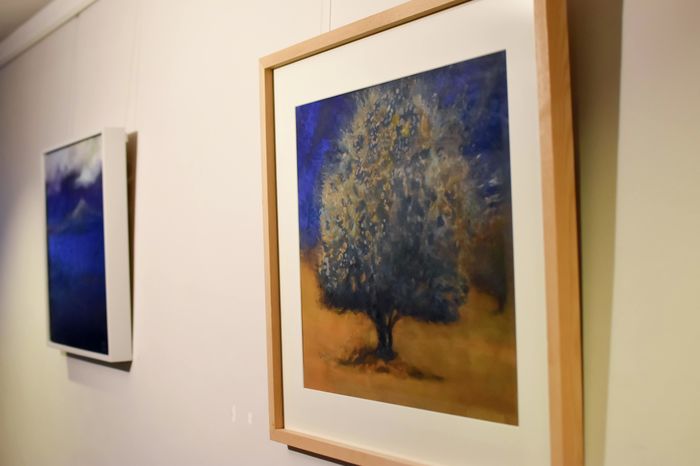
Kevill-Davies seemed to echo Blake’s sentiment through her work, drawing inspiration from the Bible in Exodus or when Zacchaeus climbs the tree to see Jesus speak or from John Donne posing in a burial shroud. Who could frame these images? Kevill-Davies’ work resounded with a practically artistic answer to this question, Zacchaeus is on a low, obvious branch as opposed to high up because of the compositional requirement. Jesus is only quietly distinct in the crowd. Imagination and observation work together, but as Kevill-Davies comments in the programme, “both are involved”. In essence no one can frame these images for anyone to see, but as Professor Frances Spalding (chair of the Clare Hall art committee) notes, “these initially strange paintings gradually get under your skin”.
“There is a symmetry to this work as it reworks itself”
As the exhibition progressed, I thought about the phrase “fearful symmetry” from Blake’s poem. There was certainly a fear in Kevill-Davies’ work, she noted that she wasn’t slick or as good as Cezanne. Slick is a term artists use for fast, fearless in a sense, willing to be quick. She assured me she wasn’t; she said that while any artist competes with the beauty of the natural world, ‘hard art’ can only compete with the human made, the urban. There was a distinct sense in which Kevill-Davies’ work, focusing on a child with a sling or calling the painting of Zacchaeus ‘A small man may learn to climb’, was reaching towards an equity for the weak rather than trying to compete with anything.
Again, she notes that her thinking is somewhat “biblical” in the programme and one is distinctly aware of this biblical David and Goliath sort of justice in her work. There is even a childlike justice to it where the little figure rises up; the weak overcome some larger status quo as we might note Kevill-Davies’ adaptation of a young Jesus speaking to church elders, ‘Child shows his fossil to the Elders in the Temple’. This extends past the Bible to something common in the exhibition where Kevill-Davies reworks her own painting, as she does when she depicts a modern print of the same title, ‘Child shows his fossil to the Elders in the Temple’, but with men in bowler hats as opposed to religious robes. There is a symmetry to this work as it reworks itself. The titling itself has a levity that the paintings reflect.
“Harking back to Blake’s concern with an “immortal hand or eye”, the art is both restless and a form of rest”
These are hard paintings, “fearful” even, but some barrows (burial mounds) stand out jutting over a horizon. The pre-biblical resounds in these ancient burials in prints with carborundum as part of a variable series where Keville-Davies alters a single barrow on a horizon. The barrow is earth and an indistinct form on the horizon, yet it has a distinct poignancy as a record of a specifically human death. Kevill-Davies took me aback when she said they were easy, and that easy work is important for an artist. It then seemed important for a viewer too. There was no ostentation with the barrows; they were easy without mocking some sense of primitivism. Like Blake’s works, they are crafted with a mortal eye and don’t seem to mind.
Kevill-Davies commented that she does the organisation of colour, but the subject is done to her. In a more modern context, it is the waiting men: refugees waiting for paperwork in camps, men gathering outside pubs, and general loitering. The indistinct figures seen from a raised perspective are faceless; there are boys on a corner, people under tarpaulin, and men on park benches. Stagnant, unknown figures; only ever men or boys sitting or standing about. These works resonated particularly with Kevill-Davies’ piece inspired by graffiti from a shuttered building in Bristol in the 1970s. In this, words across shutters read “Foxes have holes and the birds of the air have nests, but the son of man has nowhere to lay his head.” Harking back to Blake’s concern with an “immortal hand or eye”, the art is both restless and a form of rest.
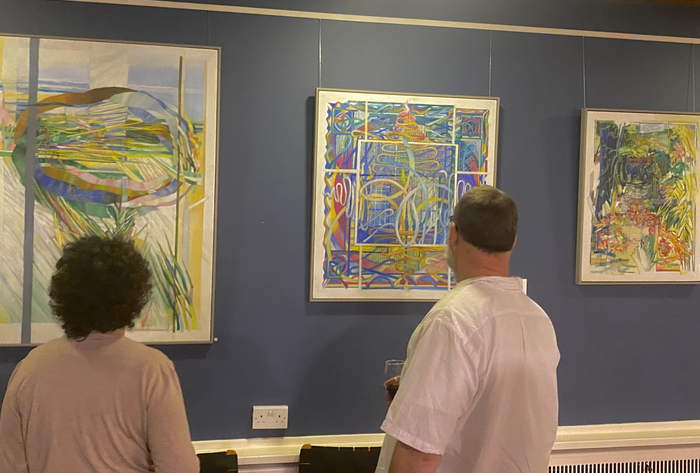
In Must We Mean What We Say? , Stanley Cavell writes of a work of art that: “It is not, as in the case of ordinary material objects, that I know because I see, or that seeing is how I know… what I know is what I see; or even: seeing feels like knowing.” Seeing these pictures feels like knowing. Experiencing this exhibition in the fragmented space of a common room rather than an exhibition room feels like you can get to know the paintings. Kevill-Davies’ greatest fear for the exhibition is indifference.
 Comment / The Cambridge drift1 June 2026
 Comment / Top of the slops: the competitiveness of college dining4 June 2026
 News / Cambridge psychologist warns against blanket social media ban for under-16s1 June 2026
 News / University support staff strikes end after month of action2 June 2026
 Music / We need to talk about Kendrick2 June 2026
- Comment / Top of the slops: the competitiveness of college dining4 June 2026
 Interviews / Bible Scholar Mattie Mae Motl: “God is a woman”4 June 2026
 Features / One big happy (college) family?4 June 2026
 Theatre / Bold beginnings in the Corpus Playroom 3 June 2026
- Music / We need to talk about Kendrick2 June 2026