A beginner’s guide to Ancient Greek tragedy
Having waded through 30 tragedies, Ella Howard summarises the good, the bad, and the forgettable
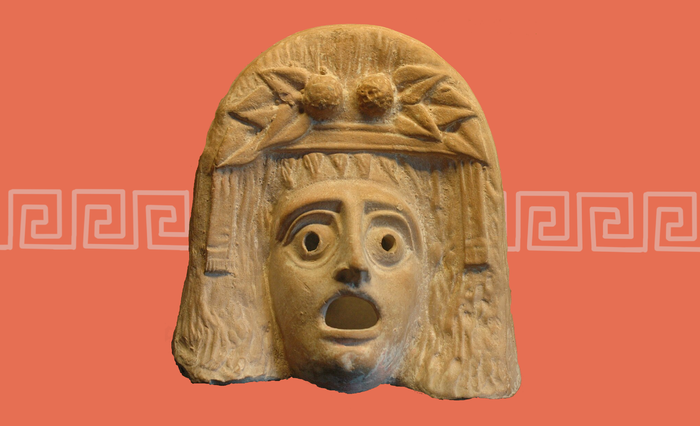
‘Evil cannot be cured by other evil’, writes Sophocles in Ajax. However, having just completed the mountainous task of reading every Ancient Greek play for my final year tragedy paper, I, like Ajax, have been left with a terrible compulsion to share. Luckily, instead of evil, I have decided to pass on knowledge. So, here is my beginner’s guide to the twisted yet fascinating world of Ancient Greek tragedy.
The important context
Performed in the annual Dionysia festivals, tragic drama was a central tradition of Ancient Greece, a method of both entertainment and religious worship. Equally important was competition, for at the Dionysia, playwrights would be judged on a submission of their work – comprising three tragedies and one more comedic satyr play.
Born around 525 B.C., Aeschylus is the oldest of the big three tragedians, credited with the introduction of a second actor on stage and known for his more archaic, sparser style. He is most famous for the Oresteia, which is the sole existing original trilogy. Next was Sophocles, who was the most prolific winner of the Dionysia, earning success over twenty times – more than the other two combined. His masterpiece Oedipus Rex continues to shape modern culture, and has inspired writers from Sigmund Freud to Haruki Murakami.
“These plays do not aim to simply depress, but to teach”
While the ancient critic Aristotle may claim that true tragedy lies not in character but in plot, it is the idiosyncratic individual that shines in the work of Euripides. The youngest of the three playwrights (and my personal favourite), he was an innovator, known for his piercing psychological insight and inclusion of a third speaking actor.
The plays themselves are formed of a chorus and up to three actors (always male). The chorus serves as both narrator and character, adding a now lost musicality to the drama through song. Beyond the undeniable spectacle of bloodshed and betrayal, there also lies a didactic undertone beneath Ancient Greek tragedy: these plays do not aim to simply depress, but to teach. Consider, therefore, how deterministic the events feel – could the horror have been averted, or was it predestined by the Gods? If ever in doubt as to the play’s message, then it is worth rereading the final few lines, as often the playwright includes a neat little summary of their lesson.
Where to start
For those wanting to test the water with just one play, then you cannot get more quintessentially tragic than Euripides’s Bacchae. This truly gruesome story is filled to the brim with crazed women, foolish kings and spiteful Gods – all the great hallmarks of an Ancient Greek tragedy.
If you’re looking for some general knowledge for the next pub quiz, then you can’t go wrong with perhaps the most famous – and most horrific – of all Greek drama: Sophocles’s Theban Plays. Starting with Oedipus Rex, the trilogy is a saga of relentless destruction, beginning with the futile attempt of a king blindly trying to escape the cruelty of his fate. At once abhorrent and heart-wrenchingly beautiful, they are certainly not for weak-stomached, featuring acts of murder, suicide, and incest. For me, Antigone is the most compelling, and if you had to skip one, then I would suggest Oedipus at Colonus for, admittedly, it can be a bit dull.
“For those wanting to test the water with just one play, then you cannot get more quintessentially tragic than Euripides’s Bacchae”
If you enjoyed Antigone and want to continue with the complex psychology of tragic women, then I have to recommend my all-time favourite: Medea by Euripides. Unflinching in its cold brutality, this play leaves no mercy as we watch a mother commit the unspeakable taboo of murdering her own children. Beyond the obvious horror of infanticide, what lends the play such awful emotion is the rare absence of fate; unlike the blind Oedipus, Medea is not compelled to act by forces beyond her control, but instead kills by her own volition, driven by rage and betrayal. Yet, what is most brilliant about Euripides is that, somehow, you will still feel sympathy for her.
Greek playwrights loved to tread, and re-tread, the same old ground, so the same myth can be found throughout the corpus of ancient drama, for example the Oresteia trilogy of Aeschylus that was retold in the Electra of Sophocles, and yet again in the (somewhat unoriginally named) Electra of Euripides. While it may seem boring for some to read the same story over and over again, comparing the different portrayals of Elektra and Clytemnestra can create a surprisingly interesting game of spot-the-difference. Is Clytemnestra an empowered revenger, or a villainous adulterer? Can Elektra ever be justified in the murder of her own mother?
What to Avoid
If there’s anything I have learned reading over 30 plays this term, then it’s that although Aeschylus, Sophocles, and Euripides are certainly among the best writers ever known, not every one of their works is a masterpiece – some in fact, I found to be the opposite entirely. Admittedly, each has their own scholarly worth, but based on pure enjoyment, here are my suggestions of which to leave dusty on the shelf.
In my eyes, there is no worse crime for a tragedy than being forgettable, and I am sorry to say that Euripides is a repeat offender: his Andromache, Children of Heracles, Suppliant Women and Ion all fall guilty of leaving no lingering impression on my mind; far from pity or fear, all I was left with was boredom. However, the playwright must be granted some leniency for the sheer volume of his work in relation to the others, for among 17 plays, there are bound to be a few slow moments.

When it comes to Aeschylus, I would place The Suppliants among the weakest, and Sophocles is unfortunately let down by Philoctetes and The Women of Trachis. For those looking to leave the beaten path, then try the lesser-read Iphigenia in Tauris instead.
So, rather than doom-scrolling through the endless tragedies of the modern-age, I suggest a change of era, for believe it or not, there is an odd comfort to be found in the bloody, merciless world of Ancient Greece.
 Comment / The Cambridge drift1 June 2026
 Comment / Top of the slops: the competitiveness of college dining4 June 2026
 News / Cambridge psychologist warns against blanket social media ban for under-16s1 June 2026
 News / University support staff strikes end after month of action2 June 2026
 Music / We need to talk about Kendrick2 June 2026
- Comment / Top of the slops: the competitiveness of college dining4 June 2026
 Interviews / Bible Scholar Mattie Mae Motl: “God is a woman”4 June 2026
 Features / One big happy (college) family?4 June 2026
 Theatre / Bold beginnings in the Corpus Playroom 3 June 2026
- Music / We need to talk about Kendrick2 June 2026