The Memory of Water is dazzlingly well done
Catherine Wray praises this play’s stunning performances and compelling motifs
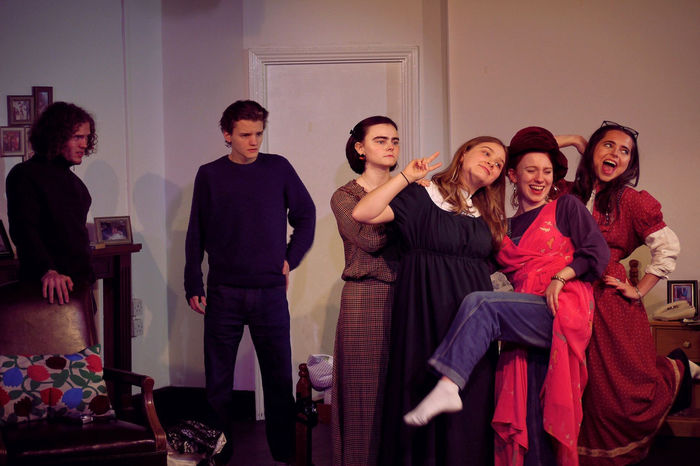
The Memory of Water opens with a rare happy childhood memory for the play’s three sisters as they clamour to be in the middle of the photo their mother Vi is taking. The lights fade to black and this scene is replaced with the play’s true storyline: Mary, Teresa, and Catherine return to their childhood home for Vi’s funeral, attempting to disentangle their conflicting memories of both her and their upbringing.
The costume choices subtly demarcate the sisters: Catherine, the youngest, is in a purple top and dungarees with one strap loosened at her back. Mary is in a top and jeans, while Teresa, who has come straight from her business venture, wears a uniform white shirt and black trousers. I did feel the male characters could have been slightly more distinct from one another visually or behaviourally, as they did blur together somewhat, though perhaps this was deliberate.
“All three actresses playing the sisters are excellent, consistently embodying their characters through impressive vocal control and mannerisms”
All three actresses playing the sisters are excellent, consistently embodying their characters through impressive vocal control and mannerisms. Scarlett Coburn as Mary delivers a compelling performance as an exhausted, cynical, and ultimately vulnerable high-achieving woman who slowly realises she cannot suppress buried memories forever. In an early scene, she responds indignantly when Catherine claims their mother didn’t like her, saying that she had a lovely childhood with memories of trips to the beach and bike rides. Catherine retorts that they left her at the beach – at which point Teresa jumps in, laughing, to correct her and say it was in fact Mary they left at the beach “with the tide coming in”. Equally, May Daws is a phenomenal Teresa. Her resentment over being forced into the role of the responsible sister is both touching and at times troubling, such as when she reveals Mary’s adolescent secret (a pregnancy their mother covered up) to the male characters in front of Mary. Her range is on full display as she pivots from laughter to pragmatism to a buried tenderness, often indulging in the same posture of superiority she accuses Mary of.
Finally, Gaby Albertelli’s Catherine is charismatic and infuriating, flamboyant but fragile, and always in search of more attention and energy than those around her are willing to give. I appreciated the excruciating silences and pauses she delivered while on the phone with Xavier, her disappointing Spanish beau whose name no one in the house seems willing to remember, and her bluntness when she says about her mother: “I didn’t like her,” rupturing the quintessentially English rule of never speaking ill of the dead.
I also appreciated the naturalistic, understated performances of both Marcus Smith as Mike, Mary’s married lover with a sick wife, and Davey Chataway as Frank, Teresa’s sensible and resentful husband. Their witty one-liners brought humour and conflict into the play, while they at times create tension by appearing a bit too practical given the circumstances: in one scene, Frank is sat with his arm draped around Teresa, who asks him directly: “You’re not having an affair, are you? And if you were, you would tell me, wouldn’t you?” Frank replies, after denying the first allegation: “Well I thought the whole point of an affair is that you don’t.” Teresa is touching in her way as she stands up for Mary, piling into Mike when he says he doesn’t plan to leave his wife because (in those famous last words): “It’s very complicated.” She replies with an acerbic “how convenient” before she eventually leaves Mary and Mike alone.
“The dual motifs of memory and water course through the play and are upheld by at once moving, unsettling, and humorous performances by the stellar cast and crew”
This brief scene hints at a blossoming solidarity between the sisters, best expressed by their laughter as they play dress-up with their mother’s clothes, re-enacting the opening picture scene with glee, now in their mothers’ dresses rather than their childhood dressing gowns. Here, the costume design is subtly skillful, with these colourful dresses contrasting vividly with the beige, matronly dress the mother wears. Fianaid Neil is also brilliant as Vi in her terse flashback scenes with Mary, with her clipped voice and physicality lending themselves beautifully to the tension in the narrative. There were moments where their tension reminded me of Greta Gerwig’s Ladybird (2017), with the implosive tension between a mother who wants a better life for her daughter and a daughter who wants a better nurturer for her mother.
The dual motifs of memory and water course through the play and are upheld by at once moving, unsettling, and humorous performances by the stellar cast and crew. The audience was often chuckling along to the three sisters’ well-delivered barbs, while the scene of Mary discovering the truth about her son left everyone in a state of subdued silence.

A breakout performance for every member of this small but stellar cast, The Memory of Water was very evidently a labour of love. These performances, paired with a stripped-back set, create a claustrophobic basin of black humour and grief. The cast and crew should be commended for setting the Corpus playroom aglow with this first-rate production.
 Interviews / ‘You have to take it as it comes’: discussing content creation with Auden Barnes17 May 2026
 News / Science Park to ‘triple’ in size with £3bn investment21 May 2026
 News / Sons of imprisoned Saudi scholars urge Cambridge to call off deal with Saudi defence ministry22 May 2026
 Science / Forked over: dish-parity between college cafeterias17 May 2026
 Theatre / Crossing Points devastates the Corpus Playroom20 May 2026
 Sport / Fitzwilliam narrowly regain Cuppers trophy in tight affair with Selwyn22 May 2026
 Comment / The personal cost of reporting sexual violence at Cambridge22 May 2026
- News / Sons of imprisoned Saudi scholars urge Cambridge to call off deal with Saudi defence ministry22 May 2026
 Science / CamGraPhIC’s crusade to curb the AI energy crisis22 May 2026
 Film & TV / Hokum and the horror of guilt21 May 2026