The Great Gatsby is an enthralling spectacle
Ella Hardy argues that this production captures the glittering excess of the Jazz Age
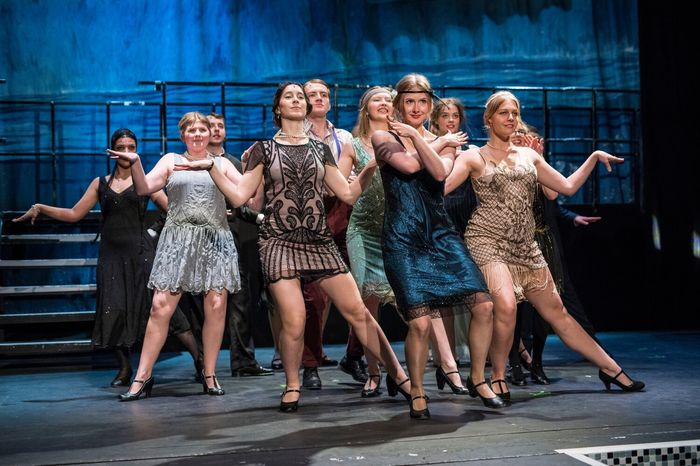
The lights go up, washing the stage in blue twilight against the backdrop of a milky impression of the Long Island Sound. Dr Eckleburg’s unforgiving eyes hold our own, but before we can contemplate what they might mean, we are swept into a flurry of feathers and sparkle. An ensemble of flappers take to the stage to perform the first of several flamboyant musical numbers. The party has begun.
Nick Carraway, played by Nick Danby, enters solemn and solitary, representative of his disconnect from this world of superficial exuberance. We hear the first of several monologues, containing lines lifted directly from the novel. The play is a journey; we travel at a rapid pace with Nick through the whirlwind of Jazz Age New York, seamless transitions carrying us from one bright place to another. Danby’s monologues are crystalline in their capturing of Nick’s exasperation and struggle to understand the egocentric, money-obsessed world he has stumbled into. The final monologue is a triumphant emotional crescendo in his character trajectory.
“Thomas Gladstone’s Wolfsheim is hysterical, and the McKees (Jacob Coughlan and Flossie Bullion) are utterly ostentatious”
Felix Warren plays a haughty and supercilious Tom, constantly roaming around the outskirts of the living room with a self-determined desire to dominate. Mia Lomer brings a light and airy energy to Daisy, bubbling with girlish naivety. She stands with one foot rolled on its side, perhaps symbolising her lack of stability and indecisiveness. Meanwhile, Mina Strevens as Jordan is suave, collected and stylish. I particularly enjoyed the retelling of Daisy’s girlhood and marriage to Tom; the use of Jordan’s narration alongside physical storytelling called to mind Gatsby’s desire to repeat the past as a beautiful, intimate portrayal of life before the play’s present world.
The production’s minor characters beautifully capture the eccentricity of the Jazz Age. Thomas Gladstone’s Wolfsheim is hysterical, and the McKees (Jacob Coughlan and Flossie Bullion) are utterly ostentatious. The Wilsons are a stunning duo, Michael Mundove in particular is extremely compelling, portraying George with a heart-breaking humility by stooping as if physically belittled by Tom’s brashness. His derailment following Myrtle’s death is one of the most striking moments of the play, as George breaks apart under the weight of the social system which has oppressed him his entire life. Violette Chereau as Myrtle is unfalteringly lascivious and overtly sexual, which I deem a perfect portrayal of her character.
“The lighting gives the stage an otherworldly feel, fading dreamily through hues of blue, green and pink”
Later in the first act, our eponymous hero reveals himself through Nick’s comical misunderstanding. Eddie Luchmun’s Gatsby is a charming gentleman and a wistful dreamer, speaking in a husky, contemplative tone which alludes to his interior complexity. Director Tally Arundell gives her cast freedom to breathe a new life into these characters, and I reiterate that the cast should be commended for their skill in embodying the essence of the iconic literary figures they are portraying.
I would have liked to have seen a little more nuance in these complex characters; Daisy’s whimsicality and obnoxious obsession for wealth could be taken even further. Warren’s booming explosion in the hotel-suite is utterly captivating, adding more vocal intensity in earlier scenes could make his performance even more powerful. Luchmun is wonderful to watch: he captures the wistfulness and romantic, dreaming nature intrinsic to Gatsby whilst moments of awkwardness, such as in the tea-party scene, render his character foolishly loveable. Yet undeniably, whilst Gatsby is about love, it is also about superficiality. Therefore, I would have liked to have seen more fragility and anxiety in Luchmun’s character regarding Gatsby’s suspiciously-acquired wealth. Again, the shirt scene stood out to me as a moment where this could be explored, rather than focusing solely on the amorous reunion of Daisy and Gatsby.
The visual spectacle of the show certainly does not disappoint. The lighting gives the stage an otherworldly feel, fading dreamily through hues of blue, green and pink. Music punctuates the world of the play – Piaf’s ‘La Vie en Rose’ interlaces a quality of softness among bold blasts of vivacious jazz music. The ADC theatre is used extremely creatively: the audience turns eagerly to the aisles as characters parade through this space, blurring the boundaries between stage-world and real-world. My favourite example of this was Nick saying “they’re a rotten crowd” to Gatsby, which made the distance between them – and Gatsby’s fatal isolation – tangible and poignantly heartbreaking.
Gatsby is an incredibly innovative, emotionally poignant and thought-provoking production, pertinent even now in its call for an undying hope.
 Comment / The Cambridge drift1 June 2026
 Comment / Top of the slops: the competitiveness of college dining4 June 2026
 News / Cambridge psychologist warns against blanket social media ban for under-16s1 June 2026
 News / University support staff strikes end after month of action2 June 2026
 Music / We need to talk about Kendrick2 June 2026
- Comment / Top of the slops: the competitiveness of college dining4 June 2026
 Interviews / Bible Scholar Mattie Mae Motl: “God is a woman”4 June 2026
 Features / One big happy (college) family?4 June 2026
 Theatre / Bold beginnings in the Corpus Playroom 3 June 2026
- Music / We need to talk about Kendrick2 June 2026