A look behind the spotlight
Nabiha Ali reflects on her experience as a followspot operator in last term’s magical panto, Jack and the Beanstalk

Huddled within the bubble of my followspot-platform, I can’t help but smile at the crowd undulating below me. If they only looked up, they’d be able to catch a glimpse of the iconic black contraptions above their heads, and behind them, half-obscured, a pair of squinting followspot operators. ‘Nest’ seems the best way to describe this platform. Crouched there in my headset, bathed in the purply-blue light and with the ceiling precariously close to my head, I feel almost caterpillar-ish; the enclosing walls cocoon me. This evening’s audience has come to watch Jack and The Beanstalk. Gazing at the swaying beanstalk below me, I am reminded of the outdoors, a breathtaking expanse which can’t yet be envisioned.
Locating the followspot platform is an adventure in itself. It involves following the panto’s lighting director, as he shimmies up a ladder (not the best option for anyone afraid of heights). As I poke my head through the ceiling, I find myself facing a tiny door, which reveals an open room, criss-crossed over with wooden frames. This is the catwalk walkway, though it looks more like a construction site than a glamorous auditorium. From here, I scale down yet another ladder into the sacred darkness of the followspot platform. Claustrophobia aside, this seems the ideal spot for a film night and, as I twizzle my followspot about, trying to get a feel of it, I can’t help but think wistfully of candyfloss and popcorn.
“Locating the followspot platform is an adventure in itself”
But for this show, I was a follow-spot operator (a fact which, weeks later, I still delight in mentioning to anyone, even if they haven’t the foggiest idea of what I’m on about) and, rather than sit back and watch the panto, I must contribute a small but integral part to it. I had around an hour before the audience files in, which I spent in equally productive segments: paranoid consultation of the script, rotating my follow-spot around in bizarre, dizzying circles, and constantly shifting position in order to get comfortable – which, as I later discovered, is impossible as a follow-spot operator, being wedged in so tight against the contraption itself. I eventually settled for knees tucked up against the body, though even this requires some adjustment every half an hour or so.
You may be wondering what a follow-spot operator, or indeed, a follow-spot is. Those of you who’ve been to see a panto might recall the burst of light following the actor about the stage. That’s a follow-spot beam. And the thing making that circle of light? That’s the follow-spot. And the thing making that move in perfect cohesion with the actor’s every movement? That’s the follow-spot operator (thank you, thank you).
“Once you’re up there, surveying the follow-spot itself is enlightening. The stage becomes merely a black dice, as cool white spots glide over it”
Although we don’t always get it spot-on every time. Stage directions such as “(cue 356) Not lighting anyone do not worry follow-spot stays there” can suddenly seem like a sliver of morse code, particularly when you’ve grown so accustomed to following someone around like a shadow for about an hour. I remember, like a sardine caught in a fishing net, tossing my follow-spot around blindly, only to find it centimetres away from where it should have been. “Close enough,” I hear the lighting director mutter. Another time, my follow-spot failed to light altogether, during which the ‘Evil Bean Merchant’ topples into the inky blackness of a trapdoor, presumably hell, rather than being illuminated by my follow-spot. Oddly enough, I found the effect rather fitting.
Once you’re up there, surveying the follow-spot itself is enlightening. The stage becomes merely a black dice, as cool white spots glide over it. Aside from the bird’s-eye-view of the theatre, plus the impending sense of falling to my very embarrassing death, perhaps what I loved most about being a follow-spot was how I was able to catch snippets of conversation backstage, as if in dialogue with the panto itself. This was one of the most rewarding parts of being backstage – from the awkward silence after Jack’s despairing “what shall I do?” followed by the remark, “does this audience know it’s a panto?” to echoes of “well done, guys” from all ends of the theatre as the panto drew to a close.
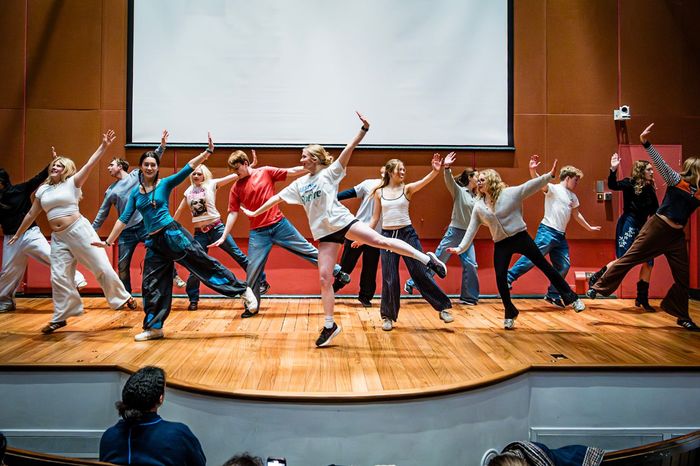
Backstage involvement proves itself not only fulfilling on a personal scale, but a wondrous celebration of the people that make theatre the sublime phenomenon it is. Next time you’re at a theatre somewhere, stop for a moment. Look up. Follow the follow-spot. Like me, you might just find yourself drawn.
 Interviews / ‘You have to take it as it comes’: discussing content creation with Auden Barnes17 May 2026
 News / Science Park to ‘triple’ in size with £3bn investment21 May 2026
 News / Sons of imprisoned Saudi scholars urge Cambridge to call off deal with Saudi defence ministry22 May 2026
 Science / Forked over: dish-parity between college cafeterias17 May 2026
 Theatre / Crossing Points devastates the Corpus Playroom20 May 2026
 Sport / Fitzwilliam narrowly regain Cuppers trophy in tight affair with Selwyn22 May 2026
 Comment / The personal cost of reporting sexual violence at Cambridge22 May 2026
- News / Sons of imprisoned Saudi scholars urge Cambridge to call off deal with Saudi defence ministry22 May 2026
 Science / CamGraPhIC’s crusade to curb the AI energy crisis22 May 2026
 Film & TV / Hokum and the horror of guilt21 May 2026