Stags and Hens (The Remix): A look behind the wedding veil
On the eve of the big night, the second show of their run at The Corpus Playroom, Eleanor Baldwin speaks with the show’s director

Step into the boozy chaos of Willy Russell’s updated classic, Stags and Hens (The Remix), set in the 1970s and playing this week at the Corpus Playroom. As they prepare to take the stage for their second night, I speak with the play’s director, Francesca Morgan. First, a brief plot summary. On the eve of their wedding, Dave and Linda, unbeknownst to each other, choose the same Liverpool club to host their stag and hen parties. Set primarily in the tacky club’s cramped loos, the play thrives in this claustrophobic space, where tensions quickly spill over and both parties must navigate the pressures of their realities. The Remix version heightens the pace of Russell’s original, pulling the audience directly into the space as the characters’ deepest truths are drawn out over drinks, gossip, and one night of rowdy realism.
“I think one of the most interesting things about the play is the way it explores friendships between men and friendships between women”
Opening with the question “What drew you to this show as a director?“, Francesca responds with the familiar desire to “be involved in a show that reflects a world I recognise”. Russell’s play is most renowned for its compelling commentary on the gritty realities of working-class life, as well as the fragility of young love. These themes reach out intimately to his audience, portraying the “people we know and love” through episodic moments we can relate to. Later, Francesca adds: “Nothing feels more like home than Willy Russell.” Our main protagonist is Linda, the bride-to-be. Her bold, feisty personality is tensely contrasted by the “less than likeable” Eddy, our main antagonist and the wedding’s best man. Then, we have the rest of the hen party: Bernadette, the mother hen; Maureen, the one who always cries on a night out; Carol, the work colleague who can’t read the room, and Frances, who always sticks up for Linda. Making up the stag-do, we have Eddy; Billy, endearingly out of the loop; Robbie, who believes he’s God’s gift to women, and Kav, who is good at drawing (this is textually relevant I promise). Finally, we have the husband-to-be, Dave, who remains off-stage for the better part of the play.
Across a night of rowdy humour, overlapping tensions, and fraught emotional dynamics, Francesca tells me that the theme which feels most central to her is friendship. “It might sound trite,” she says, “but I think one of the most interesting things about the play is the way it explores friendships between men and friendships between women.” Loyalty runs as a distinct thread through the stag-do scenes, particularly as the dynamic among the men becomes increasingly tense. This is neatly juxtaposed by the “light-hearted and fun atmosphere,” as Francesca describes, of the hen-party. The question is: how then do these dynamics overlap when both parties begin to mix?
“All I hope is that I see more and more Northern working-class stories being told in the Cambridge theatre scene”
Fundamental to this play is Russell’s exploration of working-class identity. It is refreshing to hear how the production is not heavy-handed with its treatment of this theme. Rather, as Francesca notes, “it doesn’t set out to deal with class as a theme so much as to tell a working-class story about working-class characters.” Linda, for instance, is caught between her desire to leave and the implications this choice holds for her identity as a working-class woman. Francesca discusses the challenge of articulating this, considering how “not to diminish the worth of working-class life as it already exists” while acknowledging the opportunities it can’t necessarily provide. Eddy and Linda emblematise this complexity, both dissatisfied with where they are; their taut interactions epitomise the emotional tug-of-war that defines this play. Overall, this makes for an intense and emotionally charged atmosphere, one which will no doubt be emphasised by the intimate space of The Corpus Playroom.
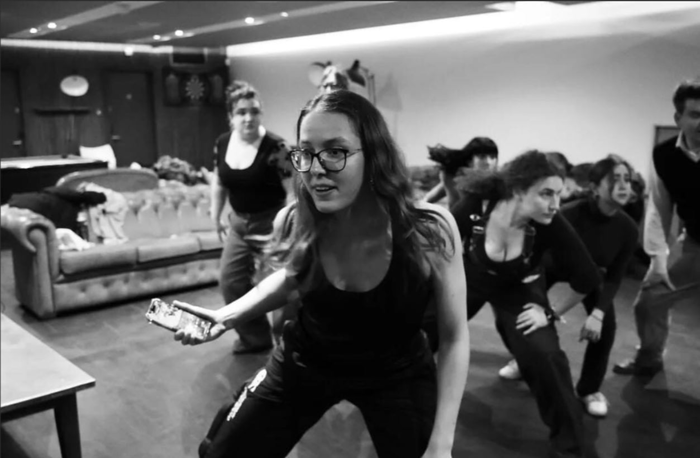
With such a fast-paced show, Francesca talks about the intense but rewarding rehearsal process, undeniably a testament to the dedicated work of a talented crew and cast. My final question: “What do you hope audiences take away from the show?” is met with a resolute answer: “All I hope is that I see more and more Northern working-class stories being told in the Cambridge theatre scene.”
Stags and Hens (The Remix) is running at the Corpus Playroom until Saturday 7th February (7pm).
 Interviews / ‘You have to take it as it comes’: discussing content creation with Auden Barnes17 May 2026
 News / Science Park to ‘triple’ in size with £3bn investment21 May 2026
 News / Sons of imprisoned Saudi scholars urge Cambridge to call off deal with Saudi defence ministry22 May 2026
 Science / Forked over: dish-parity between college cafeterias17 May 2026
 Theatre / Crossing Points devastates the Corpus Playroom20 May 2026
 Sport / Fitzwilliam narrowly regain Cuppers trophy in tight affair with Selwyn22 May 2026
 Comment / The personal cost of reporting sexual violence at Cambridge22 May 2026
- News / Sons of imprisoned Saudi scholars urge Cambridge to call off deal with Saudi defence ministry22 May 2026
 Science / CamGraPhIC’s crusade to curb the AI energy crisis22 May 2026
 Film & TV / Hokum and the horror of guilt21 May 2026