How to really deal with stage fright
Barney Sayburn questions the platitudes offered to nervous actors and provides some functional advice

When an actor experiences pre-performance nerves for the first time, the feeling compounds itself. “Why am I nervous? Is it because my performance is bad? Is the play bad? I must stop feeling this way. But the more I tell myself I must stop feeling this way, the more I feel this way. Now my performance will be even worse! I should run out of the green room and into a local café and throw my phone into a bin and wait until it’s all over.”
Yet soon all is settled. A parent, co-star or close confidante suggests that “it’s perfectly natural to be nervous before a show; it happens to every great actor.” That actor begins to see the feelings they’d perceived as a weakness are a strength. The thought even sparks in their mind; “Does that mean I could be *gasp* great?” Eventually they go onstage, and are inevitably awarded with applause and compliments in spite of their fears, completing the restoration of their self-confidence. Hoorah!
However, a problem arises when this same advice is offered again. And again, and again. There are two ways in which a recipient can interpret being told these words repeatedly, and neither of them are good. 1) “You think I don’t know this, but I do…” Or 2) “You think I do know this already, but you don’t see it as a big deal…”
“One can be intellectually capable of understanding that feelings are ‘natural’, and still find them annoying”
The former scenario leads to an agonising inward spiral. “They must think I’ve never done this before. Wait, are nerves meant to be a beginner’s thing? Should I be past anxiety by now? That must mean I’m a total rookie, or maybe something is seriously wrong. I should run out of the green room and into a local café and–” etc.
Scenario two is just tedious. One can be intellectually capable of understanding that feelings are ‘natural’, and still find them annoying. Not to mention that it is dangerous to downplay anxiety when it can actually affect your performance. There’s a large difference between the flitters of excitement one experiences before unveiling a masterwork, and pulse-pounding, head-dizzying dread. Both sensations are potentially ‘natural’, but the latter needs a cure more than it needs comfort.
So, as a seasoned thespian, allow me to proffer some usable advice. From my own experience, here’s what works – and what doesn't – in soothing anxieties.
Firstly, be cautious of the adage ‘take a deep breath’. I have taken many a ‘deep breath’ which quickly became dog-in-a-car panting and conviction that I was suffering a heart attack. A more nuanced technique is box-breathing, where one inhales through their nose for a set number of seconds (my preference is eight), holds their breath for the same duration of time and then releases the air slowly through their lips. Although I’ve yet to implement this strategy in a dramatic context, I can attest to its effectiveness. When I worked in a GP Surgery (I had an odd gap year) I guided crying patients through this process. They all came out looking healthy and proud of the NHS.
“I am a strong believer in the powers of a cup of tea and a Digestive”
Speaking of classic cures, I am a strong believer in the powers of a cup of tea and a Digestive. The heat relaxes blood vessels, the polyphenols in the tea reduce cortisol (our stress hormone) and the calories in biscuits act as a mental clarifier. However, be careful not to go overboard on both these fronts. Too often have I greedily gulped down soothing cuppas, then found myself in the wings with 30 seconds until my entrance, clamouring for the toilet. It can also be tempting to binge eat as a distraction, because in the final days of a production your fellow company will rinse the welfare budget for snacks. This may be your doom, as you’d probably rather hide nerves onstage than a tummy-ache.
Nonetheless, distraction works generally. For example, mid performance anxiety you may attempt to convince yourself that you don’t know the material well enough. In these moments, please don’t command your castmates to glumly run scenes with you. Have faith that you did indeed learn those lines you spoke perfectly without a book for weeks. Instead, make a beeline for the funniest person in the cast and listen to them chat. If they’re nervous – which they probably are – they might well be even more hilarious than usual. Consequently, time will fly much faster.
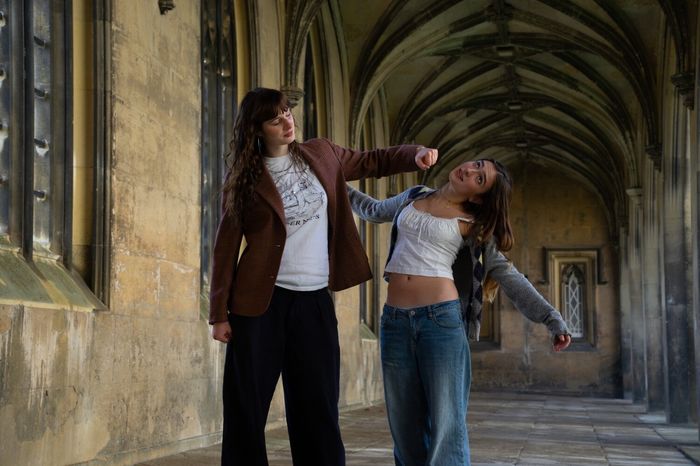
More quirkily, you could develop temporary tics to divert your attention. Some of mine have included: enlarging my mouth like a pufferfish, creating a story using finger puppetry, testing how far I can extend my rolled-up tongue, trying to touch my toes for a minute, and muttering the lyrics of Las Ketchup’s The Ketchup Song. You needn’t worry how you’re perceived, as you all probably look ridiculous in your costumes.
Actors, choose whatever works for you, but most importantly remember that stage-fright, whilst occasionally beneficial, needn’t be tolerated if excessive. And to the readers guilty of advising on how ‘natural’ nerves are, I know you only mean well. If you get the chance, though, please do away with this tired phrase and replace it with a biscuit, a box-breath, and a big, daft joke.
 Interviews / ‘You have to take it as it comes’: discussing content creation with Auden Barnes17 May 2026
 News / Science Park to ‘triple’ in size with £3bn investment21 May 2026
 News / Sons of imprisoned Saudi scholars urge Cambridge to call off deal with Saudi defence ministry22 May 2026
 Science / Forked over: dish-parity between college cafeterias17 May 2026
 Theatre / Crossing Points devastates the Corpus Playroom20 May 2026
 Sport / Fitzwilliam narrowly regain Cuppers trophy in tight affair with Selwyn22 May 2026
 Comment / The personal cost of reporting sexual violence at Cambridge22 May 2026
- News / Sons of imprisoned Saudi scholars urge Cambridge to call off deal with Saudi defence ministry22 May 2026
 Science / CamGraPhIC’s crusade to curb the AI energy crisis22 May 2026
 Film & TV / Hokum and the horror of guilt21 May 2026