
Commercial Feature
Your Graduate Salary: The Number They Offer vs. The Number You Keep
That moment has arrived. After the dissertations, the exams, and the seemingly endless job applications, you’ve landed your first graduate offer. The salary is right there in the email let’s say £32,000. It feels real, solid, like the starting line of your proper adult life. You might do a quick mental calculation for a monthly budget. Flat share? Probably. Holidays? Hopefully.
But here’s the first, and arguably most important, financial lesson of your career: that £32k figure is an illusion. It’s the gross salary. The number that will actually pay your rent, your bills, and your Pret coffees is your net salary. And the gap between the two is filled with taxes and national insurance a system you’ve likely never had to navigate before. For a graduate stepping into their first real paycheck, not understanding this difference is the fastest way to a very stressful, overdraft-filled Autumn.
Your First “Real World” Maths Problem
Let’s make this practical. That £32,000 offer doesn’t mean you get £2,666 in your bank account every month. Not even close.
First, there’s Income Tax. You have a Personal Allowance (income you don’t pay tax on, currently £12,570), and then you pay 20% on earnings above that. Then there’s National Insurance (NI), another deduction that funds state benefits. On top of that, you might have a student loan plan (Plan 2 or Plan 5) starting to tick down, taking up to 9% of your earnings above a threshold.
Suddenly, your £2,666 gross monthly pay might be closer to £2,100 net. That’s a £566 difference the potential cost of your entire rent share. You cannot budget with the gross number.
This is where you need to stop guessing. A dedicated UK pay calculator is your essential tool. You plug in your salary, your student loan plan, and your pension contribution (if any), and it does the hard maths instantly. It shows you your exact take-home pay, breaking down the tax, NI, and student loan deductions line by line. It turns an abstract offer into a concrete, usable monthly budget figure.
Why Thinking Ahead to the US Matters (Even Now)
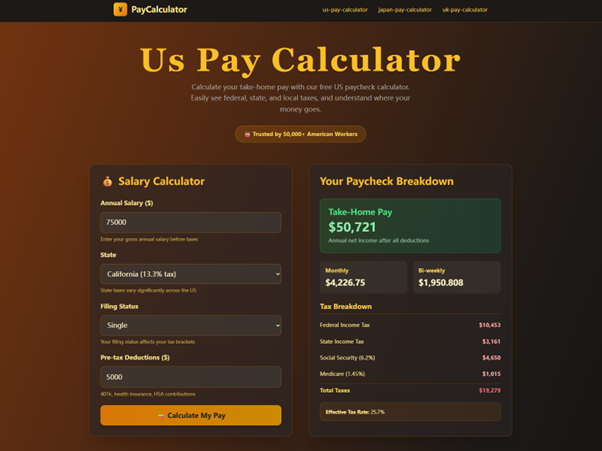
Perhaps your career path is global. Maybe you’re eyeing a Masters or internship in the US, or a role with an American firm. Their system is even more complex, involving a form called a W-4 where you declare allowances to your employer. Getting this wrong can mean a nasty tax bill or a huge chunk missing from your paycheck.
Getting familiar with a W-4 withholding calculator now even if just to understand the principle puts you ahead of the curve. It teaches you that in many countries, your tax isn’t just automatic; you have some control over it, and you need to be proactive. It’s a crash course in international financial literacy.
Your New Graduate Superpower: Financial Clarity
Taking ten minutes to run your offer through a calculator gives you two superpowers:
- The Power to Negotiate (or Accept) with Confidence. Walking into a final discussion knowing your net pay changes everything. You can assess the offer based on what you’ll actually live on, not the big, shiny gross number. You can ask informed questions about pension matching or salary sacrifice schemes.
- The Power to Build a Reality-Based Budget. With your real net income locked down, you can finally make an adult budget. You can look at flat listings, council tax, and utility bills knowing exactly what you can afford. This prevents the classic graduate shock of running out of money two weeks into the month.
The Bottom Line
Your degree taught you to analyse complex information. Apply that skill to your own life first. Your job offer is a dataset. Your net salary is the key insight.
Before you celebrate, before you sign, and definitely before you promise your mates a fancy round of drinks, do the most responsible thing you can: know your number. Not the one your employer will pay, but the one you will get to keep. It’s the first, and most crucial, step in building your independent life on solid ground.
 News / Missing Sidgwick sculpture spotted in Oxford 1 April 2026
 News / Downing law society banned from holding formals in College for a year31 March 2026
 Features / Hyper-productive or healthy? The rise of wellness culture at Cambridge1 April 2026
 News / Homerton plans to convert former Labour Club into student accom1 April 2026
 News / International students complain of ‘impossible choice’ under Cambridge travel disruption policy28 March 2026
 Lifestyle / Take a punt, and try canoeing!3 April 2026
 News / Cambridge alumnus Matt Brittin appointed BBC director-general3 April 2026
 Arts / In defence of decorative poetry3 April 2026
 News / Record-breaking £190 million donation will fund new Cambridge School of Government2 April 2026
 Interviews / Cambridge SU presidents on divestment, engagement and the role’s challenges1 April 2026
