Scientific sightseeing: a STEM walking tour of Cambridge
Laura Verdina takes you on a journey through the history of Cambridge science
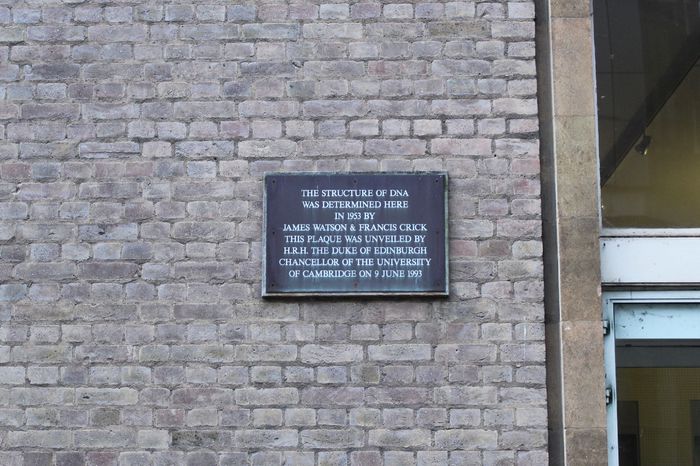
Central Cambridge is home to many commemorative plaques which document the discoveries made in buildings, or notable figures who lived in the area. Several of these plaques describe scientists who played a part in shaping our current understanding. These plaques aren’t always obvious – let this guided tour help you spot some of them as you wander through the streets of Cambridge.
Downing Site

We will begin our tour somewhere that will be familiar to most Bio NatSci students: Downing Site! Those who were attentive when going to their IA Physiology of Organisms lectures may have spotted two plaques on the outside of the Physiology, Development and Neuroscience (PDN) Department building. This is where Edgar Douglas Adrian, who was a Natural Sciences student at Trinity College, first recorded electrical signals emitted by single nerve fibres. Two other Trinity Natural Scientists (Sir Andrew Huxley and Sir Alan Hodgkin) followed in his footsteps and later won the 1963 Nobel Prize in Physiology or Medicine for discovering action potentials in nerves. Hodgkin and Huxley performed experiments on giant nerve cells from squid, as their large size (around 0.5mm in diameter) allowed them to use electrodes to measure ion currents through the nerve’s membrane.

On the same building, another plaque celebrates Bob Edwards’ work on In Vitro Fertilisation (IVF) in human egg cells. He was awarded the 2010 Nobel Prize in Physiology or Medicine for having pioneered this technique.
“Hodgkin and Huxley performed experiments on giant nerve cells from squid, as their large size allowed them to measure ion currents through the nerve’s membrane”
Free School Lane
After exiting Downing Site, take a left and continue along Downing Street until you see Free School Lane on your right. This street is home to a plaque which marks what once were the Old Cavendish Laboratories (now known as the New Museums Site). In these labs, Francis Crick and James Watson worked on deducing the structure of DNA, which they eventually found to be a double helix in 1953. Another plaque can be found on the wall of the laboratory in which they worked.

Further along Free School Lane, you will see a plaque praising J. J. Thomson’s famous 1897 discovery of the electron (a fundamental particle of the atom). Thomson was appointed as the Cavendish Professor of Physics in 1884, and won the 1906 Nobel Prize in Physics for his work on the electrical conductivity of gases. If you have spent any time in West Cambridge, you have likely walked along JJ Thomson Avenue, which is also named after him.
Old Cavendish Site
Inside the Old Cavendish site, you can find a plaque which recognises the first calculation made by the EDSAC (Electronic Delay Storage Automatic Calculator), an early British computer. The EDSAC was built by Maurice Wilkes and his team in the Cambridge University Mathematical Laboratory, near what is now the New Museums Site. Its first calculation was a program which calculated the squares of numbers, and it was used in the first Computer Science course at Cambridge, which began in 1953.
Bene’t Street

Continue down Free School Lane onto Bene’t Street and you’ll find yourself directly opposite the Eagle pub. Congratulations: you have just completed the path often taken by Francis Crick and James Watson after a long day in the Old Cavendish labs!
Outside the pub, you will see a blue plaque memorialising the 28th of February 1953 – on this day, Watson and Crick came to The Eagle to announce the fact that they had finally cracked the double helix structure and discovered “the secret of life”.
“Congratulations: you have just completed the path often taken by Francis Crick and James Watson after a long day in the Old Cavendish labs!”
King’s Parade (and onwards)
Keep going past The Eagle, and at the crossroads before King’s Parade you will see a blue plaque on the wall of King’s College. This is where Alan Turing lived as a Mathematics undergraduate. Turing is best known for developing the field of theoretical computer science, as well as his work on cracking intercepted German messages at Bletchley Park during the Second World War.

If you continue into the centre of town, you may find yourself near Boots on Sidney Street. Look above the entrance to spot the final plaque of this tour, which states that Charles Darwin lived in a house on this site in 1828. Darwin was a student at Christ’s College and is credited with the theory of natural selection and the proposition that all living beings descended from one common ancestor.

Now that you have completed this STEM walking tour, you’ll be able to spot these plaques everywhere! Taking the time to read them opens your eyes to the rich history of science found throughout the city. If you aren’t sick of seeing blue plaques yet: visit the Whipple Museum of the History of Science on Free School Lane to see the original DNA double helix plaque from The Eagle (complete with graffiti attempting to acknowledge Rosalind Franklin’s contribution).
 Interviews / ‘You have to take it as it comes’: discussing content creation with Auden Barnes17 May 2026
 News / Science Park to ‘triple’ in size with £3bn investment21 May 2026
 News / Sons of imprisoned Saudi scholars urge Cambridge to call off deal with Saudi defence ministry22 May 2026
 Science / Forked over: dish-parity between college cafeterias17 May 2026
 Theatre / Crossing Points devastates the Corpus Playroom20 May 2026
 Arts / The modern, Cambridge ‘Paragone’23 May 2026
 Sport / Fitzwilliam narrowly regain Cuppers trophy in tight affair with Selwyn22 May 2026
 Comment / The personal cost of reporting sexual violence at Cambridge22 May 2026
- News / Sons of imprisoned Saudi scholars urge Cambridge to call off deal with Saudi defence ministry22 May 2026
 Science / CamGraPhIC’s crusade to curb the AI energy crisis22 May 2026