SU hosts annual Reclaim The Night march
The rally featured speakers from the SU, End Sexual Violence, and Cambridge Rape Justice

On Thursday evening (05/03), protesters gathered in the city centre for the annual Reclaim The Night protest, organised by the Cambridge Students’ Union (SU).
Reclaim The Night originated in the UK in 1977 as part of the Women’s Liberation Movement as a protest against sexual and gender-based violence. It is an opportunity for women and other marginalised groups, who are often the target of violent crime, to walk outside at night without fear of harassment or violence.
In an Instagram post, the SU said of the event: “It is a night to reclaim our streets, our bodies, and put an end to gendered persecution”. The march has been held in Cambridge annually for over a decade – this year, it took place three days before International Women’s Day.
The rally commenced outside of the Guildhall, with representatives from the SU, End Sexual Violence (ENDSV) and Cambridge Rape Justice delivering speeches through a megaphone.
The first speaker, a representative from ENDSV, spoke about the importance of the Reclaim The Night movement.
“To me, Reclaim The Night means refusing to be silenced. It means refusing to live in a culture of fear. It means demanding your right to safety, dignity, and freedom as a human being. No one should be made to feel unsafe in their own streets, in their colleges, or in their homes,” they said.
They also referenced recent incidents of violence against women, including the murder of Sarah Everard by a police officer in 2021.
“It was one of [the Met’s] own officers who murdered Sarah Everard, but instead, the responsibility was put on us as women. Change your behaviour, limit your movements. Accept the world is dangerous for you, and this won’t change,” they said.
Olivia Ledger, SU vice president of student community and societies, also spoke at the rally, about an ongoing initiative to make misogyny a hate crime.
“90% of women report having been harassed on the streets before the age of 17. Or, in other words, 90% of women report being sexually harassed as children. As it stands, just under 20% of all reported crimes in England and Wales are due to violence against women and girls. But we know the real number of incidents is considerably higher.
“Following a survey led by dedicated sabbatical officers across student unions, research suggests that 67% of students would feel more able to report their personal experience if misogyny were considered a hate crime,” she said.
Barcode links to a petition to make misogyny a hate crime were distributed to attendees. The petition calls for the government to “amend the Sentencing Act 2020 to record crimes motivated by misogyny as hate crimes,” and currently has over 20,000 signatures.
Following speeches, protesters were led in a march through the city centre, chanting “Trans rights, women’s rights, one struggle one fight” and “Whatever we wear, wherever we go, ‘yes’ means ‘yes’ and ‘no’ means ‘no’.”
The march concluded in front of Great St Mary’s Church, where protesters were invited into Michaelhouse for a vigil and open mic.
On Saturday (07/03), Cambridge Stand Up To Racism (SUTR) held a rally in honour of International Women’s Day. The rally called for a push back against the far right, and an amplification of women’s voices.
In a post on Instagram about the event, SUTR said: “[The far-right’s] rhetoric isn’t about protecting us – it’s about dividing us, scapegoating migrants and minorities, and pushing women back into line”.
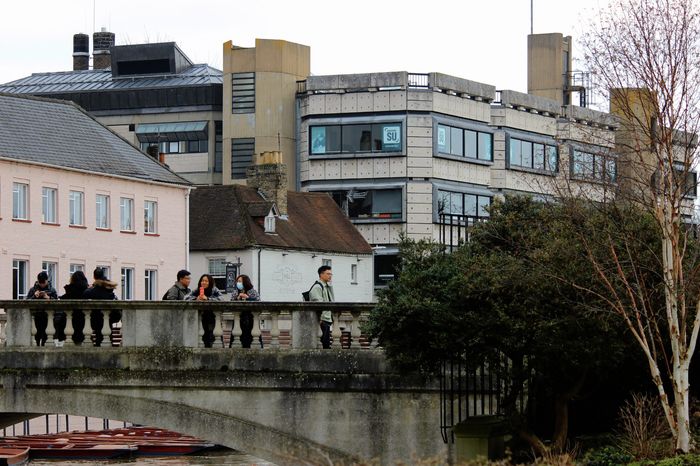
On the same day, Queens’ College for Palestine held a sit in at Cripps Court.
 Comment / Top of the slops: the competitiveness of college dining4 June 2026
 Interviews / What’s the story behind Pages coffee house?8 June 2026
 News / News in Brief: Cambridge crowns, council confirmations, and competitive cricket8 June 2026
 Comment / The Cambridge drift1 June 2026
 News / Cambridge researchers produce ‘world-first’ AI vaccine6 June 2026
 Arts / Don’t rush me – I’m reading!9 June 2026
 Lifestyle / Don’t Cry at Me, Argentina – a next-year abroad story8 June 2026
- News / News in Brief: Cambridge crowns, council confirmations, and competitive cricket8 June 2026
 Science / Failure is the foundation of science8 June 2026
 Fashion / The hidden gems of formal fashion8 June 2026