Demolition of former Cavendish II buildings at West Cambridge site approved
The project is expected to begin in August 2026 and be completed in July 2027

Plans to demolish six vacant Cavendish Laboratory buildings (Cavendish II) on the University’s West Cambridge site have been approved.
The project, projected to cost £16 million, is expected to begin in August 2026 and be completed in July 2027. This follows “a comprehensive programme of chemical and asbestos decontamination in the first half of 2026”.
Plans to demolish Cavendish II have been in the works since at least 2017.
The University Council and Planning and Resources Committee (PRC) have accepted recommendations from the Estates Committee to demolish the buildings, with the long-term aim of building new ones in their place. The PRC has authorised a ‘full business case’ to plan the demolition project, which will be developed in Easter Term this year.
According to the University, the “demolition programme will be designed to limit disruption, including noise and vibration, as far as possible. Consultation has taken place during 2025 with neighbouring institutions, including the Nanoscience Centre and the Magnetic Resonance Research Centre, to discuss and agree mitigation measures”.
The nearby Magnetic Resonance Research Centre (part of the Department of Chemical Engineering and Biotechnology) will be affected by the demolition works. Portable research equipment and offices will be relocated to the main Chemical Engineering and Biotechnology Building. Large instruments which cannot be moved will be mothballed until the demolition works are complete.
The Nanoscience Centre (part of the Department of Engineering), which is also close to the demolition site, will not be affected.
The first Cavendish Laboratory was built in 1874 at the New Museums Site, before being moved to West Cambridge (Cavendish II) a century later in 1974.
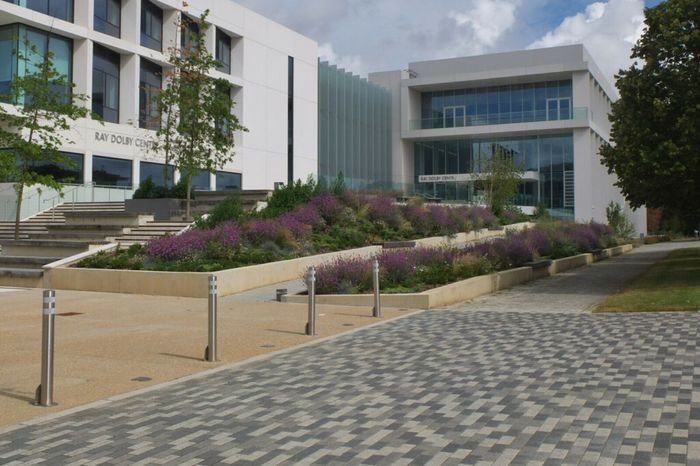
The laboratories have since been replaced by the Ray Dolby Centre (Cavendish III), which was approved in 2018 and officially opened in 2025. The Cavendish II buildings were constructed in the 1970s and are past the end of their expected design life. The Department of Physics finished vacating the buildings in October 2025.
The University Council noted in the Cambridge University Reporter that the six old Cavendish II buildings “individually and collectively […] now represent a significant health and safety risk and liability to the University”. The Estates and Planning and Resources Committees agree that there is no viable economic case for refurbishing the buildings.
The University already has planning permission to demolish the buildings following a planning application that was approved in 2024.
Their replacement, the Ray Dolby Centre, cost £303 million to build and was partly funded by a £85 million gift from the estate of sound pioneer Ray Dolby. It is equipped to support the Department of Physics’ world-leading research, with facilities including 173 laboratories, offices, two lecture theatres, seminar rooms, a learning resource centre and the ‘Cavendish Collection’ exhibition.
The Ray Dolby building was built using sustainable practices including a ground source heat pump system and sustainable drainage techniques. The centre achieved BREEAM Excellent certification when it opened in 2025.
The Estates Committee and Property Board will consider new buildings on the same site of the former Cavendish Laboratory in due course, in line with wider ambitions to develop the Cambridge West Innovation District.
The Cavendish Laboratory has made significant contributions to physics since it opened in 1874, the year after physics was introduced to the Natural Sciences Tripos. The original laboratory cost £6,300 to build.
More than 30 Cavendish researchers have won Nobel Prizes. The Cavendish Lab was the birthplace of the discovery of the electron in 1897, the neutron in 1932 and the double helix structure of DNA in 1953.
 Comment / Top of the slops: the competitiveness of college dining4 June 2026
 Interviews / What’s the story behind Pages coffee house?8 June 2026
 News / News in Brief: Cambridge crowns, council confirmations, and competitive cricket8 June 2026
 Comment / The Cambridge drift1 June 2026
 News / Cambridge researchers produce ‘world-first’ AI vaccine6 June 2026
 Arts / Don’t rush me – I’m reading!9 June 2026
 Lifestyle / Don’t Cry at Me, Argentina – a next-year abroad story8 June 2026
- News / News in Brief: Cambridge crowns, council confirmations, and competitive cricket8 June 2026
 Science / Failure is the foundation of science8 June 2026
 Fashion / The hidden gems of formal fashion8 June 2026