News in Brief: apex predators, art installations, and AI breakthroughs
A light-hearted round up of this week’s stories, from otter sightings to art installations celebrating women’s scholarship
Sidney celebrates female fellows
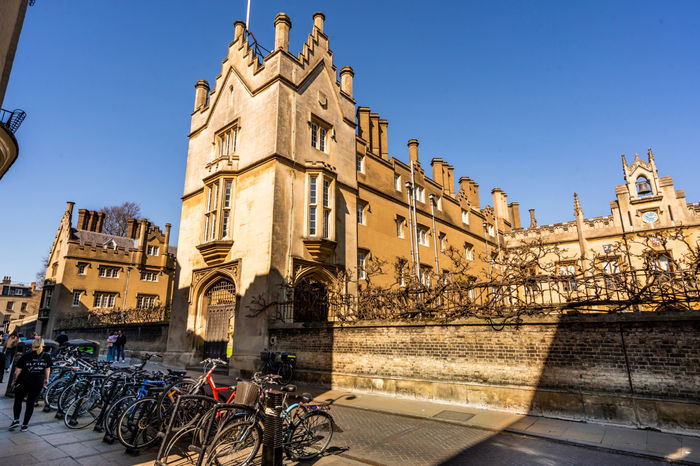
Sidney Sussex College has announced a new interactive art installation to mark 50 years since the admission of women to the College. ‘Celebration’ is a multimedia installation by artist-engineer Diana Scarborough. It features 30 portraits, displayed in pairs, depicting hands of female fellows holding objects they chose to represent their research and careers, rather than faces. The fellows span disciplines including medicine, engineering, climate science, philosophy, literature, economics, theology, and international relations. Installed in the historic College Hall, the exhibition uses proximity sensors so that, as viewers approach, different pairings of portraits are activated. ‘Celebration’ was commissioned by the College’s Forward Together Committee, and will remain on display until the end of the academic year.
Trinity spots its first otter
For the first time, an otter has been spotted in Trinity College’s grounds, caught on camera in the Fellows’ Garden at night. It is the first apex predator spotted in Trinity since Lord Byron brought a bear into the College as a student in the 1800s, after being prohibited from bringing his dog. Trinity’s Head Gardener, Karen Wells, first identified the otter from its “sparkly” droppings. After finding fish bones, empty mussel shells, webbed paw prints and “a lot of otter poo,” gardeners set up a wildlife camera in December. The adult male otter was eventually filmed crossing the bridge, diving into the brook and the garden.
UN panel on AI to include Cambridge academic
Cambridge academic Anna Korhonen has been appointed to a new United Nations panel on Artificial Intelligence. The Independent International Scientific Panel on Artificial Intelligence will bring together leading experts to assess how AI is transforming our lives, producing an annual report with evidence-based scientific assessments related to AI’s opportunities, risks and impacts. Korhonen is a professor of natural language processing and a senior research fellow at Churchill College, and will join 39 other panel members from across the world. She is co-director of the Institute for Technology and Humanity, director of the Centre for Human-Inspired Artificial Intelligence, and co-director of the Language Technology Lab in the Department of Theoretical and Applied Linguistics.
Cambridge study suggests AI could spot heart disease before GPs
A new study led by Cambridge academics suggests that AI could help doctors detect serious heart valve disease years earlier than GPs, potentially saving thousands of lives. Researchers analysed heart sounds from almost 1,800 patients with an AI algorithm trained to recognise valve disease, which often goes undiagnosed until it becomes life-threatening. The algorithm correctly identified 98% of patients with severe aortic stenosis, the most common form of valve disease requiring surgery. Professor Anurag Agarwal from Cambridge’s Department of Engineering who led the research, said: “Valve disease is a silent epidemic […] An estimated 300,000 people in the UK have severe aortic stenosis alone, and around a third don’t know it. By the time symptoms appear, outcomes can be worse than for many cancers.”
 Comment / Top of the slops: the competitiveness of college dining4 June 2026
 Interviews / What’s the story behind Pages coffee house?8 June 2026
 News / News in Brief: Cambridge crowns, council confirmations, and competitive cricket8 June 2026
 Comment / The Cambridge drift1 June 2026
 News / Cambridge researchers produce ‘world-first’ AI vaccine6 June 2026
 Arts / Don’t rush me – I’m reading!9 June 2026
 Lifestyle / Don’t Cry at Me, Argentina – a next-year abroad story8 June 2026
- News / News in Brief: Cambridge crowns, council confirmations, and competitive cricket8 June 2026
 Science / Failure is the foundation of science8 June 2026
 Fashion / The hidden gems of formal fashion8 June 2026