Unions protest handling of redundancies at Epidemiology Unit
The short protest preceded a meeting with senior management at the School of Clinical Medicine
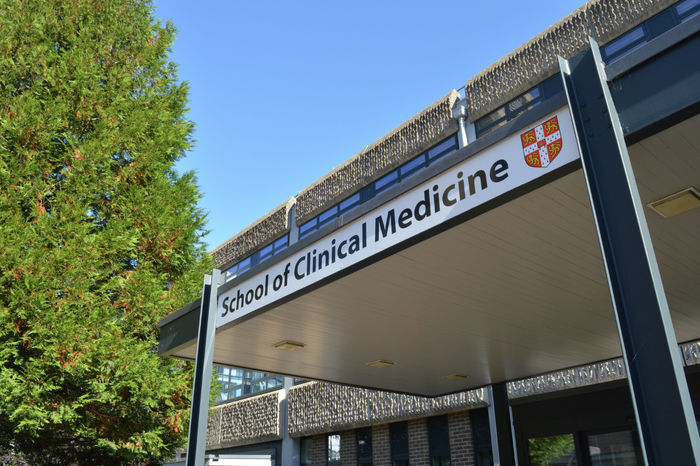
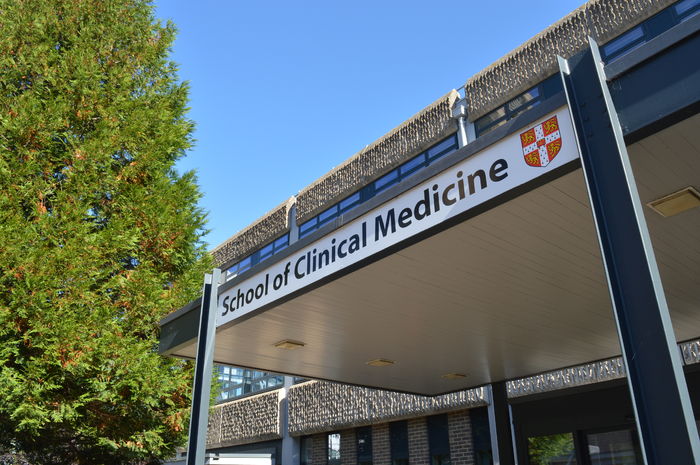
Staff unions held a short protest outside the School of Clinical Medicine ahead of a meeting with senior management to discuss the handling of redundancies at the MRC Epidemiology Unit.
15 minutes before the meeting, scheduled for 12pm on 18 December, staff gathered in front of the building and unfurled the banner of the University and Colleges Union (UCU).
This comes after UCU, Unite, and Unison all accused the University of failing to meet its contractual obligations for redundancy consultations at the MRC Epidemiology Unit, a department of the School of Clinical Medicine (SCM).
The all-staff meeting was chaired by Professor Sir John Aston, Pro-Vice-Chancellor for Research, and attended by Professor Patrick Maxwell, Head of the SCM, as well as Dr Caroline Edmonds, Secretary to the SCM.
The UCU claims the meeting was “only granted after a concerted campaign by all three recognised unions, UCU, Unison and Unite”.
According to the unions, 62 staff members are at risk of redundancy at the Epidemiology Unit, following a decision by the Medical Research Council (MRC) to cut previous funding networks for its special research units.
They claim the University’s staff consultation process has been rife with errors, including releasing essential documents late and incomplete, not providing sufficient transparency around its financial situation, and lacking a voluntary redundancy scheme for staff.
Following the meeting, Michael Abberton, UCU Branch Vice-President, said: “Staff finally had the opportunity today to confront senior management with the consequences of their actions and force them to admit failures in the way this process has been conducted. The justified anger and frustration were evident, due in no small part to the deplorable lack of respect for staff.”
In response to these allegations, a spokesperson for the University commented: “The ending of the Medical Research Council’s unit funding model has left the University in a very difficult position. The University cannot absorb all of the costs that are currently met by the MRC’s direct unit funding, which include staff salaries, as well as buildings and facilities expenditure.
“We continue to work hard to support those staff members affected, and recognise that this is a very difficult time for those at risk of redundancy. We wish to reassure staff that we are complying with the relevant policies and procedures and statutory requirements, and, wherever possible, best practice.”
The Epidemiology Unit is just one of six MRC units at the University that will suffer from the funding cuts, due to come into effect in March 2026. In January this year, 608 researchers – including 153 at Cambridge – signed an open letter calling on the government to save the 19 MRC units across the country.
Abberton continued: “We again call on the University to pause, conduct proper and meaningful consultation and give the staff the respect they deserve. MRC Toxicology, Mitochondrial Biology, and Cognition and Brain Science Units are all due to lose funding next year. We demand assurances that the staff in those units will not have to endure similar treatment and we need to see that ‘lessons have been learned’.”
In June 2024, the University Council concluded that the funding cuts meant “it would be very difficult to perpetuate the Units in their current form”. While a new funding system for “Centres of Research Excellence” (CREs) will come into force in March, the University says that this will not meet previous funding levels.
A University spokesperson explained: “Researchers in the Unit are seeking alternative sources of funding so that as much of the outstanding research as possible can continue in the Institute of Metabolic Science Epidemiology Division within the Department of Clinical Biochemistry.”
The unions are planning to meet with staff again in the new year to discuss whether further action is necessary.
 Comment / The Cambridge drift1 June 2026
 News / Cambridge psychologist warns against blanket social media ban for under-16s1 June 2026
 News / News in Brief: Corpus climbing, climate cash, and commendable contributions1 June 2026
 Theatre / CUMT’s The Wind in the Willows brings a classic to life 31 May 2026
 News / Venue cancels Cambridge talk by right-wing commentator Matt Goodwin after backlash28 May 2026
 Music / We need to talk about Kendrick2 June 2026
 News / University support staff strikes end after month of action2 June 2026
 Arts / To the letter2 June 2026
- News / Cambridge psychologist warns against blanket social media ban for under-16s1 June 2026
 Sport / Caius beat Magdalene in last-minute thriller to clinch mixed netball Cuppers final1 June 2026