SU reluctantly registers controversial women’s soc
In two statements on its website, the SU implied that CUSW ‘contradicts’ its ethos but that it was constrained by legal obligations

Cambridge University’s Students’ Union (SU) has sought to distance itself from a gender-critical women’s society after registering the group, saying it was legally obliged to do so despite believing the society “contradicts” its ethos.
Founded in October by three students, the Cambridge University Society of Women (CUSW) describes itself as a group offering a “single-sex environment for women” at the university, with its constitution defining women as “adult human beings belonging to the female sex class,” thereby excluding transgender women.
Over the weekend, the society formally registered with the SU, allowing it to access benefits including Freshers’ Fair stalls.
However, hours after registration, the SU published two explanatory statements on its website – titled ‘The registering of gender-critical societies’ and ‘What role does the Students’ Union play in approving societies’.
Writing “in response to widespread student concerns regarding the rights of our trans students”, its student communities and societies officer, Olivia Ledger, said the SU was bound by its statutory obligations.
“Aside from being a campaigning body, the SU is also the recognised union for all Cambridge University students, which makes us accountable to the Education Act, and a registered charity, which makes us accountable to the Equality Act and to the Charity Commission.
“As a result, our role and legal responsibility is to register all eligible societies – even if they contradict our ethos.”
Ledger added that while some students had raised concerns that registering the society could breach SU rules, gender-critical beliefs are recognised under the Equality Act as “protected philosophical beliefs” and are therefore “not legally considered harmful”.
Maeve Halligan, a 22-year-old MPhil student at Lucy Cavendish College and the society’s president, told Varsity: “We are pleased to have been registered with the Cambridge SU, especially given that it has come at the end of a busy and eventful first term.” However, she said it was “disappointing” that the SU felt the need to issue public caveats.
“This implies that they are responding only to the views of a loud minority of students instead of processing our application even-handedly and neutrally,” Halligan said. “If the SU’s ethos is ‘challenged’ through the existence of a society that is for and by women, it is unclear how they are fulfilling their duty to represent all students.”
This comes after the SU earlier this year condemned an April Supreme Court ruling clarifying that the legal definition of “woman” refers to biological sex, saying that “trans, non-binary and gender-non-conforming people have always existed and will always exist, and their identities are valid irrespective of any court ruling”.
Before SU registration, the society was approved by the University’s proctors in late November, a process requiring groups to appoint an academic as their senior treasurer. The society appointed Dr Anita Bunyan, a fellow of Gonville and Caius College, who said at the time that she “supports the right of junior members of the University to establish a single-sex society of women” and that “there is clearly a demand among students for such a group”.
At its time of launching, the society received a strong backlash from other student groups. Statements opposing CUSW were issued by several college feminist societies, as well as the Cambridge University Labour Club, which described the group as “the latest assault on the trans community at Cambridge” and accused it of promoting “transphobic rhetoric under the guise of ‘free speech’”.
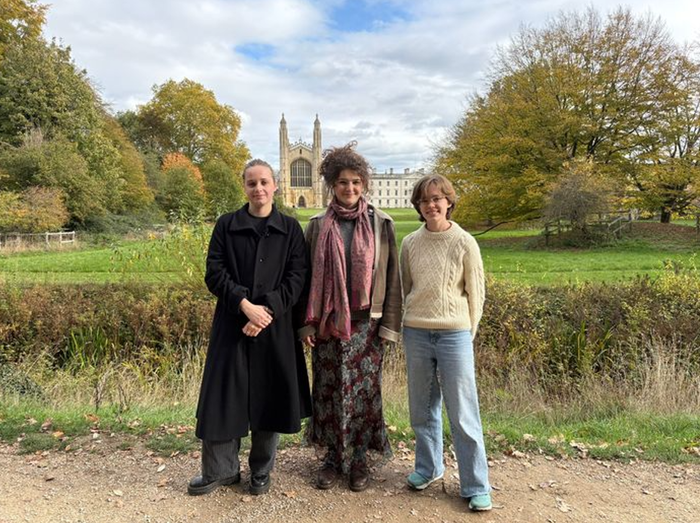
Despite this, the CUSW has attracted significant external financial support. In its first two weeks, it raised more than £13,000 in donations from over 200 donors, including £3,000 from Alex Gerko, a billionaire hedge fund founder.
Over the weekend, another of the group’s co-founders, Thea Sewell, said she was ostracised by fellow students after expressing gender-critical views and showing interest in books questioning gender theory.
Sewell, a 20-year-old second-year philosophy student at Christ’s College, told The Telegraph that the word “Terf” was scratched into her college room door earlier this year after she recommended a book by Helen Joyce to another student.
She added that she was later confronted by friends and labelled a “bigot,” leaving her feeling unable to move around college during the day and prompting her to change rooms.
 Comment / The Cambridge drift1 June 2026
 News / News in Brief: Corpus climbing, climate cash, and commendable contributions1 June 2026
 News / Cambridge psychologist warns against blanket social media ban for under-16s1 June 2026
 Theatre / CUMT’s The Wind in the Willows brings a classic to life 31 May 2026
 News / Venue cancels Cambridge talk by right-wing commentator Matt Goodwin after backlash28 May 2026
 Music / We need to talk about Kendrick2 June 2026
 News / University support staff strikes end after month of action2 June 2026
 Arts / To the letter2 June 2026
- News / Cambridge psychologist warns against blanket social media ban for under-16s1 June 2026
 Sport / Caius beat Magdalene in last-minute thriller to clinch mixed netball Cuppers final1 June 2026