Getting Killed hurts way less than it sounds
Geese’s fine balancing act between sonic brilliance and surreptitious marketing, as examined by Isaac Morley

Under the evolutionary pressure of ruthlessly efficient algorithmic consumption, pop music seems to have shilled any unnecessary sense of real authenticity or identity. What has risen in its absence is almost pure corporate brain crack. Popular music today is characterised by think-tank imbued, hyper-stimulating and hyper-sexualised ‘aesthetics’, as well as music that seeks to be instantly familiar, nostalgic, and infinitely replay-able in ‘your playlist’, needing to maintain only the thinnest vale of sincerity.
The previous buffer that existed between production and consumption, which afforded room for missteps and experimentation and gelling with ‘consumers’, seems to have diminished. What we are left with is popular music that is driven so closely by the success of machine learning based algorithms that we are almost deluded in thinking that the abject and unconscionable oncoming threat of AI produced music has not defaced us already.
“It’s an assault on your music to tether it too closely your most disgustingly human, imperfect, egotistical and frankly cringe self”
The intrinsic meritocracy that modern social media promised artists, has brought with it a host of corrosive new issues. For one, any music that isn’t instantly likeable can easily be skipped. Gone is the unconscious mental investment into an unfamiliar, deeper work that ferments the broadening of musical tastes, exemplified in the death of the album. Instead, for many passive listeners, musical collections are characterised by more atomised success stories of our brains’ toleration to ‘new’ songs; the dreaded “I’ll add this to my playlist”.
The other issue is one of authenticity, and ironically, the deluge of it. No-one wants to listen to you if they already know who you want to sound like, or what your bedroom wall looks like, or endured your blatant self-promotion. It’s an assault on your music to tether it too closely your most disgustingly human, imperfect, egotistical and frankly cringe self. Like crabsticks, a significant distance between art and artist is required to maintain at least an illusion of mystique. This is where Geese come in.
“Gone is any gratuitous flair, and in its place sits beautifully creative and purposeful orchestration that is now more Beach Boys than Black Country, New Road”
Geese, with Getting Killed, appear to have cracked the formula on both issues. Their music that appeals to the nostalgic ear without sacrificing on artistic prowess and a social media presence that perfectly straddles the line of authenticity in the regrettably necessary art of self-promotion.
The sound of Getting Killed amounts to a classy blend of energetic, spunky rock elements with tastefully candied-up, 1975-style electronic elements. Gone is any gratuitous flair, and in its place sits beautifully creative and purposeful orchestration that is now more Beach Boys than Black Country, New Road.
Cameron Winter, the band’s frontman and chief songwriter, seems emboldened by the voice he married on Heavy Metal, his first solo album released in late 2024. He is more restrained and sombre. His voice glides and falls glissando over the beautifully intricate and soft compositions, further back in the mix, striking an almost eerie, theramin-esque vibrato. With Getting Killed, this gentile is on full display, paired with a controlled loudness that now sounds more like wails of melancholy than of bravado. His voice bleeds into the songs, no longer needing to scream for attention.
“His voice bleeds into the songs, no longer needing to scream for attention”
Winter’s songwriting is at a peak too. The tracks are littered with absolutely irresistible melodies and mysterious yet simple lyrics, not drenched in irony, that unravel their meaning miraculously seamlessly on relistens. Lines meander through the harmonies, skipping beats and bars and abandoning structural dogma, but in a way that is so purposeful, that you would hardly realise if you weren’t counting, like a nerd.
The production is also refreshingly unpolished and raw, humming with messy takes and defiantly analogue notes subconsciously adding credence to the digital phenomenon having actually been conceived by real living persons of Earth. Soft, soaring, whirling, gelid, nostalgic, resonant, cathartic; their sound offers an easy sinking to any restless, headphone equipped traveller of the algorithm, and yet sneaks in some rockier aspects that can offer something real within a live setting. It is an unfortunate truth that rock bands now often must build their digital audience before their live, and Geese’s sound certainly contributes to their success in this perverse modern doctrine.
“people need bands. No self-respecting person wants to wear the T-shirt of a solo artist.”
What is perhaps more ingenuitive (and important) is the band’s marketing. Geese’s online persona is one that strikes a fine balance of levity, authenticity, mystique and heart. In a world where a tirade of short-form content is needed to remain visible, Geese seem to toe the line perfectly, with slapdash yet classy covers of artists ranging from Talking Heads to Justin Bieber, they post clips from interviews, snips from live sessions or gigs, and even the odd dreaded ‘funny video’. Even here, these glaringly begrudging posts are tinged with enough natural humour, levity and genuine weirdness that they achieve some discordant entertaining value, without sacrificing on mystique.
Their music videos are super restrained; simple, minimalistic, relatable but nonetheless powerfully emotive. In ‘Au pays du cocaine’, we follow Winters as he serenades what is surely meant to be his former baby-self across a kitchen table, telling himself, “you can change and still come home… it alright”. It’s a shattering watch to anyone who has had to seek self-acceptance and still feel the undeniable need to change.
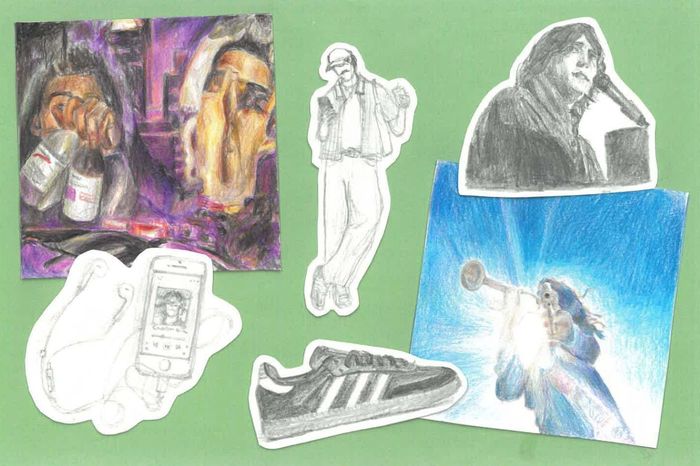
Geese’s rise in popularity reminds us of something deeper: people need bands. No self-respecting person wants to wear the T-shirt of a solo artist. The slight personal absence that registers in a band rather than an individual invites fans to become part of it, supporting a movement rather than pedestalling. The ever-tightening grip of hyper-extractive and monopolising business practices have pushed bands away from the norm, where having to split already minimalised earnings four or five ways has now become simply a too significant economic deterrent for many groups.
Unfortunately, failing some mass exodus from extractive streaming services, this is a sacrifice that many groups will have to make. But Geese give hope, that with enough talent, passion, and marketing savviness, that there is still room for bands. They are the blueprint, and a beacon of hope for the modern band, and their globalised appeal speaks to a globalised generation that crave something to represent them. For many, Geese have slipped right on into their hearts and are now loudly being claimed.
 Comment / Top of the slops: the competitiveness of college dining4 June 2026
 Interviews / What’s the story behind Pages coffee house?8 June 2026
 News / News in Brief: Cambridge crowns, council confirmations, and competitive cricket8 June 2026
 Comment / The Cambridge drift1 June 2026
 News / Cambridge researchers produce ‘world-first’ AI vaccine6 June 2026
 Arts / Don’t rush me – I’m reading!9 June 2026
 Lifestyle / Don’t Cry at Me, Argentina – a next-year abroad story8 June 2026
- News / News in Brief: Cambridge crowns, council confirmations, and competitive cricket8 June 2026
 Science / Failure is the foundation of science8 June 2026
 Fashion / The hidden gems of formal fashion8 June 2026