‘The media finds it easier to focus on personalities’: Dr. Hannah White, Director of the Institute for Government
Vienna Kwan sits down with the CEO of one of the UK’s most influential think tanks to discuss her career journey
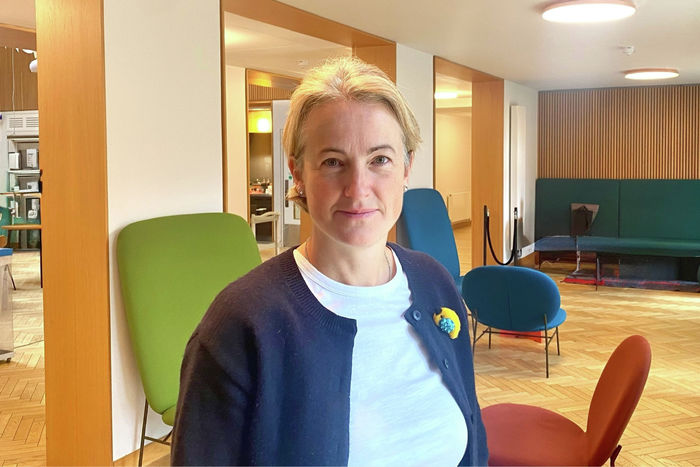
Former Selwyn Master Roger Mosey offered a peculiar piece of advice in our matriculation speeches: look out for who you stand next to in your matriculation photo. One alumnus, he said, had ended up (real-life, not college) marrying the person beside them. What Mosey didn’t mention was that the protagonist of this story was Dr. Hannah White – now Director and CEO of the Institute for Government (IfG), one of the UK’s most influential think tanks.
White’s story began at Selwyn College, where she read geography. Infected with a serious case of “imposter syndrome,” this feeling was only amplified by a moment in the matriculation queue when someone asked if she was one of the “ecclesiastical Westons” – her maiden name. “I had no idea who the ecclesiastical Westons are,” she laughs. “I was just thinking: oh my God, who are these people?”
“The whole ‘Britain is broken’ narrative has become firmly established in the public mind”
After Selwyn, White later pursued a PhD in Human Geography at Jesus College. Although she saw her degree as highly valuable, especially her fieldwork in Delhi, she realised she was: “doing a PhD with the process of working out that I didn’t want to be an academic”.
White describes having a “classic” Oxbridge experience. There was rowing. There was also a supervisor who “gave us extra supervisions every week … to write an essay on something interesting.” Even though she never became involved in any political clubs “and could never subscribe […] to the full agenda of any individual,” she was “fascinated by politics.” In hindsight, this was the key that led her towards the path of nonpartisan work, where she started at the House of Commons as a senior clerk.
Even now, when people occasionally ask her who she votes for as the head of a think tank, “I always say, under our system, I would look at who you have as your MP now in your constituency, as a person, and see what you make of them […] as a constituent.” Ultimately, her job is to look at all parties and “think about how it could work better.”
“The whole ‘Britain is broken’ narrative has become firmly established in the public mind,” she says, and worries that politicians “sometimes forget how little attention to politics normal people pay.”. Extreme messaging cuts through – but at a cost. “It becomes self-reinforcing,” she says, arguing instead for “a more balanced, and in some ways more positive, message about the strengths of the country.”
The last decade, marked by “Brexit, followed by Covid, and then the energy crisis and the ruptures within the Conservative party” has placed pressure on parliament – “more than half of MPs are now new.” It has been a decade where “we have had to legislate rapidly without the extent of scrutiny of legislation that you would anticipate.”
When White was working in the legislation office at the House of Commons, “a criminal justice bill would go into committee and be scrutinised for, you know, 10, 12 weeks. Now it’s just really normal for legislation to pass really fast, so politicians don’t have the same expectation of the groundwork you would put into a policy before you bring it into the House.”
“The media finds it easier to focus on personalities”
She argues for a return to “more deliberate policy development and […] more stability around the politics,” while acknowledging the media’s role in accelerating personality-driven politics. “The media finds it easier to focus on personalities,” she says, and politicians inevitably respond to those incentives. Still, she points to recent examples of progress, such as the Gauke and Leveson Reviews – government-commissioned reports published in 2025 that address crises in prison capacity and court backlogs.
White left the Commons for the Institute for Government to work on research into parliamentary culture. It was there that she realised she enjoyed leadership. “It’s not about me,” she says, “but about the kind of important research that we do.”
One moment particularly stands out in her memory. When the ‘Me Too’ movement broke, White saw the chance to bring attention to something she had seen repeatedly in Westminster but the media had overlooked: bullying. She contacted a journalist at Newsnight and spoke to “former colleagues who had to leave the House after they’d been bullied by MPs.” The resulting programmes triggered major inquiries, including into then-Speaker John Bercow, and eventually led to the creation of the Independent Complaints and Grievance Scheme (ICGS), which allowed allegations to be investigated independently.
“For me, that was kind of amazing,” she reflects. “When I had been in the House, I’d observed these behaviours […] and felt bad about what was happening. Once White came out of the system, she was able to “provoke the levers” that achieve change. Her role in catalysing progress within the parliamentary system cemented her transition to the IfG, where she eventually became Director and CEO.
Looking back, White laughs at the memory of standing in the matriculation queue, trying to decode references everyone else seemed to understand. “Everyone seemed really impressive,” she says. Then she pauses. “Trust yourself. You will get the good things out of this. It might not feel like it, but you’re good enough.”
Perhaps the moral of the story is to be nice to your flatmates in Cripps Court – they could one day run one of the UK’s top think tanks. But more importantly, White has built a path grounded in the ideas that systems matter, and that individuals can change them. It is a responsibility she continues to carry as the IfG navigates an uncertain political climate – one where scrutiny is thin and legislation moves fast. Despite this, White remains an optimist: better processes, better leadership, and better parties are possible.
 News / C4P vandalises University offices over divestment10 June 2026
 Comment / Top of the slops: the competitiveness of college dining4 June 2026
 Comment / ‘On the Poverty of Student Life’: sixty years on10 June 2026
 Interviews / What’s the story behind Pages coffee house?8 June 2026
 News / News in Brief: Cambridge crowns, council confirmations, and competitive cricket8 June 2026
 Lifestyle / Confessions of a May Ball crasher12 June 2026
 Lifestyle / May Week horoscopes12 June 2026
 Lifestyle / The finalist’s bucket list12 June 2026
 Theatre / All of Cambridge is a stage12 June 2026
 Music / ‘It’s feminine intuition’: predictions for OR312 June 2026