The Fruit of Silver Street’s Labour
Daniella Adetoye highlights a production exemplifying exceptional student film-making

On January 29th, The Only Fruit, a new short film written and directed by Madeleine Whitmore and produced in association with Silver Street Productions and Cambridge Arts Initiative and Collective, premiered in the Queens’ Fitzpatrick Hall. The film follows a single evening in the lives of three young people, Luce, Kizzy, and David, as tensions around intimacy, sexuality, and emotional honesty quietly (and not-so-quietly) unravel. The film is emblematic of Cambridge student filmmaking, defined by collaboration between theatre and film practitioners, growing access to shared equipment, and an appetite for emotionally ambitious work.
The film opens in the aftermath of unsatisfactory sex between Luce (Annie Rainbow) and Kizzy (Enya Crowley). The pair lie in bed circling, but struggling to name, the rift between them. Kizzy senses Luce retreating both physically and emotionally, while Luce struggles to articulate what exactly feels misaligned. From here, the film introduces David (Rob Monteiro), Luce’s ex-partner, who still lingers in the periphery of her life, buoyed by a quiet hope that their relationship might be rekindled.
“Torn between the desire to be understood and the fear of being seen too clearly”
In an awkward but revealing kitchen conversation between David and Kizzy, Rob Monteiro deftly balances humour and restraint. He plays David with a gentle awkwardness that makes his lingering presence feel intentional rather than intrusive. Similarly, Enya Crowley’s performance is especially strong, solidifying Kizzy as a character with interiority and agency beyond her relationship with Luce. Crowley noted that it was important to avoid Kizzy becoming a “stereotypical […] lesbian character”, and that care is evident in the soft back-and-forth rhythm of the scene.
One line in particular stands out: “You know crumpets aren’t inherently better”. What might initially register as throwaway humour takes on metaphorical weight, becoming an unintentional but symbolic articulation of sexual preference without hierarchy. Whitmore later remarked that the line was born simply out of her love for breakfast foods, but its resonance speaks to the film’s broader exploration of bisexuality.
Whitmore has cited influences ranging from Polly Barton’s Porn: An Oral History, to James Baldwin’s writing on heterosexual sex and the frequent dissonance he notes between physical intimacy and emotional truth. Whitmore even pointed towards less conventional influences. She humorfully cited an Instagram reel capturing a conversation between Baldwin and Nikki Giovanni that she was sent, which depicts lovers seeing both the best and worst of each other. This is reinforced through the film’s visual language, such as a match cut swapping David and Kizzy into the same physical position. Whitmore stressed that the intention was not to imply interchangeability but present the complexities of love, and the complicated weight it bears towards both individual expression and romantic unity.
Whilst the love Luce feels remains constant, its sexual and emotional expression shifts. Whitmore emphasised that she was not attempting to represent every bisexual experience, but instead focusing on Luce’s specific struggle to conceive of oneself as “two things at once”. It is distinctions like these which allowed the film to stand out and feel intensely personal and recognisably human: torn between the desire to be understood and the fear of being seen too clearly. I would further argue that Annie Rainbow’s performance was central to this effect. While Annie spoke about this being her first transition from theatre to film acting, noting how rehearsal processes differed, particularly in how romantic tension and intimacy is reoriented away from a live audience and into subtle, internal shifts that film can capture, she played her role like a natural.
“Whitmore emphasised that she was not attempting to represent every bisexual experience, but instead focusing on Luce’s specific struggle to conceive of oneself as ‘two things at once’”
Formal choices in the film helped to further support the general intimacy that it delivers. Director of Photography Finlay Wyer – with a precocious eye for detail that goes far beyond the amateurish expectations of student filmmaking – outlined how he has decided to film many scenes on two cameras simultaneously. Finlay argued that this allowed for fluid cutting between angles while preserving the integrity of extended performances. Similarly, lighting plays a particularly important role. Despite filming at various times throughout the day, Wyer maintains the illusion of evening by creating a contrast between beams of cold and warm light across faces using a mix of handheld lights, LEDs, and gels. The post-production colour grade that leans into pinkish-red hues creates a visual warmth that feels fitting for a story about intimacy, connection, and vulnerability.
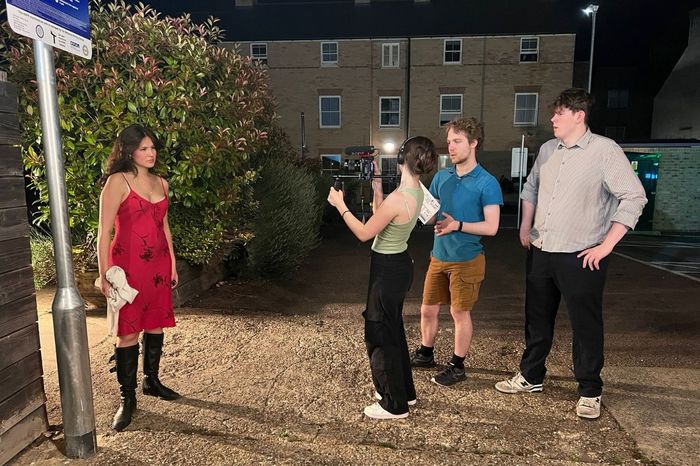
The Only Fruit is a confident and thoughtful work. Supported by a strong creative team, including Assistant Director Ella Thornburn, Intimacy Coordinator Sophia Orr, and sound operators Millie Hine and Sam Fowler, the film demonstrates a level of care and ambition that speaks to the growing vitality of Cambridge’s student film scene.
 Comment / Top of the slops: the competitiveness of college dining4 June 2026
 Interviews / What’s the story behind Pages coffee house?8 June 2026
 News / News in Brief: Cambridge crowns, council confirmations, and competitive cricket8 June 2026
 Comment / The Cambridge drift1 June 2026
 News / Cambridge researchers produce ‘world-first’ AI vaccine6 June 2026
 Arts / Don’t rush me – I’m reading!9 June 2026
 Lifestyle / Don’t Cry at Me, Argentina – a next-year abroad story8 June 2026
- News / News in Brief: Cambridge crowns, council confirmations, and competitive cricket8 June 2026
 Science / Failure is the foundation of science8 June 2026
 Fashion / The hidden gems of formal fashion8 June 2026