The Christmas films that spoil themselves
Daniella Adetoye believes that Hallmark films prioritise ambience over analysis
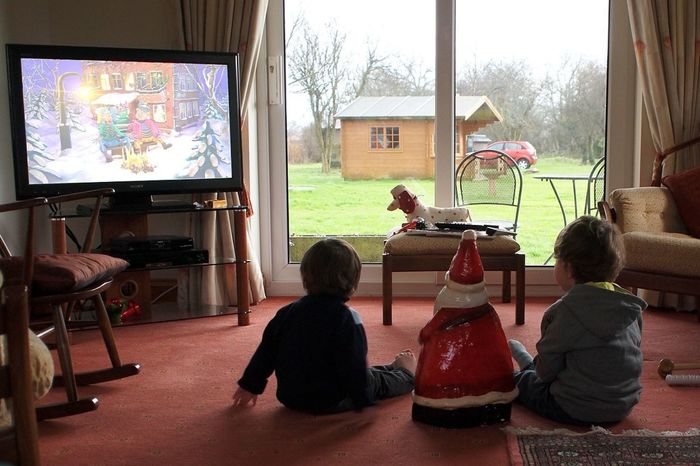
There is a specific type of film that takes over my holiday period. A burnt-out woman from the city returns to her hometown, taking a break from her high-stress job as an advertising executive, lawyer, or real estate developer. She then either stumbles into a local coffee shop, now run by her childhood best friend who is usually in flannel and holding a mug or a crate of something artisanal, or encounters a wholesome local man, usually a baker or a small-business owner, who catches her eye. Snow falls with suspicious punctuality. The colour grading is warm, the lighting diffuse, the mise-en-scène aggressively cosy. Before the film has even begun, the ending is already apparent.
I know this because I watch one almost every day in December with my mum and younger sister, a ritual that’s been going on for as long as I can remember. By the end of the month, we can usually tell exactly what’s going to happen in a film before the opening scene has finished. Sometimes before it’s even started. These films are almost always Hallmark or low-budget Netflix projects, and they are almost always the same. And yet, every year, we keep watching. The real question is why do these flat, formulaic, and creatively risk-averse movies remain so appealing, particularly in winter?
“Hallmark’s winter films have evolved into something closer to an industrial system than a traditional film genre”
Over the past decade, Hallmark’s winter films have evolved into something closer to an industrial system than a traditional film genre. Designed for maximum reproducibility, dozens are released each year, sharing near-identical narrative beats, character archetypes, and visual languages. Even the camera work – repetitive shot–reverse–shots, minimal movement, and unobtrusive editing – privileges easy conformity. The repetition has become so extreme that it now circulates as a meme: woman leaves the urban centre to return home to an idyllic, cosy village, and through romance, rediscovers a slower, simpler, more ‘authentic’ way of life.
Hallmark’s winter films have an emotional ambience. At the centre of their narratives is almost always a spatial opposition: city versus small town. Urban spaces in Hallmark films are defined by glass offices, vague corporate roles, perpetual busyness. The protagonist’s job is rarely specific beyond being ‘demanding’, and it is almost always framed as emotionally corrosive. Urban life becomes synonymous with speed, stress, and disconnection. The small town, by contrast, is cinematic in the most literal sense. The camera lingers on fairy lights, wood panelling, snow-covered storefronts. Community is visible everywhere. These films repeatedly stage a retreat away from modern precarity towards a pastoral ideal.
The influence of nostalgia is clear here. However, it is not so much for a specific historical moment, rather than a general feeling of warmth, certainty, and legibility. These films evoke a past that never quite existed, stripped of political conflict or structural difficulty. Winter becomes a time of emotional clarity rather than hardship.
This is especially clear in the genre’s romantic dynamics. The male love interest is almost always rooted in place, owning something physical: a bakery, a tree farm, an inn, a workshop. His labour produces objects, not spreadsheets. His masculinity is gentle, dependable, and geographically fixed. By contrast, the woman arrives from elsewhere. She brings ambition, restlessness, and dissatisfaction, all of which the film gradually reframes as misdirection. There is something quietly conservative about this arc. Structural dissatisfaction with work and modern life is to be solved through heteronormative security and the relinquishing of the women’s professional achievements. The films sell retreat as resolution.
“There is something quietly conservative about this arc”
And yet, while the singular world Hallmark films construct is narrow, exclusionary, and insulated from social complexity, it’s impossible to ignore how comforting this fantasy can be. This isn’t an argument for the dumbing down of cinema. I’ve tried, unsuccessfully, to force more ‘serious’ winter films into the rotation (RIP The Holdovers), but it never really works. These films aren’t competing with art cinema; they’re fulfilling a different function altogether.
In a weird way, it’s almost as if that aesthetic flatness is also central to the viewing experience. My mum doesn’t care about dynamic cinematography or narrative innovation. What matters is that we’re together with something familiar that doesn’t demand too much attention on the screen. They are designed for seasonal spectatorship, to be folded into the rhythms of the holiday period and played in the background while you put up decorations, wrap presents, or wait for dinner to finish cooking.

In a season that can feel socially intense and emotionally loaded, they offer reassuring, predictable, frictionless containment. They create space for family, for ritual, for sitting together on the sofa knowing exactly how things will turn out. Perhaps the real genius of the Hallmark Industrial Complex is the feeling it produces built from snow, nostalgia, and the comforting illusion that, given enough time away from the city, everything will make sense again.
 Comment / Top of the slops: the competitiveness of college dining4 June 2026
 Interviews / What’s the story behind Pages coffee house?8 June 2026
 News / News in Brief: Cambridge crowns, council confirmations, and competitive cricket8 June 2026
 Comment / The Cambridge drift1 June 2026
 News / Cambridge researchers produce ‘world-first’ AI vaccine6 June 2026
 Arts / Don’t rush me – I’m reading!9 June 2026
 Lifestyle / Don’t Cry at Me, Argentina – a next-year abroad story8 June 2026
- News / News in Brief: Cambridge crowns, council confirmations, and competitive cricket8 June 2026
 Science / Failure is the foundation of science8 June 2026
 Fashion / The hidden gems of formal fashion8 June 2026