Where are all the liberal Christians at Cambridge?
Frida Bradbrook talks to progressive Christians about their religious experiences at Cambridge
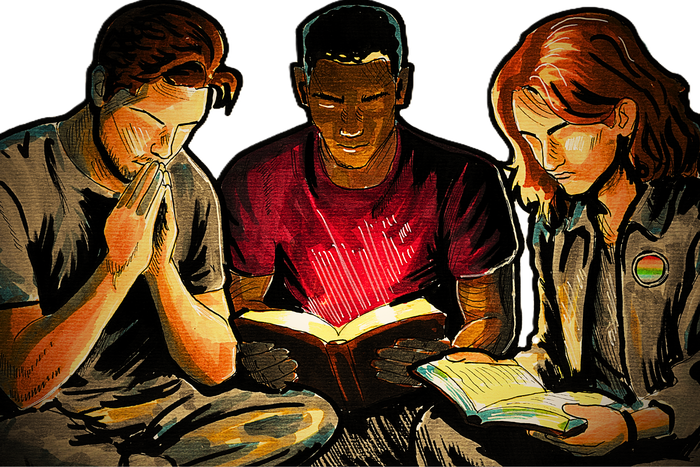
It doesn’t take much arduous searching to find a Christian at Cambridge. The religious history of the University is not a hidden footnote but rather etched into the city’s landscape: in college names, chapels, and churches. Most of all, Christianity is kept alive in Cambridge through the students’ zeal. The Cambridge Inter-Collegiate Christian Union (CICCU) is an unavoidable presence at the University. Just last week, they hosted their annual Events week, this year with the theme of ‘Fulfilled’, with guest speakers and free meals.
Yet in this active religious climate, many queer and progressive Christians are left feeling uncertain of their place.
While CICCU events are open to all and undoubtedly involve students of a variety of beliefs, the organisation adheres to the conservative evangelical doctrinal basis of the Universities and Colleges Christian Fellowship (UCCF). This includes belief in the infallibility of the Bible, the universal sinfulness of humanity, and penal substitution. The churches it promotes – such as St Andrew the Great, Eden Baptist Church, and Holy Trinity Church – also tend to be theologically conservative. In 2022, ministers at Holy Trinity and St Andrew the Great signed an open letter opposing the government’s proposed ban on conversion therapy. The Eden Baptist Church states that all sexual activity outside heterosexual marriage is sinful, and both Eden and St Andrew the Great restrict church leadership to men.
“Several students who were raised Christian found coming to Cambridge a cultural shock”
Several students who were raised Christian found coming to Cambridge a cultural shock. As a Catholic brought up in the aftermath of ‘liberation theology’, which emphasises social justice in the Catholic church, Clare described living in a “little bubble” when it came to faith and social justice, and being “pretty shocked at some of the evangelism I’ve witnessed” in Cambridge. Bea and Natalie, raised in Church of England congregations, also had to adjust. Bea notes: “I’ve always been at a church where women have been in roles of leadership, so that was a big shock.”
Natalie initially was excited at the prospect of meeting other young Christians, after attending a congregation with an older population. She attended some CICCU events with the awareness that they had a “different theology to me, but I was willing to park that because I feel you have to appreciate that people have different beliefs”. However, over the course of her first year at Cambridge, she became increasingly uncomfortable with the people the CICCU chose to platform. She cites CICCU’s inviting Rebecca McLaughlin to speak at one of their events as a moment where she began to pull away from the Union. McLaughlin describes herself as ‘same-sex attracted’, but believes that the bible does not affirm same-sex relationships.
In this environment, Natalie felt she couldn’t voice her liberal opinions comfortably, “because I have and you do get funny looks”. On a bus ride back from a CICCU weekend away, she raised her thoughts on gay relationships and noticed “conversation moved very quickly away from that”. She felt that CICCU hadn’t created a “space that allows for dissent or any form of healthy different opinions”.
In response, Danny King, the president of CICCU states: “We are really sorry that someone was made to feel unwelcome at one of our events. Our purpose as a society is to make the good news of Jesus’s salvation for all known to students in Cambridge, and to be a spiritual home for Christians as well as those exploring the faith. We do hold to evangelical Christian beliefs, including the infallibility of the Bible, but don’t believe this conflicts with seeking to show love and generosity to everyone, including those who disagree, and always strive to do so in all of our activities.”
“Liberal Christians aren’t concentrated in one place in Cambridge, but scattered all around”
An alternative exists in the Cambridge Student Christian Movement (SCM), which the CICCU was previously part of, before splitting in 1910. SCM at Cambridge is an openly progressive, LGBTQ+ affirming society that hosts talks on political theology and queer rights. Their current president Miriam describes the SCM as an “open space where anyone can feel free to come and learn and discuss”. Their vision of faith is one “shown by doing, not by saying”, with activism central to the SCM nationally.
However, the SCM remains small compared to the CICCU. According to Hannah, a former president, funding is a persistent challenge. While Miriam highlights a recent Student Union grant to establish a small SCM library, Hannah recalls that during her presidency, “we didn’t have a budget for snacks,” relying instead on donations from a local vicar. Moving forward, she argues that the society must reflect on its own visibility: “If people aren’t coming to us…why is that?” She reflects on a quote by the former Archbishop of Canterbury, Rowan Williams: “How do we recapture the imagination of the nation of Christ?” To her, this means: “How do we meet people where they are?”
Liberal Christians aren’t concentrated in one place in Cambridge but scattered all around. Bea, Clare, Hannah and Natalie all attend or sing in college chapels, which tend to be more liberal spaces. For example, the Dean and Chaplain of Emmanuel College, Jeremy Caddick, has long campaigned for the recognition of LGBT relationships within the church. Others attend inclusive churches with fewer students. For Reuben, who is a Methodist, this is a benefit, enjoying that on “Sunday morning I can get out of the university world a little bit”.
Others, like Bea, prefer a church with a strong student community, even if that means attending a more conservative place like Holy Trinity. She’s had “really good conversations” with people she disagrees with there and argues that “it’s helpful for some of these people to be reminded that Christianity is broader”. She hopes her presence confronts assumptions that liberal Christians “just don’t believe in the Bible”. Rather, it is the Bible and the example of Christ that often shape progressive Christians’ political perspectives. As Reuben puts it: “Religion is far too all-encompassing, a far too powerful a force in my life for me to separate it (from politics). It’s certainly not a kind of intellectual curiosity to keep away for a Sunday”.
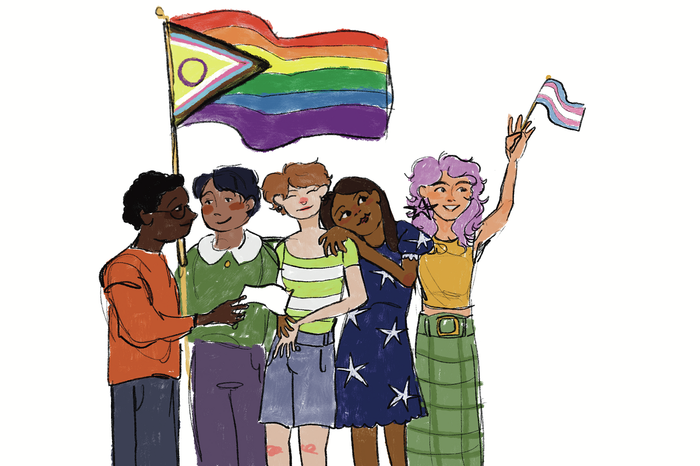
Searching for community in queer Cambridge
You can find great diversity within Christianity at Cambridge (and in the country), if you know where to look. Clare stresses that despite difficulties, “there is space being made within Churches for queer, socially liberal, radically marxist Christians”.
*Names changed upon request
 Features / The language of optimisation and the architecture of merit30 May 2026
 News / Venue cancels Cambridge talk by right-wing commentator Matt Goodwin after backlash28 May 2026
 Comment / We must support our strikers29 May 2026
 Theatre / CUMT’s The Wind in the Willows brings a classic to life 31 May 2026
 Interviews / Cambridge MP Daniel Zeichner on political realism and the ‘politics of grievance’29 May 2026
 Fashion / From princesses to PAs, power dressing is nothing new31 May 2026
 Lifestyle / What kind of punter are you?31 May 2026
- Theatre / CUMT’s The Wind in the Willows brings a classic to life 31 May 2026
 Science / Wired and tired: the science of caffeine31 May 2026
 Interviews / ‘Thank you for the music’: ABBA Support Society on friendship and managing stress through fun 31 May 2026