Accessibility in a neurodivergent wardrobe
Molly Weston investigates the accessibility issues which can present themselves to neurodivergent fashion lovers
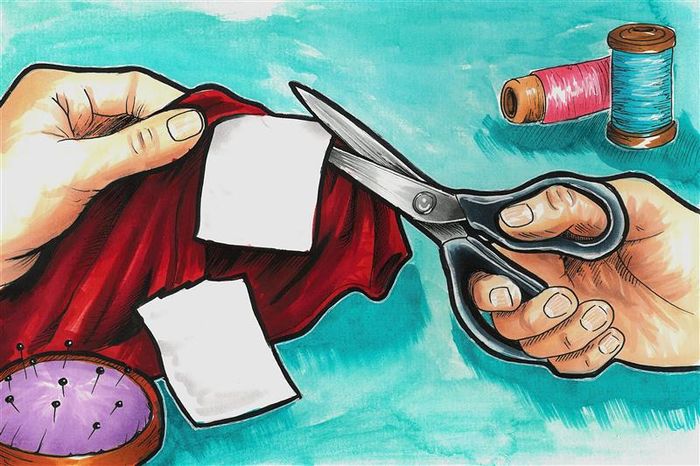
If you’re anything like me, you may suffer from the inevitable appearance of sporadic holes in all your clothing. But before you start thinking my wardrobe has a moth infestation, rest assured: these holes are self-inflicted, the result of tearing out tags and lopping off labels. For neurodivergent people with sensory issues, even a simple clothing tag can feel equivalent to being cheese-grated or having a cactus stuck to your skin. Labels demand to be removed, and with them often goes the structural integrity of your favourite shirt. Only last week, THIIS Magazine reported on a new Intotum poll that found 98% of people with sensory sensitivities say clothing labels bother them, and 91% even take the scissors to those troublesome tags. Walk into any high street store and you’ll also be sure to find raised seams, scratchy synthetic fabrics, rigid waistbands and sharp embellishments like lace or sequins: all completely inaccessible.
It’s a travesty that most clothing isn’t designed to be more sensory-friendly. After all, recent studies suggest that between 69% to 90% of autistic people have a sensory processing disorder. Much of the fashion industry still treats accessibility as optional rather than as something that ought to be built into the fabric of designs. But when seams feel more like sandpaper for a good portion of the population, why are retailers still ignoring the need to adapt?
“They appear as an ‘inclusive’ marketing campaign, only to slowly sidle off the scene in less than a month”
The truth is plain: accessible fashion is overlooked time and time again. On the few occasions the industry has produced adaptive clothing lines, they’ve sadly turned out to be short-term and tokenistic. They appear as an ‘inclusive’ marketing campaign, only to slowly sidle off the scene in less than a month.
To truly be inclusive, companies should consider disability access in the very foundations of designing their products. But instead, it’s as though many just want to say “Look at us! We cater for everyone!” before immediately reverting to inaccessible options. It’s nothing more than window-dressing. The same often goes for physical disability, which is severely underrepresented in fashion media. Accessible clothing is often simply not an option, especially when it comes to mainstream retail stores.
You may, of course, be able to relate to this struggle yourself. After all, around 25% of Cambridge undergraduates have a disability. For those attending Cambridge with sensory processing difficulties, environments like formals can end up feeling like a personally-crafted hell. From loud, echoing dining halls to the buzz of overhead lighting, many neurodivergent students already find formals overstimulating. For some, being forced to wear a stiff shirt, heavy gown and a choking tie is like the cherry on top of a nightmarish sensory cake.
“Inclusive fashion shouldn’t be a fancy, hidden-away special collection; it should be the bare minimum baseline for all clothing”
Surely if sensory-friendly formalwear were readily available, neurodivergent students could enjoy Cambridge’s traditions without the discomfort and anxiety caused by clothing that fails to prioritise accessibility. Even removing scratchy labels and printing care instructions directly onto clothing would be a simple step in the right direction.
While we clearly still have a long way to go with mainstream brands, there are luckily smaller businesses offering functional fashion. Cyber Cherry Clothes, for example, sells sustainable, affordable garments on Depop and Vinted, tailored to sensory needs. It’s all second-hand, alternative clothing – a bit like walking into a vintage store designed specifically for neurodivergent people. They even offer curated bundles for all of your sensory (and style) needs. Similarly, Intotum provides clothing designed to “bridge the gap between function and fashion,” with ethically manufactured garments that were featured during London Fashion Week 2025.
The line of best fit
Although I am glad that small and independent businesses like this exist, they only highlight how appalling the rest of the fashion industry is at meeting these needs. Why should neurodivergent people have to hunt through niche websites and reach the deepest depths of the Internet just to find clothing that doesn’t cause them pain? Inclusive fashion shouldn’t be a fancy, hidden-away special collection; it should be the bare minimum baseline for all clothing.
Removing barriers benefits everyone. I hope that, eventually, accessible clothing enters the mainstream. From seam-free socks to tagless trousers, fashion should truly be for all of us.
 Comment / The Cambridge drift1 June 2026
 News / Cambridge psychologist warns against blanket social media ban for under-16s1 June 2026
 News / University support staff strikes end after month of action2 June 2026
 News / News in Brief: Corpus climbing, climate cash, and commendable contributions1 June 2026
 Music / We need to talk about Kendrick2 June 2026
 Comment / Top of the slops: the competitiveness of college dining4 June 2026
 Interviews / Bible Scholar Mattie Mae Motl: “God is a woman”4 June 2026
 Features / One big happy (college) family?4 June 2026
 Theatre / Bold beginnings in the Corpus Playroom 3 June 2026
- Music / We need to talk about Kendrick2 June 2026