The line of best fit
Jess Gotterson investigates the resurgence of a historical favourite
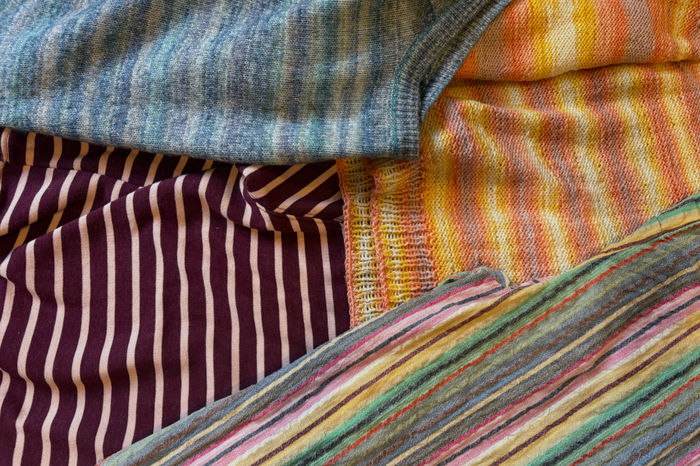
Having just purchased three new stripe-adorned items of clothing, you may now call me the self-proclaimed queen of the stripe. Maybe it was the graphics GCSE that trained my eye to love the way in which a clean, crisp stripe can cut through a blank canvas. Maybe it's the surge of energy that stripes send rippling through my wardrobe, and the vibrant colours they come in. Whatever it is, my new obsession left me researching the psychology of striped clothing, and why exactly it has suddenly become the pattern within the fashion world.
Fashion trends are constantly dying and resurfacing just when you thought they wouldn’t. Stripes, however, have always been timeless, and have always stood out. It’s hard to ignore anyone wearing them because their bold appearance automatically demands attention, and historically, that was precisely the point. Their history is tied to a long line of nonconformity. Stripes were a class signal, “a mark of the outsider – linked to jesters, sex workers, and prisoners, those who existed on the fringes of society”. But, whereas wearing stripes was once shameful, it’s now desirable. Throughout time, stripes appear to have signalled a desire to look different, and the participation in a long visual history of ‘standing out’, even as the popularity of the stripe threatens to dilute that very distinction.
“Stripes refuse to perform gender too loudly, worn by all”
Coco Chanel is renowned for bringing stripes to the 20th century. Though her connection to the nautical Breton stripe is sometimes exaggerated, photographs have captured her enjoying the comfort of a striped shirt with effortless assurance. After the iconic blue and white shirt became the uniform of the French Navy in 1858 (the high contrast designed to allow sailors who’d fallen overboard to be easily spotted), Chanel reintroduced the pattern to womenswear in 1917, thus binding women to French seaside holidays and relaxed leisure chic. Artists too gravitated toward them; Pablo Picasso famously wore stripes to work and later, stripes were elevated as they became Jean Paul Gaultier’s signature style. Audrey Hepburn too wore them determinedly, both on and off screen. Stripes then, refuse to perform gender too loudly, worn by all, foundational in menswear but equally now staples for women. Perhaps polka dots exude a slightly more playful, feminine energy, whereas stripes, helped by designers like Gaultier who placed men in striped skirts, are androgynous.
“Has their rebellious edge been erased once and for all following their flurry of fame?”
The rules that fashion force us to uphold, regarding our bodies and how they should look, are broken, and redrawn, by stripes – it all depends on how we choose to wear them. They play with the eye. The Helmholtz illusion explains how a pattern like stripes can distort vision: a square with horizontal stripes will seem taller, expanding the space in the direction opposite to the lines, while one with vertical stripes appears wider. Stripes automatically create movement as the eye is forced to travel along them, and Helmholtz’s illusion demonstrates such a phenomenon, as well as the powerful capabilities of what might otherwise appear a simplistic pattern.

It is often said that there is also something undeniably optimistic about stripes – a confrontational kind of optimism – how can you be faced with the pattern which adorns deckchairs, helter-skelters, sticks of rock, and also adds to ‘the festive charm’ of a candy cane, without feeling so much as a flicker of joy? Maybe it’s this that’s been drawing me to them (seeing even the tiniest hint of positivity in the mirror can instantly make a bad day with a 9am essay deadline much, much better).
The final question for me now lies in whether stripes have become too safe? Has their rebellious edge been erased once and for all following their flurry of fame, or will they continue to showcase confidence, individuality and positivity? They certainly succeed in challenging minimalist fashion and its many beige shades; a breath of fresh air for all the maximalists out there. Perhaps stripes are the line of best fit for 2026 fashion.
 Comment / Top of the slops: the competitiveness of college dining4 June 2026
 Interviews / What’s the story behind Pages coffee house?8 June 2026
 News / News in Brief: Cambridge crowns, council confirmations, and competitive cricket8 June 2026
 Comment / The Cambridge drift1 June 2026
 News / Cambridge researchers produce ‘world-first’ AI vaccine6 June 2026
 Arts / Don’t rush me – I’m reading!9 June 2026
 Lifestyle / Don’t Cry at Me, Argentina – a next-year abroad story8 June 2026
- News / News in Brief: Cambridge crowns, council confirmations, and competitive cricket8 June 2026
 Science / Failure is the foundation of science8 June 2026
 Fashion / The hidden gems of formal fashion8 June 2026