So, do feminists wear pink?
Arushi Dattani wrestles with the historically contentious relationship between feminism and feminine fashion

For as long as I can remember, the colour pink has always been associated with femininity and little girls. Given my age, that’s probably not saying much. In fact, contrary to popular belief, the association of girls with pink is actually a relatively new concept, dating to around World War II. Before then, girls were often associated with blue and boys with pink. Go even further back, to before the 20th century, and both genders were dressed very similarly up until the ages of five-to-seven. So why did we suddenly develop gender-coded colours?
Originally, all children were dressed in white dresses for practicality (dresses for movement and white to bleach out stains). However, by the 20th century, after a trend in pastel colours, magazines were starting to promote pink for boys (considered as a dominant colour, being a lighter version of red) and blue for girls (as it was more ‘dainty’). After World War II, blue started to be seen as a more masculine, military colour, while pink started to be associated with domesticity, leading to a reversal in the genders of the two colours. Marilyn Monroe reinforced these stereotypes through wearing a hot-pink dress in the film Gentlemen Prefer Blondes, which firmly established the link between pink and femininity. In the 80s, with new ultrasound screenings, enabling the gender of babies to be determined before birth, there was an increase in the marketing of gendered colours. Films such as Mean Girls further promoted the pink stereotypes, although Legally Blonde did its best to distance itself from the stereotype of the pink-loving ‘dumb blonde’.
“Even households who resolve to bring up their children in gender-neutral environments will struggle”
Nowadays, if you walk into a girls’ section in a clothing or toy shop, you will immediately be struck by a sea of pink. From the moment a child is born, they will be surrounded by the colour assigned to their gender. Girls will be given pretty pink dresses and dolls, whereas boys will have blue baby grows and similarly coloured trucks and cars. Even households who resolve to bring up their children in gender-neutral environments will struggle. My parents managed to hold out for two years, until one relative decided to “treat me right,” buying me a doll and princess dresses! Even now, my wardrobe is still disproportionately made up of pink items.
Over the past couple of decades, many movements associated with feminism have been trying to raise awareness about gendered colours and discouraging parents from forcing them on their children. However, I can’t help but think that they’re going about it the wrong way.
When you think about feminists, words that almost never come to mind are ‘pink’ and ‘dresses’. Over time, we seem to have developed stereotypes of people who hold these political ideals: short hair, trousers and no make-up. While this may describe some feminists, we’re leaving out so many others who may not fit these stereotypes. Some people may not even identify themselves as feminists simply because they don’t fit these generalisations. It’s easy to see how these ideas have come in place. We believe that to be a feminist, you have to renounce all gender stereotypes. This would seem to include rejecting traditionally ‘feminine’ clothing such as dresses and skirts. However, being a feminist is more complicated than that. It’s true that you tend to rebel against gender stereotypes, however, in my opinion, that doesn’t necessarily mean you can’t wear clothes or colours that are considered to be feminine.
“The problem comes when we try to determine people’s political beliefs or judge or classify them based on the clothes they wear”
Personally, I believe that feminism doesn’t mean rejecting everything considered feminine, but rather it means the freedom to choose. It means that we shouldn’t associate any colour or clothing with any one gender and we should allow women to decide for themselves what they want to wear. And if we choose to wear dresses or pink, it shouldn’t mean that we’re classed as a ‘girly girl’. Similarly, we shouldn’t be called a ‘tomboy’ if we choose to wear jeans or trousers or have short hair. By using these names, we’re restricting women to those labels and ideas of gender. It’s perfectly possible to like both girly and tomboyish styles, to wear pink and blue, dresses and trousers. The problem comes when we try to determine people’s political beliefs or judge or classify them based on the clothes they wear.
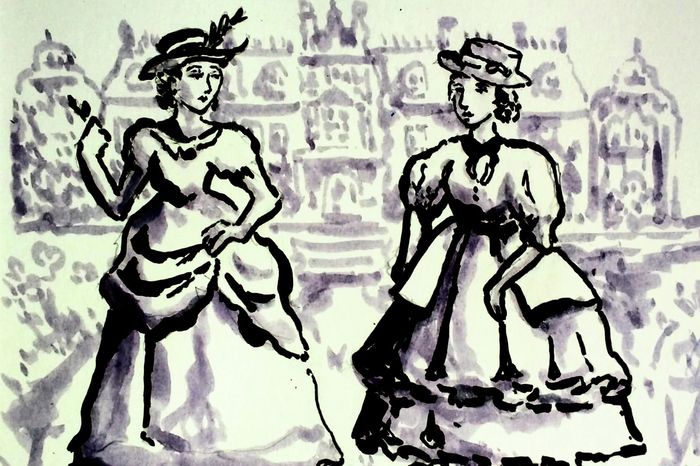
A history of Cambridge women's fashion
It’s true that clothes are an amazing form of self-expression – we can choose to say different things about ourselves through our outfits – but, our clothes should never limit us. We shouldn’t be afraid of wearing a dress if we’re feminists or think we’ll be called ‘girly’ for wearing pink. We should be able to wear what we want without fear of being judged by others. Now, I’m not saying that we should replace Cambridge Blue with Barbie Pink – quite frankly, that’d be ghastly – but I’m saying that we should all have the liberty of self-expression without being limited to pre-existing ideas of what we are and are not allowed to wear. As for me, I’ll be wearing my pink jumpers proudly to lectures this term – because of, not in spite of, my feminist beliefs!
 Comment / Top of the slops: the competitiveness of college dining4 June 2026
 Interviews / What’s the story behind Pages coffee house?8 June 2026
 News / News in Brief: Cambridge crowns, council confirmations, and competitive cricket8 June 2026
 Comment / The Cambridge drift1 June 2026
 News / Cambridge researchers produce ‘world-first’ AI vaccine6 June 2026
 Arts / Don’t rush me – I’m reading!9 June 2026
 Lifestyle / Don’t Cry at Me, Argentina – a next-year abroad story8 June 2026
- News / News in Brief: Cambridge crowns, council confirmations, and competitive cricket8 June 2026
 Science / Failure is the foundation of science8 June 2026
 Fashion / The hidden gems of formal fashion8 June 2026