Are pedestrians more irritating in Cambridge?
Bibi Boyce and Ellie Buckley go head-to-head in this wheel-y heated debate
Bibi Boyce
As a fresher, if I found a pedestrian in my path while cycling, I would swerve round them, roll my eyes, and silently curse the wheelless fool in my way. Now, as a more seasoned veteran of the rather poor Cambridge road surfaces, I find my thumb perched ready on my bicycle bell. In recent history when my incessant ringing has failed, I’ve even opted for the all-time classics of “oi” and “move” delivered in a raised voice and sharp manner, accompanied by a furrowed brow – if people looked both ways before crossing the road, or didn’t walk four abreast with two small children in the middle of Trinity Street, then maybe we wouldn’t have this problem.
Even as an adamant cyclist, when stripped of my wheels and reduced to pedestrian status, I am confident I do not transform into a day-dreaming idler. I can feel my legs itching to overtake. The 2008 Dark Knight quote “die a hero or live long enough to see yourself become a villain” is not lost on me, but do not be mistaken: you will never find me standing aimlessly gawking at King’s Chapel with both feet planted in different potholes on King’s Parade, nor with an apple atop my head while I soak up space on the pavement outside of Trinity. Mind you, the real apple tree is in Grantham, and, as a second year Phys NatSci, I find this continued perversion of the truth (the apple did not land on Newton’s head) overwhelmingly irritating – but this, I’ll allow, can remain a personal gripe.
“You will never find me standing aimlessly gawking at King’s Chapel with both feet planted in different potholes on King’s Parade”
This sentiment carries through to non-cycling students: a close friend of mine is sure of her ability to get from Murray Edwards to New Museums in 13 minutes on foot, and she’ll complain profusely if dawdlers push that limit and create a late arrival to a seminar. Following this, I’d bet my Nectar card that the residents of Cambridge feel a similar sense of dismay when the weather forecast is a positive one, ensuring a packed city on a day that necessitates focused errand-running.
But this is what leads us to the crux of the issue. If it’s not the locals or the students clogging the pavements, that leaves one obvious category: the tourists. This conclusion is far from new. We all love to complain about someone taking photos of us cycling down this lane and over that bridge, yet will turn around and take that same photo when the sun hits the limestone just right. I’m not going to play into this hypocrisy. I recently went to Oxford and did my duty by capturing the RadCam on my iPhone camera, and when in Florence I forced my mother to take numerous pictures of me attempting to recreate Botticelli’s iconic The Birth of Venus. Tourists everywhere are annoying, but I’m convinced they’re worse in Cambridge.
“Tourists everywhere are annoying, but I’m convinced they’re worse in Cambridge”
I’ve walked along Oxford Street on the 20th of December and yet still find a warm Spring weekend worse in Cambridge, and every day it becomes more apparent to me what the problem is: the infrastructure. Cambridge is cramped. A medieval city essentially built on a university campus, Cambridge is simply not designed to host this much foot (and wheel) traffic. Shops and cafés are squeezed into corners and narrow pavements facilitate frequent bottlenecking – it’s much more obvious that someone is in your way when you can’t get around them without stepping into the path of a vehicle.
But there’s another, more in-your-face, reason to blame the infrastructure for snail-paced shuffling, and that’s its appearance. The architecture of (typically) the central colleges is undeniably a sight to behold. Just because we, as students, see it everyday does not mean we have any grounds on which to diminish the aesthetic appeal of the city to tourists (although I will continue to question the specific appeal of the Corpus Clock). A world famous historic university, with fantastic buildings and a convenient distance from London makes for the perfect day trip, and when combined with a city designed for academics and horse-drawn carts, it’s inevitably going to be a recipe for disaster. For these reasons, we ultimately cannot blame the tourists.
“Tourists walk up from the station, get to Emmanuel, and forget that they’re entering a real city”
Thankfully, for the more antagonistic among us, I have thought of a reason where we can blame the tourists. For me, at least, this reason underpins exactly why the visitors that overwhelm Cambridge are, on average, lacking in self-awareness when compared with tourists in other cities. The infrastructure and relatively small size of Cambridge create an almost ‘model-village’ feel. Tourists walk up from the station, get to Emmanuel, and forget that they’re entering a real city – suddenly, they are in a magical fantasy land of attractive buildings, intellectuals and Harry Potter rip-off gift shops. In fairness, it may not be immediately obvious that the romantic cobbled lanes are in fact one-way roads. However, you’d think seeing one bike fly past would actualise this, but I’d argue that object permanence also vanishes upon entry.
So, personally, I will continue to ring my bell as an attempt to pull the tourists back to reality, while simultaneously recognising that they’re perfectly welcome to visit. Besides, I’d probably be more sympathetic to the mooching if they got more inventive with their touristic ventures – so do let me know if you see anyone attempting the ‘Leaning Tower of the UL’ pose.
Ellie Buckley
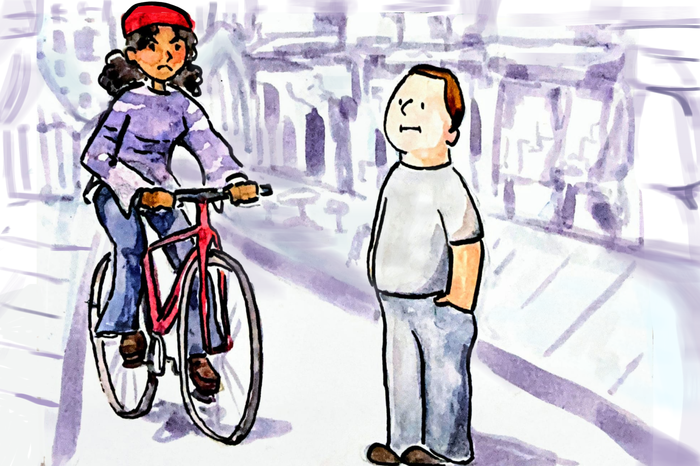
Cambridge’s old, cobbled, winding streets are perfect for meandering, getting lost in your thoughts, admiring the shop fronts and pretending you’re in a sepia photograph … until a harsh BBRRRIIINGGG brings your daydream crashing down. Such a return to reality is caused by a two-wheeled machine that glides past, forcing you into a hedge in a move that feels less like stepping aside and more like bowing to a monarch. Many times I’ve been walking along and had to sacrifice my space for two bikes coming from either side, or had a bell rung furiously at me on a path so wide you could land a small aircraft on it. And this is all while I am already ankle-deep in mud because the cyclist seems to think they’re manoeuvring a tractor rather than a feather-light vehicle, wielding speed as if it were a constitutional right.
“The city reveals itself at walking pace, not at the velocity of someone checking their watch at every junction”
Of course, the cyclists will say the opposite. Pedestrians are the unpredictable ones. We stop suddenly, we drift, we walk around aimlessly and three-abreast like a human barricade. We take photographs of King’s, Rose Crescent and Catz as if it hasn’t been photographed before. We step into the road without looking, headphones in, latte in hand, living proof that self-preservation is no longer fashionable. To the cyclist, we are chaos embodied – slow, unaware, and everywhere, an affront to the clean geometry of their route planning.
But walking is meant to be slow, an opportunity to admire the things that pass you by on the daily. The city reveals itself at walking pace, not at the velocity of someone checking their watch at every junction. On a bike you are in permanent transit, your relationship with Cambridge reduced to a series of obstacles and short cuts, a tactical map rather than a lived space. To walk is to notice the small beauties of the city where we live: the way the light hits the chapel stone, to overhear half a supervision argument, to pause on a bridge and admire the view without calculating where to lock your bike or whether it will still be there when you return.
“Efficiency, the cyclist’s favourite word, is more myth than reality”
Efficiency, the cyclist’s favourite word, is also more myth than reality. Getting the bike out of the bike shed, putting on a helmet, finding lights that actually work, unlocking the D-lock with frozen fingers, circling endlessly for somewhere to chain it up. And then, arriving at lectures flushed and dishevelled, helmet hair announcing your exertion before you’ve even said hello, as if punctuality must always come with evidence of athletic effort. The pedestrian, meanwhile, continues in a straight, uninterrupted line, not negotiating with railings and racks.
Cyclists argue that they are environmentally virtuous, the moral high ground on wheels. And yes, they are better than cars – but this does not automatically grant the right to occupy both pavement and road as mood dictates. On the hill, they ring bells at pedestrians while a perfectly good bike lane sits to their right unused, like a decorative suggestion. The bell, defended as a courteous warning, lands less like a request and more like an instruction to clear a path immediately. If the aim is to move with the authority of traffic, then join the traffic. Likewise, if you lack the confidence to ride on the road, then don’t ride a bike at all. The selective use of pedestrian space only when convenient feels less like sustainable transport and more like spatial opportunism.
“The cyclist weaves through and sees inefficiency; the pedestrian sees a city being experienced and lived in”
What makes Cambridge uniquely combustible is that the city was not designed for any of this. Not for the volume of pedestrians, not for the number of bikes, certainly not for large vans wedged into streets built for horses. On a Saturday or any public holiday the pavements become an obstacle course: prams, tour groups, street performers, people queuing for coffee as if it is a matter of national importance. The cyclist weaves through this and sees inefficiency; the pedestrian sees a city being experienced and lived in, a place where stopping is not a failure of movement but the whole purpose of being there. Unlike the tourists who come to admire, it is easy to not appreciate the beauty we live in, especially when we move at rapid paces every day.
And perhaps that is the real divide. Cyclists experience Cambridge as a route – a network of shortcuts, gradients, and tactical overtakes, seconds shaved only to be surrendered at the next red light or the next tangle of handlebars. Pedestrians experience it as a place. The irritation on both sides comes from these incompatible purposes. To the cyclist, the walker is in the way. To the walker or tourist, the cyclist is missing the point.

Cambridge was established six centuries before the bicycle, and its streets still carry that memory. The thin wonky paths reward slowness (if not for the need to appreciate their beauty, then for the fear of falling over). They reward attention. They reward the person who is willing to take the long way round simply because it is beautiful. You cannot do that at 15 miles an hour while ringing a bell at someone’s back.
So yes, pedestrians drift and take up space. We are, at times, infuriating. But we move at the speed the city was built for, and if that means occasionally stepping into the grass to avoid a bell-ringing blur of high-vis and moral superiority, then at least we have time to notice where we are – and, crucially, we do not expect the entire pavement to rearrange itself for our arrival.
 Comment / Top of the slops: the competitiveness of college dining4 June 2026
 Interviews / What’s the story behind Pages coffee house?8 June 2026
 News / News in Brief: Cambridge crowns, council confirmations, and competitive cricket8 June 2026
 Comment / The Cambridge drift1 June 2026
 News / Cambridge researchers produce ‘world-first’ AI vaccine6 June 2026
 Arts / Don’t rush me – I’m reading!9 June 2026
 Lifestyle / Don’t Cry at Me, Argentina – a next-year abroad story8 June 2026
- News / News in Brief: Cambridge crowns, council confirmations, and competitive cricket8 June 2026
 Science / Failure is the foundation of science8 June 2026
 Fashion / The hidden gems of formal fashion8 June 2026