The ‘class’ of Cambridge
Beth Wade argues that class divisions in our social interactions are often based more on negative preconceptions than reality

Every university has its stereotypes. Nottingham and Leeds are for the party lovers, Durham’s full of Oxbridge rejects, and according to many sources, Bristol apparently has a serious affliction of vegans. As for Cambridge, well, I would be surprised if at least a third of the student body hadn’t heard some version of “isn’t that university really posh?” before getting here, or had been told to watch out for any miscellaneous ‘Tarquin’s’ roaming the streets. Speaking of which, I haven’t met a Tarquin yet. I feel slightly cheated. The point of the matter is this – does Cambridge still deserve its Tarquin-infested reputation?
“People can’t help what tax bracket they’re born into, after all”
As in the past education was only an option for the rich, it makes sense that an academically prestigious institution like Cambridge would have traditionally had more of an upper-class cohort within its walls. With its old-fashioned ceremonies and rich history (figuratively and literally), it seems clear that this is the student body that it would attract. However, with some state schools having made the monumental rise from horrific to kind of okay, reaching an educational standard that can get their students into top universities, I must wonder if the tides have shifted slightly. Something must have caused the sudden deficit in people bragging about their fashionable summer houses in the south of France.
Has the rising influx of state school kids completely shifted the atmosphere of the university? I find that hard to believe. As far as I can tell from my short time here, nothing ever seems to change that much in Cambridge – it’s a defining characteristic. A few percentage points of a rise within a group of the student body certainly wouldn’t be able to change it. Additionally, the University’s admissions statistics still show a relatively large intake of private school students. So, perhaps the gap between stereotype and reality has not – or not only – been caused by the increase in quality of state schools, but by our own misconceived perceptions of what private school kids are like.
“Whoever wanted completely normal friends, anyway?”
Now, don’t get me wrong – I’m sure private school kids who embody the stuck-up stereotype both exist and are thriving within various Cambridge colleges. But, as someone who was told to expect the worst, I’ve found the private or boarding school kids at my college to be relatively … normal? Sure, some of them do have terrifyingly long names, but I will be the first to admit this has no direct impact on their character.
From what I can tell, we state schoolers seem to hold similar prejudices towards private schoolers now as they did towards us in the past. People can’t help what tax bracket they’re born into, after all; these stereotypes are doing nothing more than making an already nerve-racking transition from home to university all the more terrifying. At the end of the day, if you do run into a stuck-up trust fund baby who brags nonstop about his three houses and tenth-generation Oxbridge lineage, at least it’s a funny story to tell your friends at home.
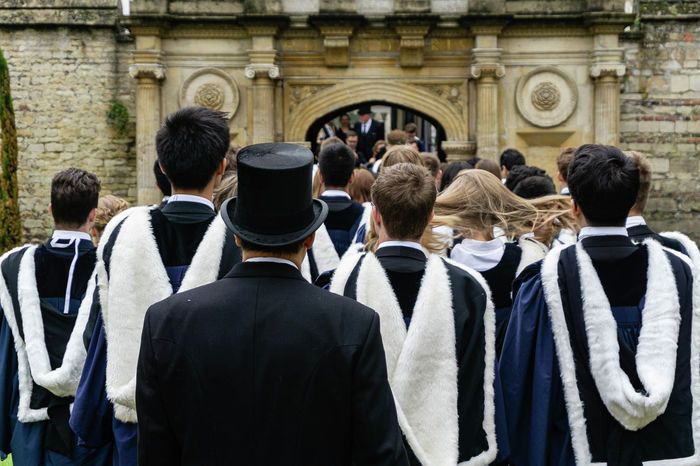
So, to all the state schoolers hesitant about applying to Cambridge because of its upper-class reputation who are probably not reading this, have no fear! The people here are generally as friendly as at any other university, and at least mostly normal. Whoever wanted completely normal friends, anyway? And to all the current students at Cambridge who hopefully are reading this, try not to let your prejudices affect your experience. You never know, that one person you’ve been avoiding because of their private boarding school background could be just the type of person you get along with best.
 Comment / Top of the slops: the competitiveness of college dining4 June 2026
 Interviews / What’s the story behind Pages coffee house?8 June 2026
 News / News in Brief: Cambridge crowns, council confirmations, and competitive cricket8 June 2026
 Comment / The Cambridge drift1 June 2026
 News / Cambridge researchers produce ‘world-first’ AI vaccine6 June 2026
 Arts / Don’t rush me – I’m reading!9 June 2026
 Lifestyle / Don’t Cry at Me, Argentina – a next-year abroad story8 June 2026
- News / News in Brief: Cambridge crowns, council confirmations, and competitive cricket8 June 2026
 Science / Failure is the foundation of science8 June 2026
 Fashion / The hidden gems of formal fashion8 June 2026