Does Cambridge lack spaces for creative freedom?
Cambridge’s artistic communities are too scattered, says Jessica Leer

As I write this, I am faced with a pile of sketchbooks from my time at university. Far less filled than my previous ones, I have become sluggish in my creative process as I must balance it with my degree. Only recently have I started to discover who I want to be as an artist, something I thought I had worked out at sixteen which has become completely redundant since then. Despite the mountains of May Ball graphics and Varsity illustrations behind me, I remain, like many others, an artist isolated in the world of Cambridge. When I consider my environment, it is purely luck which has brought me some semblance of an understanding of who I am as an artist.
When starting Cambridge, many of us look for somewhere to feel at home in a new place. Whether it be forgotten loves or hobbies we have retained like an old friend, we find a way to be ourselves in a new environment. What is immediately clear is a lack of larger university arts societies. Instead we see college societies or roles in non-art related clubs. Art is a solitary pursuit here. Without a clear art scene (specifically visual art in my case), Cambridge lacks a space to explore who you are as a creative. Despite many opportunities, from poster designers to social graphics, art is usually seen as a small role in a larger event rather than having its own space. This means artists run relatively separate from each other, lacking a space to connect and develop.
“Artists run relatively separate from each other, lacking a space to connect and develop”
Within the art spaces we do have, life drawing continues to remain the dominant form of art. Consequently, Cambridge has defined itself by traditional forms of art and those who have had the privilege to enjoy and learn them. Life drawing, despite being a good technical practice, is a traditional skill which not everyone has had access to prior to university. Life drawing spaces lack the creative freedom for artists to ask who they want to be. It is a pursuit of skill and practice without knowing what you are doing it for. Art in Cambridge is posed (no pun intended) through a traditional lens where the priority is technical superiority over self-expression.
Here we must ask, has Cambridge cultivated an exclusivity within its art ‘scene’ (paying particular attention to the quotation marks)? Life drawing was something myself and others experienced rarely before uni, which usually meant sneaking out to ditch school to catch long trains to attend. Here, life drawing is a central aspect of what we consider the visual arts within Cambridge, despite it being a privilege in many places to have access to life drawing events.
Although life drawing events in Cambridge are often budget friendly or free, many people I have met feel unwelcomed at such events. Society events like ArcSoc’s life drawing do not make it easier when upon entry you are met with a drawl of esoteric music and architecture students whose technical precision in their degree is reflected on the pages in front of them. Despite my place as an architecture student, no matter how much art I have consumed or drawings I have done, I find myself, like many others, an outsider in a life drawing class.
“The pursuit of art remains confined into the realm of a hobby or pursuit rather than an actual career opportunity”
Communities like life drawing seem to dominate the art spaces in Cambridge, leaving little room for other disciplines. Rarely do we see high level art societies which give space to artists exploring creative outputs. Cambridge has a lack of artistic diversity, focusing only on giving space to the traditional way of creating ‘art’. We lack illustrators, ceramicists, painters. In the end, we end up with a culture of performance, in constant pursuit of perfection.
These traditional paths of what we consider acceptable forms of creativity further drive the idea that art is only meant to be made in one way. In Cambridge, art can only be created by those with access to the ideas and teachings which are historically exclusionary. There is an assumption of trips to galleries, connections to those who have the finances to devote their life to art without the worry of monetary gain. Art is free, art is a way of living, yet never acceptable as a way of gaining monetisation.
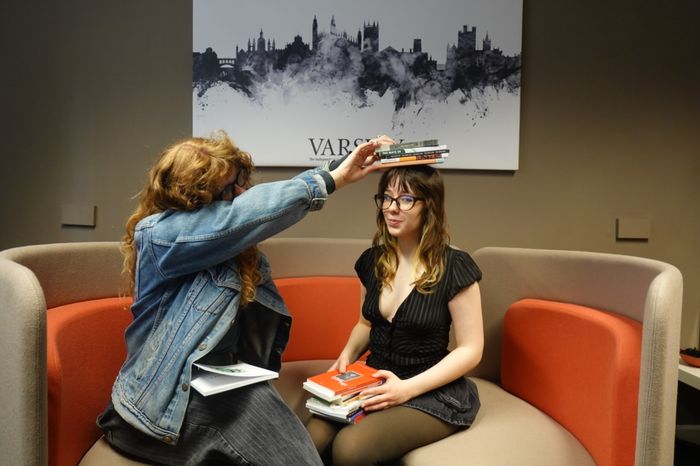
The pursuit of art remains confined into the realm of a hobby or pursuit rather than an actual career opportunity. Consequently, the culture around art in Cambridge frames it as a reflection of the artist, the students with the time to pursue it. Often, artists are asked for work, society logos, private projects, without considering that they would want compensation. The definition of art remains traditional, often played in the voyeuristic landscape of a life drawing events, it is a performance of class and those can afford the luxury of pursuing art.
Consequently, Cambridge lacks, not in illustrators or artists, but a shared culture which is built around a shared love of creation. Instead, we are faced with an exclusionary art scene which is more focused on who belongs and who does not. We remain stuck in a game, one most of the world has moved on from, of who deserves to be considered an artist.
 Comment / Top of the slops: the competitiveness of college dining4 June 2026
 Interviews / What’s the story behind Pages coffee house?8 June 2026
 News / News in Brief: Cambridge crowns, council confirmations, and competitive cricket8 June 2026
 Comment / The Cambridge drift1 June 2026
 News / Cambridge researchers produce ‘world-first’ AI vaccine6 June 2026
 Arts / Don’t rush me – I’m reading!9 June 2026
 Lifestyle / Don’t Cry at Me, Argentina – a next-year abroad story8 June 2026
- News / News in Brief: Cambridge crowns, council confirmations, and competitive cricket8 June 2026
 Science / Failure is the foundation of science8 June 2026
 Fashion / The hidden gems of formal fashion8 June 2026