Why the Romantics were wrong
Forget the room, says Zoe Large, a whole city of one’s own is there for the taking

Even if you know nothing else about Virginia Woolf, you’ve probably heard her most famous maxim: that “a woman must have money and a room of her own if she is to write fiction”. Feminist concerns aside, this notorious statement seems to confirm a basic common sense truth. Surely works of great genius can’t be produced amidst the hustle and bustle of the city, with all its barking dogs, hooting vehicles and screaming children? They require space to develop; silence in which ideas can be fully processed and explored.
Woolf’s words are being taken literally by the Hosking Houses Trust – a registered writers’ charity founded in 1999. Its purpose is to offer selected applicants rent-free accommodation in the rural site of Cottage Chambers, supporting talented writers by giving them space to work outside the city. Likewise, the Arvon Foundation aims to take members of its writing course to ‘a secluded atmosphere where there are no distractions, other than the beautiful countryside’, imbuing them with rural ‘sustenance and inspiration’. (Quoted from www.arvonfoundation.org).
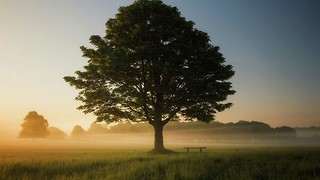
The logic behind such projects coheres with the artistic theories of Blake and Wordsworth, Emerson and Thoreau. It’s difficult to argue when Wordsworth denigrates the anesthetizing effect of the city, because his writing seems to support his claims – his belief that the Imagination is properly nourished only by rolling hills and unpolluted skies. “Humble and rustic life’” he argued, was where “the essential patterns of the heart find a better soil”. The wandering, meandering lifestyle upheld in his poetry is certainly at odds with the frenzied pace of modern London.
Apparently, we don’t have the patience to browse for books any more, let alone write them. Digital stores such as Amazon proudly lead us directly to our goal while showing us virtually nothing along the way. Cities provide a hub for this kind of technology: devices which save time, but inevitably prevent the expansion of our imaginative world. Conceived as nothing more than the sum of mechanised parts, cities lack the subtleties which inspire great writing.
Engineers cannot design epiphanies, computers cannot measure alliances or associations, and marketers do not deal in meaning or emotion. Add people into the mix, however, and this landscape turns into a repository of possibility. Cities might be built by men, but they always contain more than any one inhabitant can know. Perhaps they run to fulfil inhuman criteria of efficiency and predictability, yet the by-products, at the level of the individual, are refreshing possibilities for anonymity and infinite variety.
This year marks the 200th birthday of Charles Dickens, whose continuing popularity is affirmed by the thousands of festivals and events being held to celebrate his life’s work. Dickens’ acclaim owes much to his vivid and intricate explorations of urban dwellings. Famously hailing London as his ‘magic lantern’, his novels evokes the city in terms which praise industrial progression. Dreams realised are often placed in vibrant proximity to dreams deferred; thriving trade reproduced alongside grubby opium dens.
In fact, these are the juxtapositions highlighted within any city, yet they are always more easily appreciated in fiction. Reading the novels of Dickens or Defoe, we can come to appreciate London as its own sort of wilderness – the perfect landscape in which to get lost, or expand our horizons. How ironic, then, that many writers feel the need to escape its bounds in order to produce great work. Rather than indicating any debilitating quality in the atmosphere of cities themselves, this notion reveals a problem in our own attitudes to the world around us.
In her beautiful book Storming the Gates of Paradise, Rebecca Solnit longs for a ‘public landscape in which we can roam the streets at midnight, in which every square is available for Virginia Woolf to make up her novels’. Her solution to Woolf’s maxim is not an escape from the city, but a reclamation of public space. Urban sites can be used to our advantage, and material circumstances are only distracting if we work against them rather than alongside them. The metropolis will become the home of the imagination when it is welcomed and treated as such – approached, no less than rocks and soil, as an environment to be ‘roam[ed]’, explored and enjoyed.
 Comment / Top of the slops: the competitiveness of college dining4 June 2026
 Interviews / What’s the story behind Pages coffee house?8 June 2026
 News / News in Brief: Cambridge crowns, council confirmations, and competitive cricket8 June 2026
 Comment / The Cambridge drift1 June 2026
 News / Cambridge researchers produce ‘world-first’ AI vaccine6 June 2026
 Theatre / The recipe to success this Easter term 10 June 2026
 Music / To Be Forever Yung10 June 2026
 Comment / ‘On the Poverty of Student Life’: sixty years on10 June 2026
 Arts / Don’t rush me – I’m reading!9 June 2026
 Lifestyle / Don’t Cry at Me, Argentina – a next-year abroad story8 June 2026