
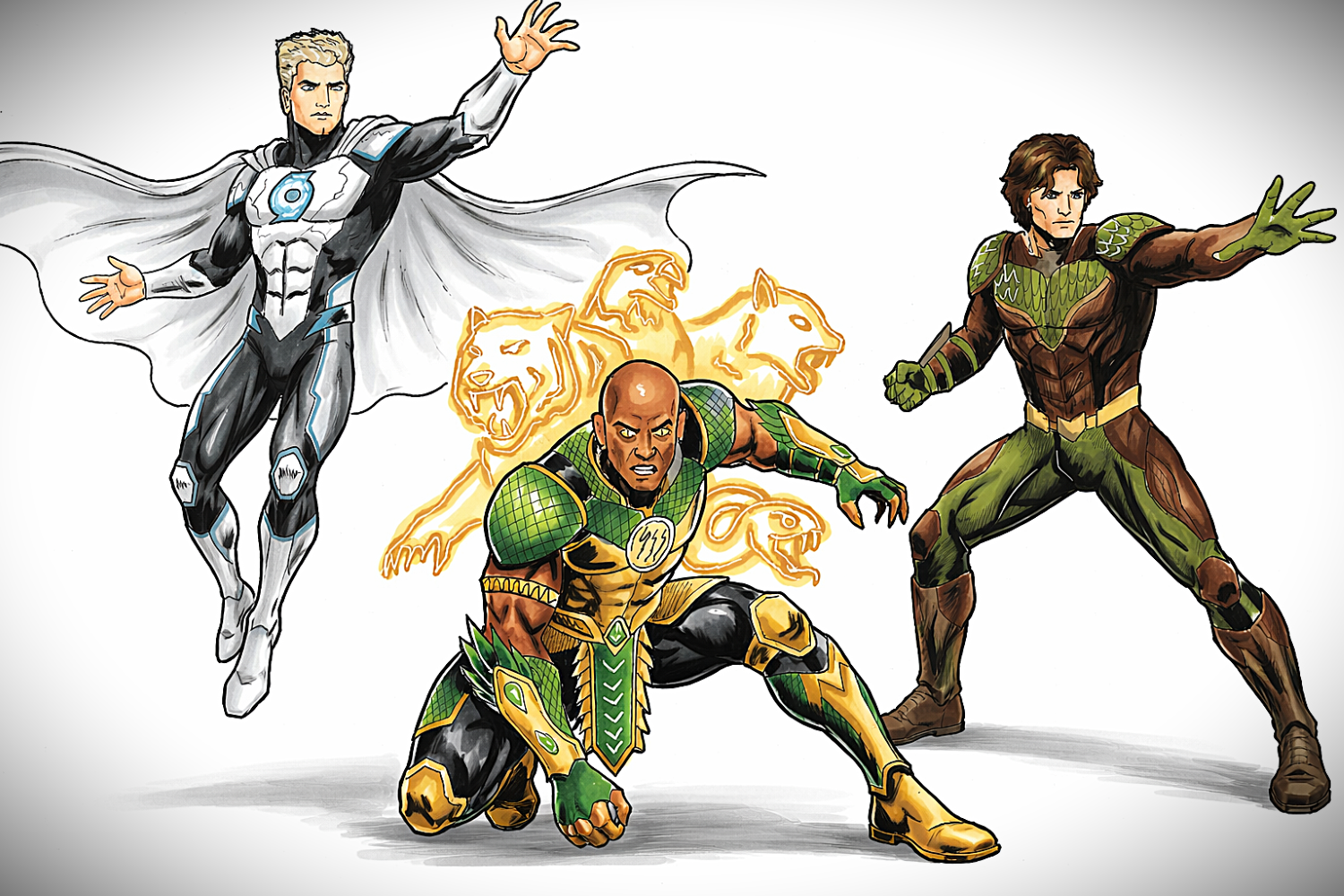
Earth, 2100: drought grips entire continents, rising seas have swallowed cities like Venice, Jakarta, and Miami, and species once familiar are disappearing from the planet. Disease spreads easily through a world destabilised by climate collapse. It sounds like the opening of a post-apocalyptic film, or the premise of a horror story. But it is also a superhero story. An existential villain? Tick. A seemingly impossible challenge? Tick. A race against time before catastrophe? Tick. Across the world, scientists, engineers, and researchers are developing extraordinary tools to confront the climate crisis, from space-based solar power to carbon capture. The question is not whether superheroes exist, but who they are – and where to find them.
Meet ‘The Cartographer’
Behind the imposing glass façade of the David Attenborough Building in the heart of Cambridge – up three flights of stairs and past a floor-to-ceiling plant wall – sit the brightly-lit offices of the Department of Planetary Computing. It is here that I found a tall, bespectacled gentleman: Dr Sadiq Jaffer, the Bernstein Planetary Computing Fellow. He works on one of the central problems in environmental science today: scientists can collect vast amounts of data about the planet, but making sense of it is far harder.
That challenge begins in space. Satellites are continuously capturing data about the Earth’s surface, producing an extraordinary record of planetary change. Missions such as the European Space Agency’s Sentinel-1 and Sentinel-2 provide freely available radar and optical imagery of everything from forests and farmland to coastlines and wildfire scars. But while the data is abundant, turning it into something scientists can actually use to track environmental change is, as Jaffer puts it: “really hard”. Most existing methods depend on large quantities of labelled data – images that have been annotated by humans – and producing those labels is slow, expensive, and often impractical at planetary scale.
“TESSERA offers something invaluable: a faster way of seeing what is happening to the planet”
TESSERA (Temporal Embeddings of Surface Spectra for Earth Representation and Analysis) was built to get around that problem. Developed by a team co-led by Jaffer, TESSERA is a foundation model for Earth observation trained on around 32 billion pixels of Sentinel data. Rather than relying on hand-labelled examples, it uses self-supervised learning to detect structure within the imagery itself, identifying recurring patterns, similarities between surfaces, and the ways landscapes vary across time and place. For almost every 10m by 10m patch of land, TESSERA produces a 128-dimensional embedding: a set of numbers that provides a compact summary of what that patch looks like from space. These summaries allow scientists to analyse landscapes at scale, spotting patterns and changes that would be far harder to detect from raw images alone.
Following the 2025 California wildfires, for example, researchers used TESSERA to compare affected land before and after the fires. Areas where vegetation had been severely burned showed clear shifts in their embeddings, allowing researchers to map the extent and severity of the damage without manually inspecting thousands of satellite images. If the climate crisis is a race against time, TESSERA offers something invaluable: a faster way of seeing what is happening to the planet.
Meet ‘The Curator’
After navigating a labyrinth of corridors, staircases, and turns, I found our second superhero: Dr Sam Reynolds – flaxen-haired, flannel-clad, tea in hand, and wrestling with one of conservation’s biggest problems: evidence. Conservationists are not short of research on how to respond to habitat loss and biodiversity decline. The problem is that this evidence is often too scattered, too slow to synthesise, or too inaccessible to inform real-world decisions.
And the stakes are enormous. According to the IUCN Red List, more than 47,000 species are at risk of extinction. Over the past 30 years, the Conservation Evidence initiative has screened more than 1.6 million papers across 17 languages, evaluating over 3,600 conservation interventions. But doing this manually has come at a huge cost. As Reynolds puts it, it took: “20 years, 75 years of human researcher time, and millions of pounds” – a scale of effort that is clearly unsustainable in a world where new research is constantly being published.
“The problem is that this evidence is often too scattered, too slow to synthesise, or too inaccessible to inform real-world decisions”
The AI Living Evidence Pipeline was built to address that problem. Developed by a team including Reynolds, it uses Cambridge’s Dawn supercomputer to process research at an unprecedented scale. The system ingests millions of papers from global databases, identifies which are relevant to a given conservation question, and extracts key information such as the intervention, outcome, and context. These outputs are then checked by human experts, preserving the reliability of traditional systematic reviews while dramatically reducing the labour involved. The result is a ‘living evidence’ database: continuously updated, fully traceable, and grounded in verifiable sources.
Built on top of this is Conservation CoPilot, a chatbot interface that allows users to query the database directly. Rather than trawling through hundreds of papers, a conservationist can ask a specific question and receive ranked interventions, evidence of their effectiveness, and the contexts in which they work. When the pipeline was tested on the Butterfly and Moth Conservation Synopsis, it screened more than 150,000 papers, achieved 97% recall compared with the manually curated version, and identified hundreds of relevant studies that human reviewers had missed. If TESSERA offers a faster way of seeing what is happening to the planet, Conservation CoPilot offers something just as valuable: a faster way of deciding what to do about it.
Meet ‘The Calculator’
After an email exchange spanning weeks, frantic schedule reshuffling, and the wonders of modern video conferencing, I finally met our third superhero: Dr Michael Dales, the Tarides Planetary Computing Fellow. Dales works on one of the hardest problems in environmental science: deciding where an intervention will have the greatest impact. The consequences of environmental change are unevenly distributed, and not all land carries the same ecological weight. Losing one hectare of rainforest in the Amazon, for instance, has far greater consequences for biodiversity than losing one hectare of farmland in the UK. As Jaffer explains, local restoration can backfire if it merely shifts environmental damage elsewhere.
“The consequences of environmental change are unevenly distributed, and not all land carries the same ecological weight”
LIFE (Local Impact on Flora and Ecosystems) was designed to make those trade-offs measurable. It is a biodiversity impact metric that quantifies how much biodiversity is lost or gained when land use changes – for example, when forest is converted to agriculture. The need for such a metric is urgent. According to the UN Food and Agriculture Organisation, between 2015 and 2025, an estimated 11 million hectares of forest were lost every year – equivalent to more than 15 million football fields annually.
By reducing biodiversity impact to a single, comparable number, LIFE allows researchers and policymakers to weigh trade-offs across regions and prioritise action where it matters most. In practice, this means making more informed decisions about agricultural expansion, rewilding, and infrastructure development. If Conservation CoPilot helps researchers decide what to do, LIFE helps them answer the hardest question of all: where should we act first?
“The real tragedy of the climate crisis is not ignorance, but inaction”
But if we’ve met our superheroes, the question remains: what is our villain? It is not a lack of data, evidence, or innovation. It is a lack of political will. Short-term thinking, weak incentives, and powerful counter-narratives continue to delay meaningful action, even as the science grows clearer. As Jaffer notes, asking people to make short-term sacrifices for long-term gains “they may never see […] is a hard one”. The real tragedy of the climate crisis is not ignorance, but inaction.
And time is running out if we want this story to have a different ending. Unlike in superhero films, where the world waits to be saved, real change depends on collective action. As students and future scientists, policymakers, and activists, we cannot afford to be bystanders. As Dales reminds us: “we are fortunate to be in a place where we can make something of a difference.” The future depends not on waiting for superheroes, but on becoming them. We owe our planet that much.
