
On the first of November last year, I arrived at Heathrow airport clutching my passport, ready to deposit three massive kit bags with LATAM Airlines. I was heading south – so far south that commercial flights to the tip of Chilean Patagonia wouldn’t cut it. My final destination was Antarctica, and I wouldn’t be coming home for months.
A desire to study ice cores in the Antarctic wilderness has driven my academic pursuits, leading to a PhD position here in Cambridge and a trip to the white continent. Ice cores – great cylinders of ice extracted from ice sheets and snowpacks from across the world – capture time-resolved chemical information about our atmosphere’s evolution. When snow falls, it traps tiny air bubbles – little samples of the ambient atmosphere. Over time these become locked away and buried by more falling snow, which eventually condenses into ice, creating a record of our atmosphere’s chemistry though time. These cores can be kilometres long, and the deeper you go, the further back in time you travel!
“When snow falls, it traps tiny air bubbles – little samples of the ambient atmosphere”
My mission, alongside 11 others from the British Antarctic Survey (BAS), was to drill another of these invaluable climate records, the ‘REWIND’ core. It was time to head out to one of the most remote and hostile places on Earth.
At Rothera Research Station, BAS’s largest Antarctic base, I spent 12 days training and preparing cargo – and conducting my own mini safari of penguins, seals and whales. Both nervous and excited, I was ready to leave the wildlife of Rothera behind to fly even further into the icy abyss towards our field site.
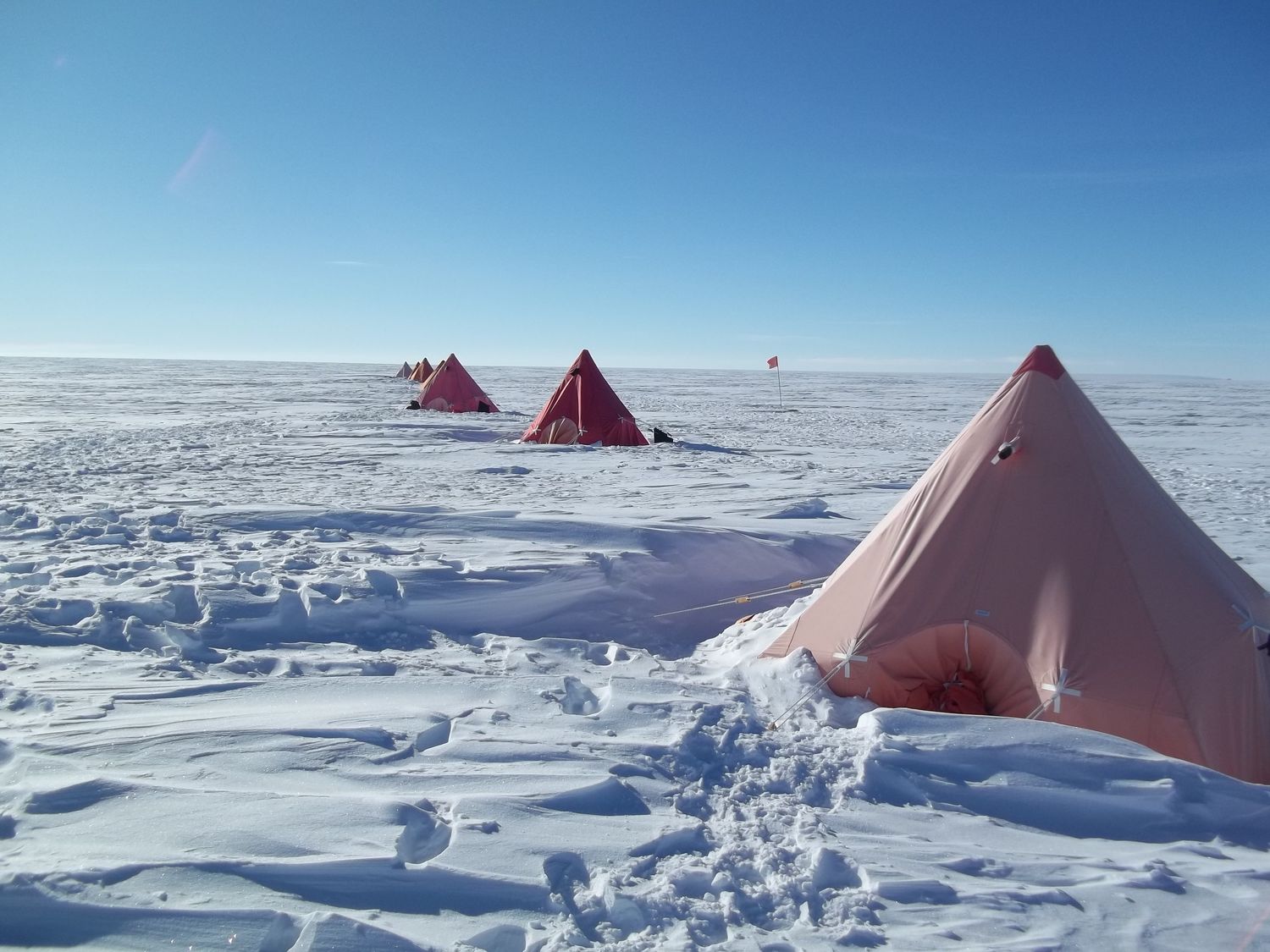
As the dynamic mountain peaks gave way to an expanse of uninterrupted white, the sense of isolation became much more intimidating. I began to realise that my life would be completely dependent on my other campmates, and the simple Codan radio with which we could contact BAS operations. For the next 50 days, my world was to be confined to a collection of tents and flags stretching out in one long east-to-west line. Welcome to ‘Sledge Hotel’.
“It was truly an exciting day when you switched out your underwear”
This rather affectionate name is not a reflection of luxury living and buffet breakfasts. Rather it comes from the old days of Antarctic exploration, when any research activities away from the main stations were conducted with dogs pulling sledges. To this day, all field parties are referred to as ‘Sledge’ followed by a letter of the phonetic alphabet, in keeping with proper radio terminology – so here we were, Sledge Hotel. I became accustomed to our radio ‘scheds’: the daily call-ins with Rothera, always at 2030hrs, to inform of progress, problems and kit requests. Most of our requests were food: ‘Freshies’ (fresh fruit and vegetables) were a luxury for which we always longed.
Camp life was entirely different from home, and I had to adapt quickly to this extreme environment. Tent canvasses replaced solid walls, heating was sourced from Tilley lamps, buckets became toilets, and showers were a thing of the past. It was truly an exciting day when you switched out your underwear for a fresh set, a luxury afforded every ten days or so. On those days I’d get through more baby wipes than a newborn and generously slather myself in moisturiser to tackle the layer of dandruff that fell off every part of my body (my tent mate and I nicknamed this ‘tent snow’, ever keen to laugh at how gross we’d become). I never washed my hair for fear of it freezing to a solid block, and you can imagine that after 10 weeks I neither looked nor smelt my best. However, with a hat on to hide the grease and a drill suit to ‘seal in the stink’, staying happy, healthy and alive was far more of a priority. As was, of course, drilling hundreds of metres of ice.
“Most days would follow a simple pattern: wake up, complete a 12-hour shift from 2pm till 2am, then go to bed”
One beauty of Antarctic life is the simplicity of purpose. Cambridge life is chaos; you’re reading, writing, talking, teaching, experimenting and exploring all at the same time. By contrast, out on the ice I had one job – drill that ice core. Most days would follow a simple pattern: wake up, complete a 12-hour shift from 2pm until 2am, then go to bed while the other half of the team continued to process ice. That simplicity calmed the hyperactivity of my brain, and I became acutely aware of what was (or wasn’t) in my control.
That said, the shifts were still long and physically demanding – even more so when the weather worsened and you had to dig your way out of each tent. There was also lots of waiting around for the winch to unspool hundreds of metres and the drill head to cut away at the next metre segment of ice for you to recover. We found the only appropriate way to entertain ourselves in this time was to dance around, the manic energy serving to keep us warm on days that were colder than the average –17 °C. I discovered a whole new genre of music – who knew power metal could be such a good way to raise the mood?
“I discovered a whole new genre of music – who knew power metal could be such a good way to raise the mood?”
Fieldwork makes you incredibly resourceful, as you’re forced to use creativity to fix problems, fashion practical set ups, or recreate home comforts. Wood chucks hammered into the ice walls of our drilling trench made for good coat hangers, and an unused toilet seat was doodled on to make a Christmas wreath. I thought celebrating the festive season away from my family would be tough, but our field party had become a family of its own by that point, and cobbling together a roast on a camping stove was a Christmas miracle worth cherishing.
One of the team’s best moments of resourcefulness came from fishing a metal screw out of the borehole. This kamikaze screw had fallen off the winch and down into the hole, threatening to break the drill completely if left down there. To counter this, we magnetised the cutting blades of the drill and spent an entire shift playing our own version of Operation. When the offending screw finally came up, quivering on the blade’s edge, we leapt up in excitement, and treated ourselves to some whisky before bed.
Having returned to Cambridge, I’m now back in the swing of PhD life. The ice core, however, won’t reach us until July, after a long voyage on the RSS Sir David Attenborough. Once it’s back in our labs at BAS, we’ll melt the ice to analyse lots of different chemical species. Our focus is to assess the role of the Southern Ocean (SO) as a source or sink of atmospheric CO2. It is estimated that the SO currently stores approximately 40% of all anthropogenic CO2 emissions. However, the storage or release of CO2 is dependent on the complex interplay of climatic and oceanic processes, including temperature, sea ice extent and the strong westerly winds that drive the Antarctic circumpolar current. Understanding how these factors affect the SO’s storage or release of CO2 is crucial for predicting future climate changes and their impact on our planet.
While not the easiest of places in which to work, Antarctica is addictive. If given an opportunity to return, I’d snap it up in a heartbeat.
