
In the 1990s, the chemist who would become master of Trinity and a Nobel laureate, Gregory Winter, dons an unembroidered white lab coat, slings a borrowed stethoscope about his neck, and steps out of the Medical Research Council’s Laboratory of Molecular Biology to meet a hospital inmate taking his newly developed drug. Despite his appropriation of medicine’s human face, the academic researcher has never met a patient before.
This meeting, as Winter recalled on the BBC’s The Life Scientific podcast in 2019, would change the professional course of his life. Struck by his power to help people beyond expanding collective scientific knowledge, Winter would move away from sluggish academia for the efficacy of the private sector, going on to create life-saving drugs and drug companies worth billions.
“The campus contributes £4.2 billion to the UK economy and supports over 22,000 jobs”
You might think of it as just Addenbrooke’s, but since the hospital moved from Trumpington Street (subsequently assumed by the business school) to its current location, it has been part of the impressively realised Cambridge Biomedical Campus (CBC), a place straight out of a science consultant’s mood-board. Addenbrooke’s sits alongside the prestigious MRC Laboratory of Molecular Biology, pharmaceutical giant AstraZeneca’s flagship headquarters, and many other research, medical and teaching institutions to form “a thriving hub [of] academia, industry and healthcare”. According to the CBC website, the campus contributes £4.2 billion to the UK economy and supports over 22,000 jobs – an achievement the CBC has collectivised by lack of detail.
When Queen Elizabeth II opened the ‘new Addenbrooke’s’ site at the end of Hills Road in 1962, the CBC encompassed just a few Cambridge hospitals. But this new site, not decoratively embellished like the old Trumpington Road building, was a modernist construction, modular, primed to expand, develop and change. The Queen would be back twice to open new units and research centres, but if she’d been needed for all new expansions and constructions, she would’ve hardly left.
“Combine the overflowing commercial growth and the world-class University with proximity to patients and you have an internationally unique set-up”
The University of Cambridge attracted this proliferation, all while pushing the CBC’s development to the city’s southern fringes. It seems dons were insecure about Cambridge’s future in the postwar years; reports like Holford and Wright’s in 1950 emphasised limiting growth to maintain the University city’s character. The image of an isolated sanctum of scholarly tradition, a popular conception of Oxbridge over the centuries, certainly clashes with the CBC’s ambition. Yet by 1980, the atmosphere had shifted into the furious activity of the ‘Cambridge phenomenon’ – drawn by the university, hundreds of science and technology companies established themselves in Cambridge. Now, the CBC plans to be a “new quarter for the city”. But the campus doesn’t just operate on the municipal level; combine the overflowing commercial growth and the world-class University with proximity to patients and you have an internationally unique set-up.
“Biomedicine emerged triumphant after WWII, combining increasingly centralised, professionalised healthcare with biological developments”
To give some background, biomedicine is a fairly novel idea. Biology itself only came together as a cohesive discipline around 1900 (to oversimplify, previously animals, plants and the environment were studied in a diverse set of disconnected disciplines, and expressed mainly through museological Natural History). Biomedicine emerged triumphant after WWII, combining increasingly centralised, professionalised healthcare with biological developments like genetics and advanced cell cultures. Roughly, healthcare before biomedicine consisted of two vaguely discrete realms: curing the individual of specific illnesses, and public health measures concerned with sanitation and disease spread. Biomedicine married the individual and population levels; population statistics define the normal person, and individual healthcare aims at maintaining that normalcy (which of course still requires curing illnesses, but with a different overall focus). Everyone, not just the sick, is implicated in the biomedical project, and culture reflects this ubiquity (consider ‘brain chemistry’, the biologically inaccurate concept of having a gene for something, ‘Love and Other Drugs’, etc).
As biomedicine further entrenched itself, the CBC’s justifications for development were upscaled and augmented. Much initial reasoning focussed on regional services and the East Anglia economy; development for dividends close to home. Justifications have since extended outwards, and the campus now incorporates international companies’ headquarters, state-of-the-art research hospitals and world class education institutions, aiming to be a global model for the future of the life sciences. Biomedicine’s frontlines can be found just down Hills Road.
“Walking through the campus feels like walking through different people’s visions of the future”
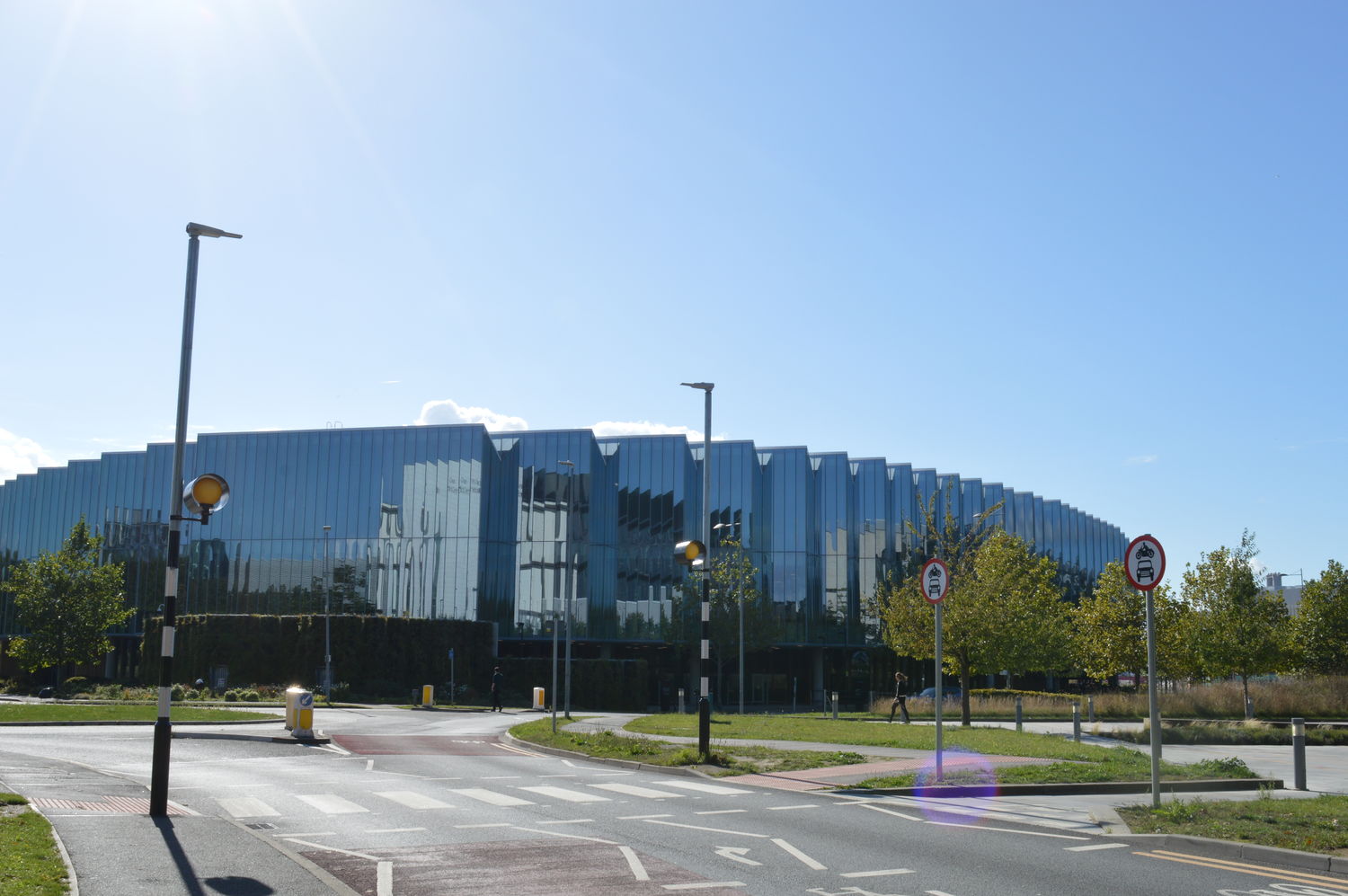
I hadn’t been back to the CBC since I was born there, in Addenbrooke’s Rosie Maternity Unit (about 21 years ago, and, as I recently and somewhat disappointedly discovered, on a Tuesday), when I attended a guided walk around the campus, masterfully led by sociologist David Skinner and urban systems researcher Will Brown. Walking through the campus feels like walking through different people’s visions of the future, separated by time but not space. In each case growth is central, but growth itself has changed, precise steel and glass overshadow ad hoc concrete as I approach AstraZeneca HQ. White coats and microscopes can be seen from the periphery; the world-leading architecture firm incorporated glass walls to make ‘science visible’, a concern ringing distinctly postmodern in such a modernist construction. If conventional busyness isn’t immediately obvious on the campus, there is the sense of a system running, part of which is revealed through the transparency of those walls.
The rest of the system is rather less visible. Hospital patients play multiple roles in the CBC; most obviously as subjects of the healthcare system, but also as consumers of biomedical services and sources of experimental data. Much has been made of the laboratory bench to bedside potential of the campus, but as Skinner pointed out, it could equally be bedside to bench. The CBC subsumes the impetus for pharmaceutical development, the development itself, and the consumption of products.
“Ambitions can clash as starkly as the stagnating hospital and shiny ‘Big Pharma’ buildings themselves”
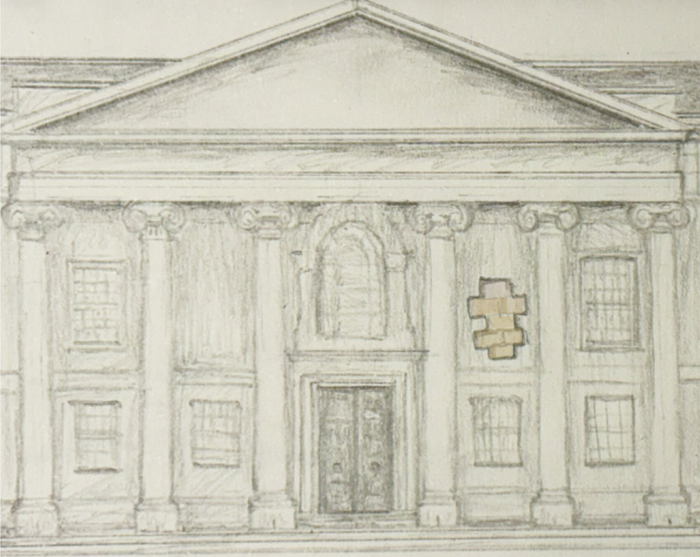
The CBC may well be more than the sum of its parts, but considering the tensions running through the site, it is certainly harder to pin down. The diversely-formed buildings of the campus suggest various modernities, encode many ambitions on scales local, regional, global. These scales are often incommensurable, these ambitions can clash as starkly as the stagnating hospital and shiny ‘Big Pharma’ buildings themselves (the NHS is currently in conflict with pharmaceutical companies, and many problems between the two go challengingly deep). Gregory Winter’s journey from bench to bedside took him through spheres of the campus that, as Skinner has described, are both questionably coherent and increasingly blurred. The most striking tension of all lies between the CBC’s grandly structured, synergistic plans and the very presence of those tensions, tightening.
It’s not just the future; the CBC is in the business of making futures. Science, medicine, and legislature concentrate and universalise on campus, becoming difficult to disentangle. Imagination is crucial to science in many ways. After that era-defining scientific achievement of the atomic bomb, readers of sci-fi author H.G. Wells posited that he’d predicted the future – Wells had described controlling nuclear energy to create bombs in The World Set Free (1914). Or, rather than seeing the future, Wells’ imagination helped create the cultural environment which enabled the scientific development of the bomb. Science isn’t only directed by logic or experiment; lots of physicists read Wells’ book. And, in this biomedical moment, we are all entangled. Whose imagination is deciding our futures?
