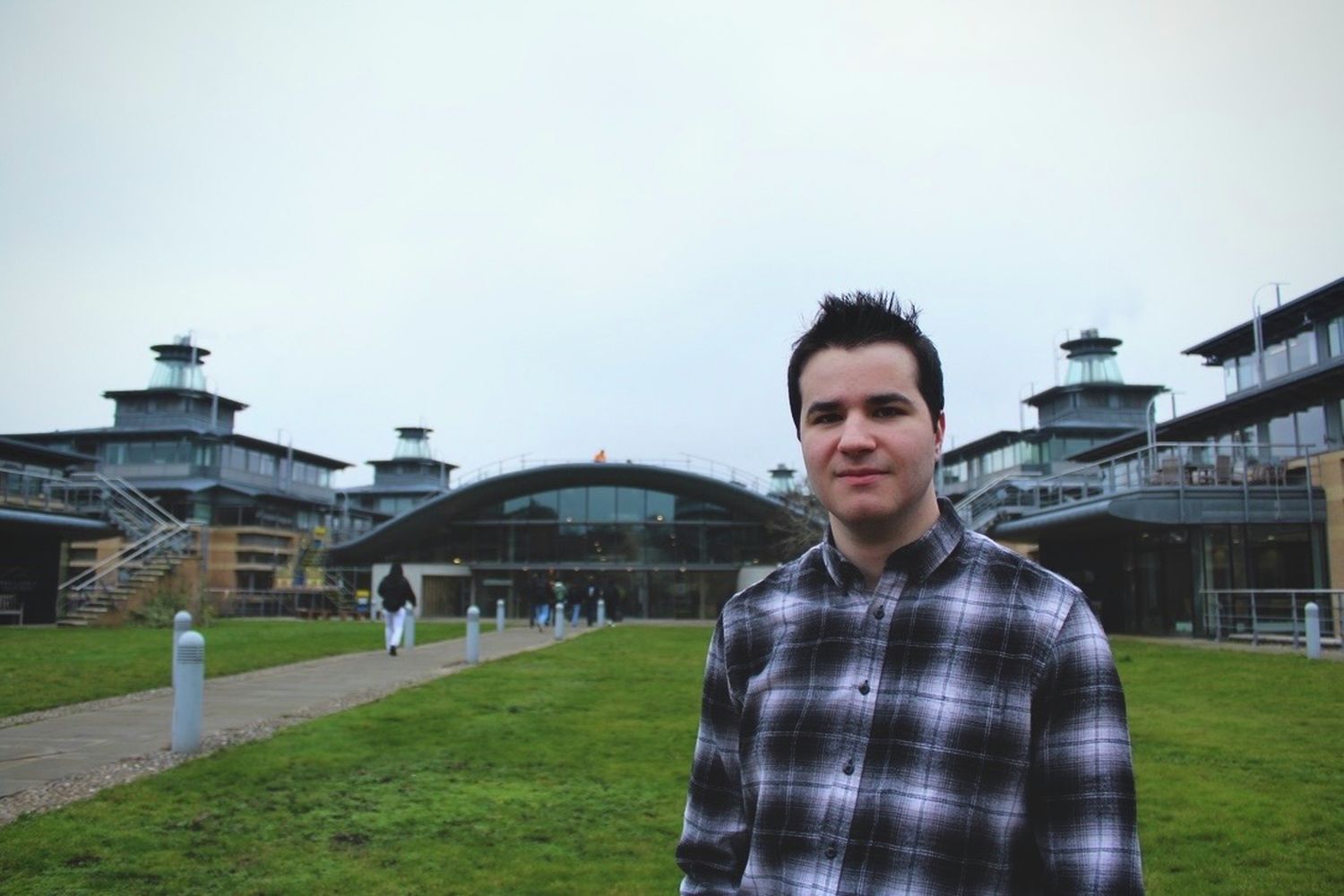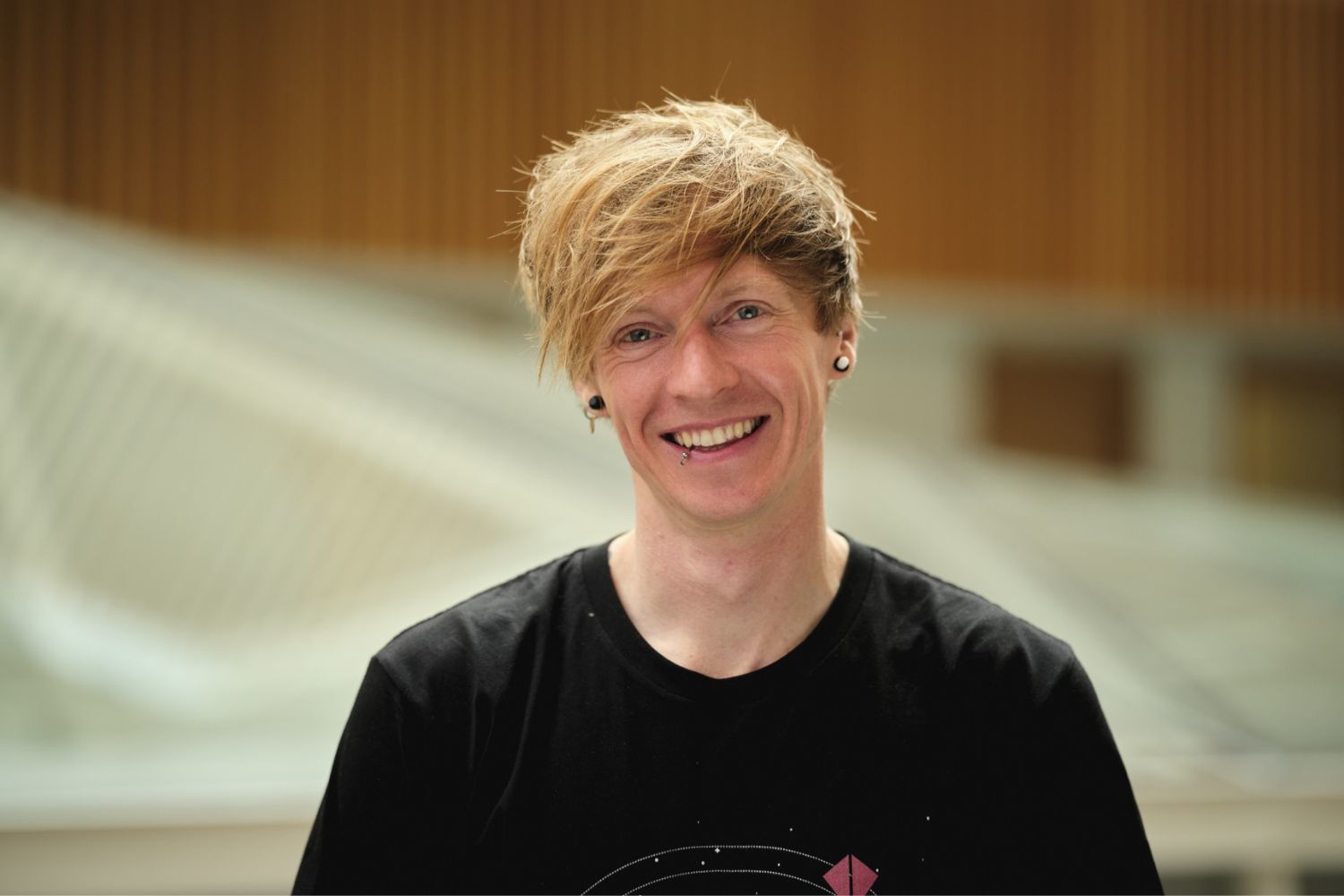
With over 240,000 subscribers on YouTube and more than 26 million views, Dr Tom Crawford – better known as Tom Rocks Maths – is something of a rockstar mathematician. He’s also a Teaching Fellow at Robinson College, supervising first- and second-year mathematicians at Selwyn and Robinson. I sat down with Tom to discuss his journey, his work in outreach, and how mathematics can be made more interesting and accessible.
“Maths is a way of making sense of the world,” Tom explains. “It’s just one of the many tools we use to understand the things around us.” His passion for maths started at a young age. After completing his undergraduate degree at Oxford, he pursued a PhD in fluid dynamics at Cambridge. It was during his doctorate that he began an internship with the BBC as a science radio presenter – the start of his career in popular mathematics. I asked Tom about what outreach means to him. “I feel disbelief being here,” he says, holding back emotion, “in the best way.”
Tom looks back fondly on his time at Oxbridge, grateful for the opportunities education has given him. As the first person in his family to attend university – and one of the first from his school to go to Oxbridge – he recalls the barriers that he faced. “Bless my teachers, but they were basically clueless about the admissions process. I’d tell them about tests I needed to do, and they’d be like, ‘You need to do a test? ’”
“As the first person in his family to attend university, he recalls the barriers that he faced”
For Tom, being able to do maths every day is a genuine privilege. “I think it’s really just emphasised to me how much a really good education, and being surrounded by similarly motivated people, can change your life,” he says. Yet, despite the glamour of his achievements, he remains aware that many of his family and friends didn’t have access to the same opportunities – and that enjoying your job is far from universal.
“Something I’ve just noticed […] for example, my parents […] they just don’t enjoy their jobs. And even a lot of my friends. It’s just very rare to find someone who actually enjoys what they do. They all just feel burnt out and exhausted.” He contrasts this with his own experience. “The vast majority of my days just don’t feel like I’m working. It’s just like ‘Oh cool, I get to think about this really cool maths thing.’”
“It’s just very rare to find someone who actually enjoys what they do”
Tom’s gratitude for the opportunities he’s had (and worked hard for) is clear – and it fuels his desire to widen access for the next generation. But how does he do that?
“I think the most important thing to do is to help young people see themselves in that position.” This means using inclusive language and ensuring proportional representation. “I find it crazy that students can go through their whole undergraduate degree in maths without having a single female supervisor.”
Thus, one of Tom’s first actions at Robinson was to work towards making supervisions more diverse, helping students relate to their supervisors and, in turn, build confidence in their abilities. “When people think of a Cambridge mathematician, they don’t think of me,” he jokes. “But I do think the work I do is relatable.” He stresses the importance of providing a positive experience to his audience. “It’s possible that I’m providing someone with their first good experience of maths.”
“I find it crazy that students can go through their whole undergraduate degree in maths without having a single female supervisor”
So, what’s been keeping him busy recently? “I’ve just submitted the first draft of my new book. It’s called ‘How many Pikachus would it take to power a lightbulb? ’” he says cheerfully. “It’s 400 pages of ridiculously silly questions like that – answered mathematically!”
From the maths of Harry Potter to the Marvel Cinematic Universe, Tom views the world through a unique, mathematical lens. Communicating maths in a fun way is central to his mission.
His role at Robinson complements that work. “Apart from my teaching duties, I do a lot of outreach for Robinson College, and by extension, Cambridge maths in general,” he explains. The day after our interview, he was set to visit a local secondary school. “There’s no set format. I’m just going there to do some fun maths. I’m not telling them to apply – I’m just trying to provide a positive experience with maths.”
When we turn to admissions and the Tripos, it becomes clear that Cambridge still holds a few surprises for him. Compared to Oxford’s exam structure, the Cambridge Maths Tripos has a unique system of Alphas and Betas. The result is that working out exam strategy is itself a task — trying your hardest to maximise Alphas and Betas in the right combination.
Effectively, along with raw marks scored in the exam, students get an additional alpha or beta mark if they score highly in a question. Therefore, in grading, the difference between 14 marks and 15 marks (which scores an extra alpha mark) is actually more like 11 marks lost rather than 1.
“The gamification of exams is inherently competitive and alienates students rather than motivates them”
“I feel it’s way more complicated than it needs to be,” Tom comments. “And I feel like change is likely coming. Whether that’s ten years or sooner, who knows.” He notes, however, that many senior examiners feel pride in tradition, and that many students enjoy the system. As an outsider, though, I can’t help but feel that the gamification of exams is inherently competitive and alienates students rather than motivates them (plus optimising an exam mark is the antithesis of having fun).
I also asked about access to official mark schemes for past papers – currently unavailable to students. “I think it’s not a big deal,” he says, “provided that your supervisor is willing to mark your exam practice questions.” He adds that this probably falls within a supervisor’s remit, though formal recognition in supervisors’ timesheets might help.
As a supervisor, Tom comes across as incredibly supportive. “One of the first things I do in Freshers’ Week for 1st year students is drill into them that I’m there to help them and that it’s part of my job to teach them.” He pushes back against the idea that problem sheets must be perfect, firmly emphasising that supervisions are where learning should happen.
Finally, I was keen to get his thoughts on admissions. Tom is especially known for his YouTube videos analysing maths entrance exams and A-level papers. So what does he make of Cambridge’s system? “Compared to Oxford, where in my college, about 6 students get offers each year and like 99% of them get in after exams, Cambridge has the unique system of STEP.”
STEP (Sixth Term Examination Papers) forms part of almost all Cambridge maths offers. Even after a successful interview and conditional offer, students must achieve the required STEP grades – and some ultimately miss out.
The result is that Tom may give offers to 14 diverse students, but many won’t meet the STEP requirement. “There’s evidence to suggest that girls are disadvantaged in exam halls, and it’s possible that the exam system will discourage girls from applying to maths,” he notes with concern. This issue is something Tom hopes he can address while working here.
There is clearly much afoot for mathematics at Cambridge. For Tom, however, the goal remains simple: to make maths more diverse, welcoming, and fun. As Tom asserts, his experience at Oxbridge was overwhelmingly positive – and he aims to help ensure the next generation can say the same.