
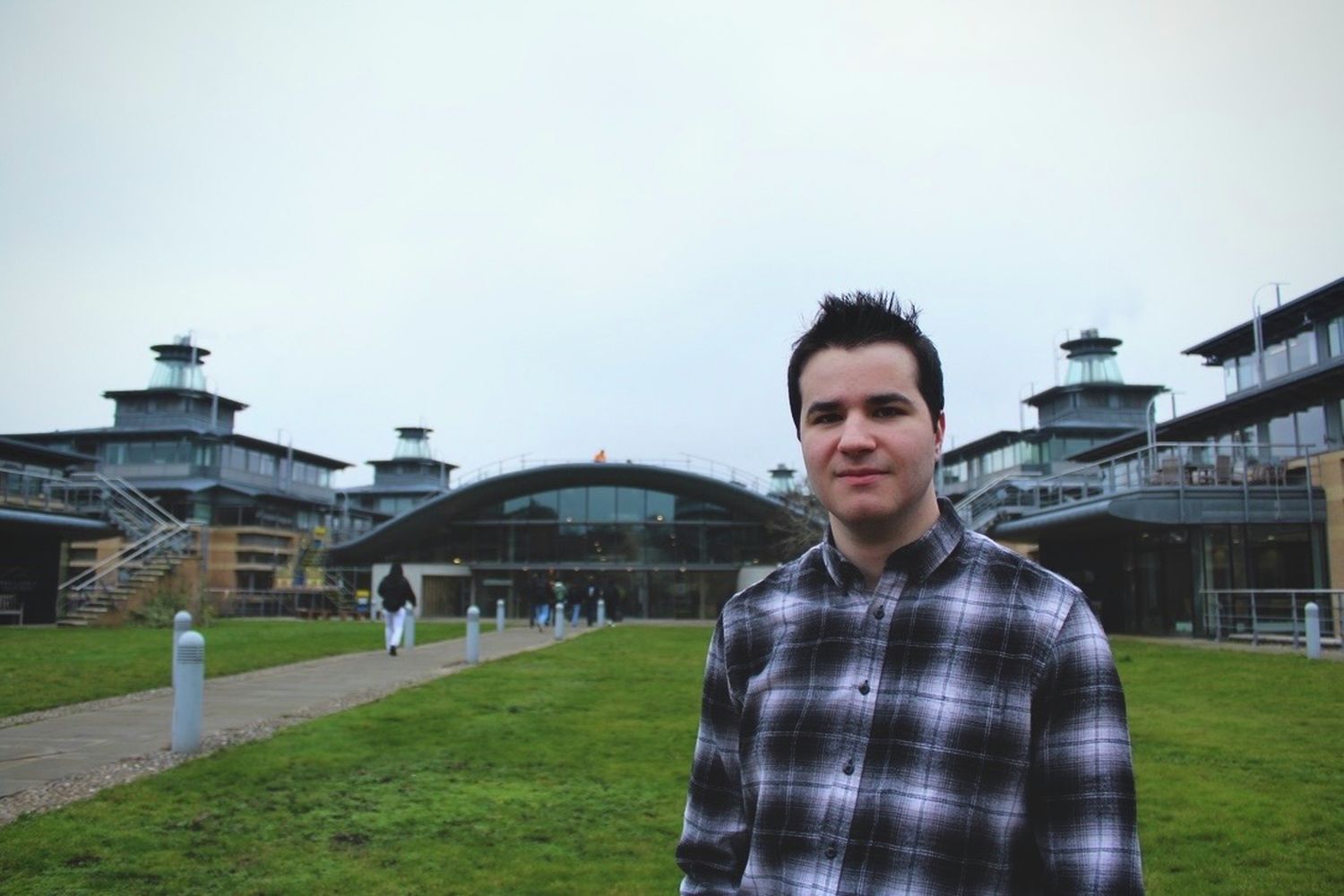
One of the most prolific mathematicians of the 20th century, Paul Erdős, proposed over a thousand mathematical conjectures throughout his career: the Erdős problems. Around 40% have been solved, but none by AI – until last month. To the surprise of many mathematicians, it was in fact the world’s first fully autonomous AI solution to an open mathematical problem (a problem recognised by researchers yet to be solved). And the mathematician that solved it? Kevin Barreto, a second-year Queen’s Mathmo.
Kevin began tackling Erdős problems in earnest in November 2025, after seeing that an AI startup, Harmonic, had obtained a partial solution to an Erdős problem using their AI system, Aristotle. “You know, maybe there’s some low-hanging-fruit problems that would be within reach of an undergrad,” Kevin said he thought at the time.
By early December, he’d already solved one Erdős problem without using AI, in his field of specialty, number theory, and obtained a partial result on another. His work quickly gained attention on a forum dedicated to cataloguing Erdős problems, earning him congratulations from Terence Tao, whom many consider to be the greatest living mathematician – although Kevin was “actually rather nonchalant” about it. “When one is entirely confident in their proof, no congratulations are needed; the mathematics speaks for itself.” Encouraged, he began experimenting with using AI to solve these problems.
“When one is entirely confident in their proof, no congratulations are needed”
Collaborating online with a hobbyist mathematician, Liam Price, the pair eventually identified a promising candidate problem that ChatGPT-5.2 solved entirely without human intervention. Kevin then fed the proof into Aristotle, which automatically formalised it in Lean – a programming language used to quickly verify the logic of mathematical proofs.
After Kevin excitedly posted the result on Twitter on Christmas Day, another forum user quickly discovered the problem had actually already been solved. Undeterred, the pair continued their work and within weeks, achieved a fully autonomous AI proof to a genuinely unsolved problem, Erdős problem #728–albeit using arguments similar to earlier work. Since then, AI has gone on to fully solve several more Erdős problems and contributed to many others. For some of the problems which Erdős considered more interesting or difficult, he offered prizes of up to $10,000, but Kevin believes these are currently far out of reach for today’s models.
Directly solving problems is not the only way AI can assist mathematicians. Large Language Models’ (LLMs) ‘deep research’ modes have also proved transformative for literature review, unearthing obscure but relevant results that might otherwise be missed, and helping researchers avoid retreading old ground. The rapid progress of LLMs over the past year has made their potential in maths and science increasingly clear. Systems that once struggled with basic reasoning are now highly capable of undergraduate and even competition mathematics – as any Mathmo or Natsci behind on their problem sheets will know. However, Kevin’s work marks a further step.
“Undeterred, the pair continued their work and within weeks, achieved a fully autonomous AI proof to a genuinely unsolved problem, Erdős problem #728”
While these models will undoubtedly continue to improve, Kevin argues that a “fundamentally new architecture” is needed to achieve true mathematical superintelligence – one capable of tackling the deepest unsolved problems in mathematics, such as the Millennium Prize problems. Trained on existing work, today’s LLMs are adept at cleverly combining known ideas. This may be enough to solve Erdős problems, but cannot produce the completely novel concepts required for the hardest problems; partly because these ideas are so foreign that they would require entirely new mathematical language, which LLMs are inherently incapable of creating, to even express.
Kevin’s work is striking but equally compelling is Kevin himself. He may look like a typical Mathmo, but his path into research is far from conventional. He comes from a working-class immigrant background and is the first in his family to attend university, with parents who left school early. He has always had a clear passion for mathematics – by thirteen, he knew he wanted to be a mathematician, and by seventeen he was obsessively reading the newest research in analytic number theory. Yet he has no Olympiad background, having been comparatively average at school maths competitions, and entered Cambridge only after being accepted into Queen’s through the summer pool, after a rejection from Trinity.
Arriving in Cambridge, Kevin hoped to eventually pursue a PhD under James Maynard, a Fields medallist in the field of analytic number theory. But his first year was derailed by mental health struggles, and he failed the Tripos exams. After taking a gap year, he was allowed to resit first year, this time achieving a 2:ii. He is blunt about the experience: “Tripos is not my thing,” a judgment he attributes to having very specific mathematical interests and being someone who is “not very good at thinking of ideas on the spot.”
“I think there is a far too competitive atmosphere in Cambridge”
At Cambridge, it becomes ingrained in students that Tripos ranks reflect mathematical potential, making it unthinkable that someone outside the top of the cohort could already be capable of original research. I confess that I was expecting Kevin to be someone who flew through the tripos with ease and thus had time on his hands to do such work. Kevin describes how this attitude can turn toxic, recalling instances of top-ranked students deriding those lower down the Tripos despite their deep passion for the subject. “I think there is a far too competitive atmosphere in Cambridge. […] I have felt that the words I speak are dismissed by peers or faculty simply because I am not as well-performed on Tripos as they are. It’s like people will tactfully refuse to help each other, such as on example sheets, just to help secure their ranking above that person.”
Kevin is not the first to show that Tripos rank is an imperfect predictor of research ability. He points to the example of Klaus Roth, Britain’s first Fields medallist, who graduated with a third-class degree and was advised by his supervisor to abandon mathematics altogether. “The Tripos is genuinely a good way to test mathematical ability,” Kevin reflects, “but it’s a form of mathematical ability I don’t possess.” His struggles with the tripos also pushed his turn to AI: “it got to a point where I felt like I could make a bigger contribution to maths by trying to make a machine that can do what I can’t.”
After being allowed to return to Cambridge following his gap year, Kevin now faces the opposite problem: securing approval to take another year out to continue his work at a leading AI research lab. Companies including OpenAI and DeepMind, as well as specialist maths AI startups such as Harmonic, have approached him directly, actively courting him, something Kevin says is “actually rather overwhelming […] it has been a long-time dream of mine to eventually work at DeepMind after seeing the revolutionary accomplishments they’ve made.” He is quick to add, however, that xAI is off the table – he “will not be helping Elon Muskrat.”
“I felt like I could make a bigger contribution to maths by trying to make a machine that can do what I can’t”
For many in STEM, these labs are the ultimate place to work, akin to a modern-day Manhattan Project or Bell Labs. Unsurprisingly, positions are so competitive that they’re effectively inaccessible to most students, and undergraduate placements are essentially unheard of. Again, unsurprisingly, Kevin is being considered as a special exception. He is now weighing whether to drop out to pursue this work, although he is worried that eventually he “may get bored of this AI for maths stuff” and want to return to his original dream of doing a PhD – a path that would almost certainly require finishing his degree.
It has been a transformative few months for Kevin whose work has now been featured in the New York Times and the New Scientist. As recently as last November, he wrote that it would be a dream of his to simply make a minor contribution to an Erdős problem. Despite this, he remains very humble. “I’m not cracked,” he insists, adding that “anyone interested in these problems could have done this.” I’m still deciding whether I believe him.
Speaking to Kevin, I found myself genuinely inspired – not only as a physicist increasingly weary of the Tripos grind – but by the picture he paints of the extraordinary years that lie ahead of us in science and mathematics.
