
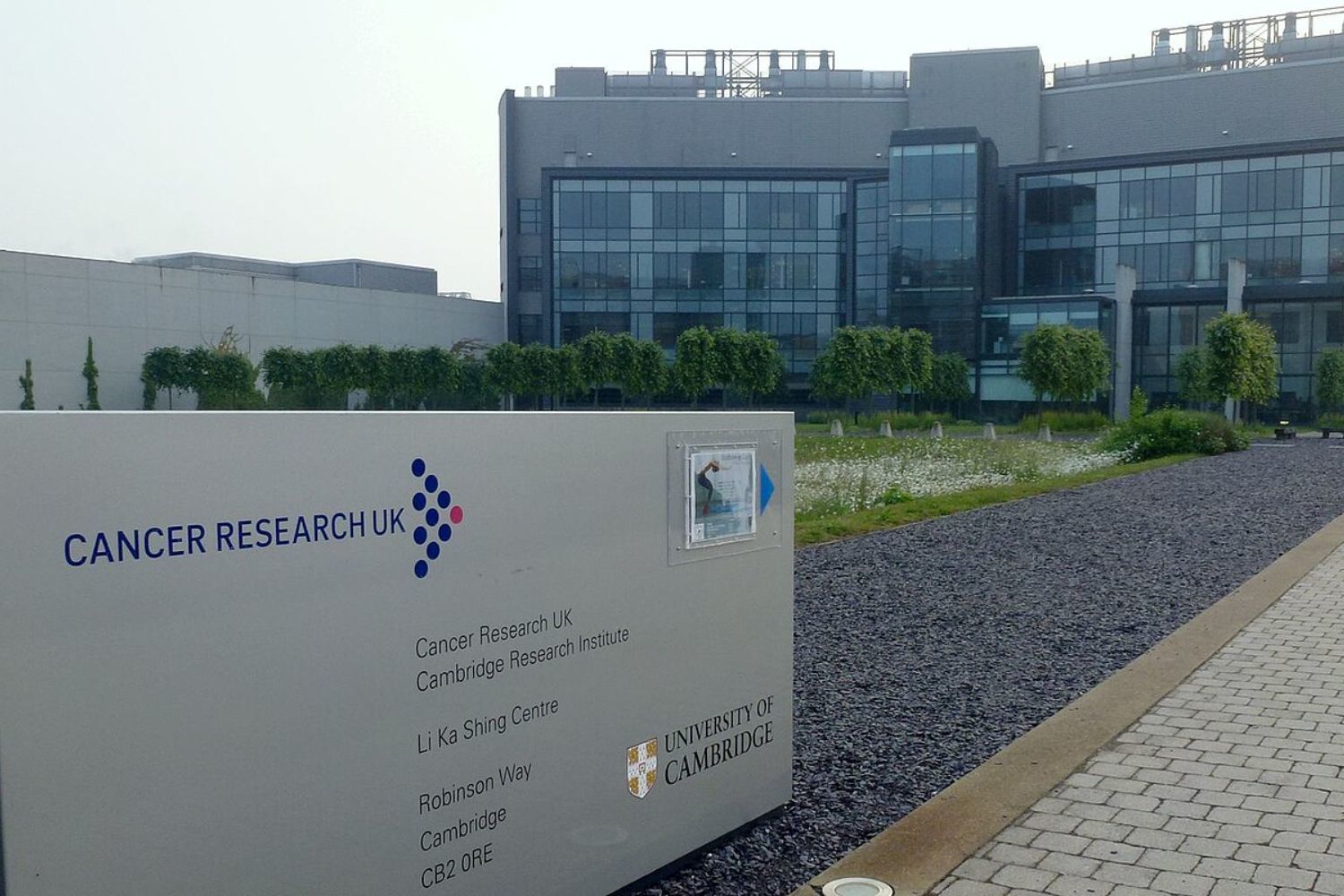
From unraveling the biology of tumours to developing new ways to treat them, Cancer Research UK’s Cambridge Institute is at the forefront of cutting-edge cancer research. I sat down with several of the scientists behind this work to discuss their motivations for research, the breakthroughs they hope to achieve, and the challenges that come with tackling one of the most complex diseases in modern medicine.
Please could you all introduce yourselves?
Jason: My name is Jason Eigenbrood, and I’m a third-year PhD student. I come from Philadelphia, and now I’m here working on supratentorial ependymoma, a very rare tumour.
Joey: I’m Joey Toker. I’m a second-year PhD student, also from the USA! I’m studying a few different types of brain tumours, understanding the drivers of paediatric brain cancer.
Jessica: Hi, I’m Jess Taylor. I came to Cambridge to do my postdoc, and I’ve been here for about seven years now! I work on a rare subtype of medulloblastoma.
Oscar: I’m Oscar Baldwin, and I’ve been here since 2019 on the MB-PhD program. I work on choroid plexus carcinoma – the rarest of the rare brain tumours we work on!
Demi: I’m Demi van de Kaa. I’m working on how cancer cells spread to the body – metastasis is the number one cancer-related death, so it’s important to study.
What first inspired you to work in cancer research?
Jessica: My family have the BRCA1 gene mutation. Thankfully, I don’t, but my dad and nan have really suffered with their quality of life after cancer treatment, rather than the cancer itself. Their treatments have been really horrific. For me, it was really important to do something with my science to help improve quality of life.
Jason: One of my best friends in high school had a paediatric bone cancer, and I was with him throughout his entire two-year journey. From that experience, I realised the limited treatment options there are for children, and knew I wanted to do research in paediatrics.
Joey: My brother had a paediatric cancer as a child and thankfully survived, and my mother had a brain tumour. Those two things got me interested in paediatrics and brain tumour research together. It’s also just an exciting area to work in – the brain is fascinating, yet poorly understood.
“For me, it was really important to do something with my science to help improve quality of life”
What are the key questions your research is currently trying to answer?
Jessica: For a few years, I’ve been looking at whether we can diagnose and treat a specific subtype of medulloblastoma without surgery. The subtype that I work on very readily haemorrhages during surgery, which can damage the brain. We also know that survival doesn’t correlate with removal of all the tumour, unlike every other cancer that’s ever existed! If we could diagnose that subtype with a scan, we could reduce that risk of surgery for this cohort of patients.
Demi: Previously, our lab found that when a specific protein was mutated in gastrointestinal cancers, it caused cancer cells to spread around the body. It seems like this protein is needed for the spread of cancer cells, but there’s many other proteins described that do the same thing. My project follows up on how differentiated cells can be so plastic, and how cancer might actually hijack certain processes to become multiple things.
What are the biggest challenges of doing research?
Demi: That nothing works!
Jessica: Novelty mostly comes with failure! Recently, when we were trying an experiment from a paper, it didn’t work for a long time. The science made sense. The paper said it worked. Everything said it should have worked, and it just didn’t!
Joey: What’s particularly challenging is that a paper could come out in a huge journal. It’s not at all uncommon, though, for you to try to reproduce that finding, and you just can’t! In fact, a shockingly high amount of so-called ‘High Impact Research’ cannot be reproduced.
“A shockingly high amount of so-called ‘High Impact Research’ cannot be reproduced”
How do you stay motivated when experiments go wrong?
Oscar: Knowing that every single negative result, every single experiment that doesn’t work, is still an extra step towards the experiment that will work. When you wake up and think ‘I’m not sure if I can do this today’, then remind yourself why you’re doing it – to improve the quality of life for these children who have no other option – that really kicks you into the lab. You also want to do the best work you can to honour those people who have given you their tissues, but know it’s not going to benefit them. It’s heartbreaking, but it keeps you going.
Jessica: It’s pretty hard to forget why we’re doing research in the first place. Speaking to patients and their families also really motivates you. If you can communicate the science you’re doing to other people reasonably well, then I think they’re really excited about it, even though they understand that it might never help them. It’s always good to hear that they’re not blaming you for not doing your job fast enough.
What’s the most exciting part of your research?
Joey: Observing something that’s consistent with your work – or even wildly inconsistent with an original hypothesis – I think that’s always cool. When you come across a mysterious finding, or something that aligns with what you were thinking was happening, that can be really exciting. It’s further motivation to keep going with your project. Projects often take unexpected turns, which is also exciting!
Oscar: Making things work that didn’t work before! Then suddenly, the last two years of banging your head against the wall were all worth it. You also pick up many side projects, and help out on other people’s projects. When you first start your PhD, you have a plan of what you think you’re going to do, but you just can’t predict it.

What advice would you give to students hoping to go into research?
Oscar: Give it a go! If you’re thinking of doing research, do an internship or a small placement. You don’t accidentally fall into a PhD – you will know very quickly whether you like it or not! Also, try things out and see what you like. There’s lots of different angles of research.
Jason: Find a question you’re really interested in as well. The techniques and skills will eventually come, but what keeps you motivated through all the optimisations and the troubleshooting is that you really want to know the answer to this question. Find something that you really feel passionate about!
