
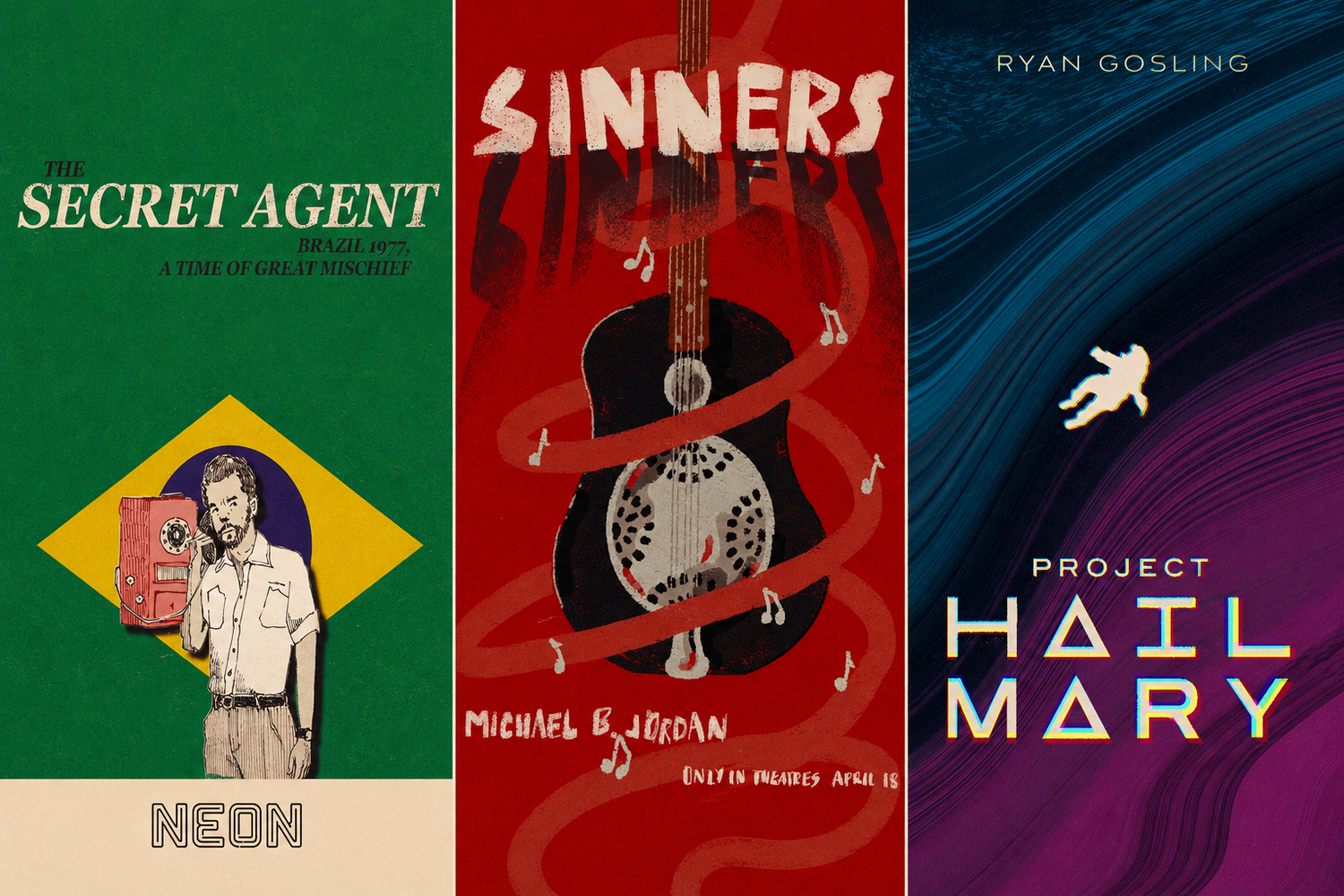
The last year has been great for the movies, from high-concept science fiction in Project Hail Mary to the deep cultural implications of The Secret Agent and Sinners. But what did the experts think? We sat down with four Cambridge academics to discuss films related to their research with its pop-culture interpretation.
The Secret Agent - Dylan Ingram
The Secret Agent is a Brazilian political thriller nominated for Best Picture earlier this year at the Oscars. Set in Recife in the 1970s, under the military dictatorship, it follows researcher Armando as he evades two hitmen and tries to maintain a relationship with his Jaws-obsessed son. I spoke with Professor Maite Conde who has written on early Brazilian cinema and modernity. She also hosted Secret Agent director Kleber Mendonça Filho in Cambridge in 2017, during which he shared his work on his 2019 Pictures of Ghosts and gave an interview to Varsity.
I start by asking about the political background of the film, which lurks under the surface like a shark threatening to strike. The Secret Agent is set during Brazil’s military dictatorship, which lasted from 1964–1985, but it was written during the far right authoritarian Bolsonaro regime, which styled itself on that military dictatorship. Maite tells me that in Brazil there wasn’t a prosecution of crimes committed under dictatorship, which resulted in a kind of cultural forgetting of what it felt like. Filho, in this film and in his previous Bacurau, aims to remember the period and the film itself is invested with different kinds of memory: urban legend, archival material, and family ties. This strange memory results in a film that is surreal and hard to parse for those not in the know.
“If you liked The Secret Agent, Maite recommends Filho’s earlier Bacurau and 2002’s beloved City of God”
Under the dictatorship itself, Maite describes the “weirdness” of a society held between a paranoia-inducing authoritarian government and a surprisingly playful, thriving film industry. The only film to challenge Jaws at the Brazilian box office in the period was 1976’s Dona Flore And Her Two Husbands, a sexual comedy about a woman who remarries after her husband dies and then imagines having sex with both husbands at once. The poster features her in bed with the two men. Maite said the least censored films were the most sexual ones: there was a surface-level liberal, consumer culture alongside deep, repressive forces. This might be represented best in the film when the ‘hairy leg’, a real urban legend invented by the press to report on police brutality, beats up gay men cruising at the beach. This moment is strange and gory and funny, but underscores a repeated pattern of conflict between a free culture and a corrupt, authoritarian state that feels so unique to the film’s texture.
If you liked The Secret Agent, Maite recommends Filho’s earlier Bacurau and 2002’s beloved City of God for more depictions of the military dictatorship. When I ask about Dona Flora and Her Two Husbands and she says it was fun but a bit dated.
What particularly struck me was Professor Conde's emphasis on the project of ambivalent memory that The Secret Agent and Kleber, as a director, is taking on. It is a film written at a point of political misremembering and uses a surreal memory to bring the feelings of danger and paranoia of life under dictatorship onto the screen.
Sinners - Georgia Gooding
Coming off a record-breaking 16 Oscar nominations, it’s safe to say that Sinners has received a fair amount of praise. Francis Ford Coppola himself raved about the film, applauding its ability to invite him into a life “he could never know any other way”. This rings true – with me, at least. Sinners sheds a light on the ambiguous realities of life as a Black person in the Jim Crow-era US, and as the average viewer, the film appeared to do a great job of correcting misperceptions about the Black experience at the time. I was left wondering, however, whether unreality begins and ends with the film’s inclusion of vampires. I sat down with Dr Ali Meghji, a Sidney professor of postcolonial sociology, to investigate whether Sinners really walks the walk.
“There was “no one ‘Great Migration’ […] just an ongoing practice of movement”
I start by asking Ali about the film’s tackling of ‘myths’ surrounding this era of history – a concept addressed by the main characters, Smoke and Stack (Michael B Jordan), who attempt to quash their cousin Sammie’s (Miles Caton) fantasies about the salvation that awaits Black people in the US North without the Jim Crow laws. They advise him against believing everything he hears, stressing that Chicago is just “Mississippi with tall buildings instead of plantations”. Ali confirms this reality, referencing the unofficial segregation that plagued the housing and education systems of the city. The twins had learned this truth the hard way, having left their Mississippian hometown in pursuit of a better life up north. This nonlinear trajectory – Smoke and Stack’s ‘escape’ leading them right back to where they started – particularly struck Ali. The Great Migration, he explains, is largely understood without nuance; it was not a singular, one-directional movement from the South to the North, but rather it encompassed movement within the South and, prominently, from the North back to the South. There was “no one ‘Great Migration’ […] just an ongoing practice of movement”.
As well as a tale of racial inequality, though, Sinners is a celebration of African-American culture – principally shown through Sammie’s supernatural musical ability which summons past and future members of the community to dance together. At a time where it was thought that society “was only white society” (Ali notes, referencing W.E.B. Du Bois’ ‘veil’ theory) and Jim Crow therefore refused Black people “the capacity to have social organisation”, Sinners presents a defiant truth: that there were, in fact, “pockets of space” for Black people. Sinners’ highlighting of Black-ran shared spaces and religious organisations demonstrates that Black communities could “fulfil the criteria of a functioning society” – even if they did only exist because of segregation. It demonstrates that there was a life ‘beyond’ the veil – and that segregation is not the “only way to present a story of Black life in the states.”
It would be remiss to end this interview without touching on the film’s headline-grabbing vampires. Widely understood as a metaphor for cultural appropriation, the vampires feed not on blood, but on Black characters’ “stories”. I was struck by the film’s emphasis on the selective nature of this thirst – summed up as Slim remarks, “white folks, they like the blues just fine. They just don’t like the people that make it.” And when I bring up this quote to Ali, he asks: “how is that different from this movie?” Films like this, he explains, are often embraced by audiences today, achieving critical acclaim, but their treatment of such media’s creators is a different story altogether. This year’s BAFTA Film Awards disappointingly played right into the film’s self-commentary, complimenting Sinners with 13 nominations, but neglecting to protect Michael B. Jordan and Delroy Lindo (Slim) in their failure to edit out the N-word shouted at them by an audience member with tourettes, despite other such outbursts being cut. The connection makes itself: white institutions are seemingly all too happy to drink up the success of this Black-made film, but they draw the line at treating its makers with respect.
“It’s hard not to respect [Sinners’] commitment to justly honouring the Black experience.
Overall, my conversation with Ali highlighted how the film addresses areas of misconception among its viewers and characters alike – elucidating the sad truth about the illusion of escape from oppression, while also rejecting the idea that African-American people didn’t experience community in the same way that white people did. All of this to say: whether you loved, hated (which I doubt) or just haven’t seen Sinners, it’s hard not to respect its commitment to justly honouring the Black experience.
Project Hail Mary - Dylan Ingram
Project Hail Mary is a science-fiction film about a desperate space mission in which Earth’s top scientists send Ryan Gosling to the distant star of Tau Ceti in an attempt to solve a world-ending crisis: the Sun is getting dimmer. It turns out there’s an alien microorganism, ‘astrophage’, living on the Sun and Tau Ceti harbours a natural predator, the microscopic ‘taumoeba’. Gosling’s Ryland Grace teams up with the adorable alien Rocky to collect a sample of the taumoeba, which they ship back home to feast on the astrophage and control its population.
I talk about this attempt at biological control with Dr Justin Gerlach – a tutor and fellow at Peterhouse and an expert in conservation biology, ecology, and evolution – and I begin by discussing this attempt at biological control. Dr Gerlach has conducted extensive research on species interaction, discovery, and evolutionary history. When we talk about the biological control in the film, his first point is that it tends to go wrong! He tells me that most predators are not evolved to be specialists and typically eat a lot of different organisms. When introduced to a new ecosystem, this flexibility means they end up eating things you don’t want them to. Maybe Rocky and Grace will have to deal with the disastrous consequences of their poorly thought-out ecology in Project Hail Mary 2.
A key plot point in the film is breeding the taumoeba to a stable population. Dr Gerlach says that maintaining a healthy and sustainable breeding program for conservation can take ten to fifteen years. The film squeezes this into a couple of months, which makes sense for a film – even if it is almost three hours long. Even after that time investment, though, Justin stresses that the process of conservation itself might hurt the success of the organism’s population. The film addresses this idea in the most dramatic way possible, as the taumoeba escape captivity, and cause chaos on Grace’s ship.
“Chris tells me that NASA have considered using algae to produce hydrogen for fuel in space”
The mysterious astrophage is a high-concept organism, able to use the light energy from the Sun to power its propulsion. I speak with Professor Chris Howe, leader of the Howe Group, which pioneers research into photosynthesis. Chris who describes photosynthesis as a process “using light energy to strip electrons out of water”. Some bacteria, as well as plants, can photosynthesise, and when they do, they sometimes release excess electrons. In the film, the scientists use the astrophage’s extreme interaction with light to power a long-distance spaceship.
Chris’ research group were able to harness these electrons to generate enough electricity to power small-scale electronics like microprocessors. The scale of these circuits is limited, so powering a space ship is pretty out-there, but Chris tells me that NASA have considered using algae to produce hydrogen for fuel in space or for use in waste-management and food production. He emphasises the fundamental importance of photosynthesis to life on Earth, calling its development the “most important event in the history of the Earth” and this relationship between light and life is at the centre of Project Hail Mary’s conflict.
The key takeaway from my conversations with Chris and Justin was that the more science fiction tries to explain its high concepts, the less believable they become. All of these films are deeply researched and carefully put together and are heavily invested in, if not perfect accuracy, the stakes of their subject matter.
Huge thank you to Maite Conde, Ali Meghji, Justin Gerlach, and Christopher Howe, for their time and expertise!
